'Spider-Man: Brand New Day' surges past $1b in six days
Updated 1 hour ago

Director hails artificial intelligence as a creative aid while critics warn of risks to artists and the filmmaking pro
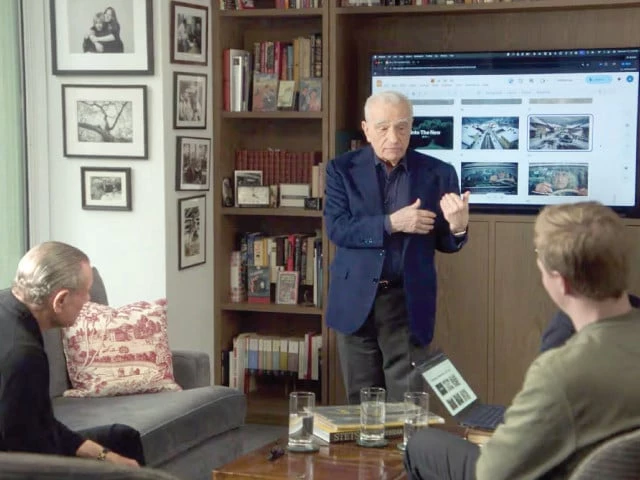
For more than half a century, Martin Scorsese has been regarded as one of cinema's most influential storytellers, a filmmaker whose meticulous craftsmanship helped define modern Hollywood. But the Oscar-winning director's latest venture has placed him at the centre of a different kind of drama - a growing battle over artificial intelligence and its place in the creative industries.
The 83-year-old director has publicly endorsed the use of AI-powered tools in filmmaking and joined German AI company Black Forest Labs as an adviser, triggering a wave of criticism from artists, filmmakers and fans who fear the technology could threaten creative jobs and fundamentally alter the filmmaking process.
Scorsese's support for AI comes at a time when the entertainment industry remains deeply divided over how far technology should be allowed to influence artistic work. While proponents argue that AI can streamline production and unlock new creative possibilities, critics see it as a threat to the human imagination that has long been at the heart of cinema.
At the centre of the controversy is Scorsese's use of Black Forest Labs' image-generation technology to create storyboards during pre-production. Storyboards are visual plans that help directors communicate scenes, camera angles and artistic concepts to their production teams before filming begins.
According to Scorsese, the technology addresses a challenge he has faced throughout his career: translating ideas from his imagination into a visual form that can be easily shared with collaborators. "For 70 years, I've been creating my own storyboards," Scorsese said while announcing the partnership. He argued that AI enables him to communicate concepts more clearly and efficiently to designers, cinematographers and other members of the creative team.
The director described the technology as "creatively freeing", saying it allows production teams to move faster without sacrificing quality or artistic standards. He also suggested that reducing time spent during pre-production could lower costs and ease pressure on film crews.
Scorsese framed the move as part of a long tradition of technological innovation in cinema. He pointed to his use of 3D technology in 'Hugo' and digital de-ageing effects in 'The Irishman' as examples of how filmmakers have continually adopted new tools to expand storytelling possibilities.
"Cinema is a young medium," he said. "We have to be open to how it can evolve." Yet many artists and industry professionals were unconvinced.
Among the most vocal critics was storyboard artist and illustrator Karla Ortiz, who argued that AI systems are often trained on work created by human artists without their consent. She accused Scorsese of undermining the very professionals who have helped bring his films to life over decades.
Other critics echoed similar concerns, warning that the increasing adoption of AI could eliminate jobs that have traditionally been performed by artists, designers and visual development specialists.
Animation director Samuel Deats questioned whether AI was even necessary for a task such as storyboarding, arguing that experienced artists can often sketch visual concepts in a matter of seconds. For many opponents, the issue extends beyond efficiency and touches on questions of ethics, ownership and respect for creative labour.
Supporters argue that AI should be viewed as another technological advancement rather than an existential threat. They compare its emergence to previous innovations such as computer-generated imagery, digital editing and motion-capture technology, all of which initially faced scepticism before becoming industry standards.
Some fans defended Scorsese's position, noting that the director is not replacing the creative process but using AI as a tool to visualise ideas more quickly. In their view, technology can assist artists without replacing artistic judgement.
Scorsese is also not alone among prominent filmmakers exploring AI's potential. Directors including James Cameron and Darren Aronofsky have expressed interest in the technology, while Steven Spielberg has suggested AI could save filmmakers considerable time when used for practical production tasks.
Others remain firmly opposed. Acclaimed filmmaker Guillermo del Toro has repeatedly rejected the idea of using AI in creative work, while many artists cite Japanese animation master Hayao Miyazaki's famous description of AI-generated art as "an insult to life itself".
The dispute surrounding Scorsese highlights a broader question facing the entertainment industry: whether artificial intelligence will become a valuable creative assistant or a disruptive force that reshapes artistic professions.








This material may not be published, broadcast, rewritten, redistributed or derived from. Unless otherwise stated, all content is copyrighted © 2026 The Express Tribune.





COMMENTS
Comments are moderated and generally will be posted if they are on-topic and not abusive.
For more information, please see our Comments FAQ