Gold prices decline by Rs3,500 per tola in local market
Updated 1 hour ago

Geopolitical tensions, budget jitters also fuel heavy stock selling
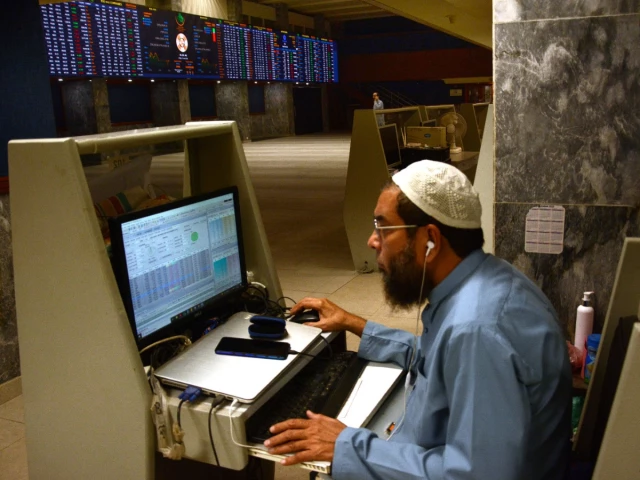
Bears dominated trading at the Pakistan Stock Exchange (PSX) on Monday as investors reacted to rising inflation and lingering geopolitical concerns. The benchmark KSE-100 index remained under pressure throughout the session, with broad-based selling dragging it down by over 3,350 points.
Investor sentiment was weighed down by uncertainty surrounding the government's upcoming budget announcement where it was required to satisfy both the International Monetary Fund (IMF) and the general public. At the same time, the absence of progress on US-Iran peace talks and shipping disruptions at the Strait of Hormuz added to market nervousness.
Pakistan Bureau of Statistics reported that the Consumer Price Index (CPI) for May reached 11.7% year-on-year, the highest since June 2024, compared with 10.9% in April. The higher-than-expected inflation raised concerns over interest rate outlook.
The KSE-100 touched the intra-day high of 174,171.64 before heavy selling pushed it to the low of 170,396.85. At close, the index registered a loss of 3,362.62 points, or 1.93%, and settled at 170,600.20. Despite a sharp decline in the latest session, the KSE-100 recovered 6.7% month-on-month in May to close near the 174,000 level, reducing its calendar-year 2026 losses to below 1%, JS Global Capital noted. However, trading activity remained subdued throughout the month amid geopolitical uncertainty and a lower number of trading sessions.
KTrade Securities' equity trader Ahmed Sheraz observed that the market witnessed a broad-based corrective session following strong gains last week. Investor sentiment remained subdued throughout the day, with profit-taking across major sectors.
A key factor weighing on sentiment was the latest development in US-Iran negotiations. Over the weekend, reports indicated that the US administration rejected an amended proposal submitted by Iran and sought strict revisions. The news triggered a sharp reaction in global energy markets, where crude oil futures opened nearly 3% higher and Brent was trading around $94 per barrel. It raised concerns about the potential impact on Pakistan's inflation and external account outlook.
Additionally, news flow suggesting that the IMF had urged Pakistan to maintain a strict fiscal framework in the upcoming federal budget further dampened investor confidence. Going forward, market direction is likely to remain closely tied to developments pertaining to the budget, IMF discussions and the US-Iran situation, Sheraz wrote.
According to Arif Habib Limited (AHL), selling pressure dominated the start of the week, pushing the KSE-100 towards the 170,000 support level. The biggest drags on the index were Engro Holdings (-4.59%), Fauji Cement (-1.98%) and Lucky Cement (-3.59%). On the positive side, TRG Pakistan (+7.07%), Honda Atlas Cars (+10.10%) and Pakistan Oilfields (+0.50%) contributed the most to the index gains.
AHL highlighted that inflation accelerated to a two-year high, with the CPI rising 11.7% year-on-year in May, driven by higher energy import costs amid Middle East tensions. The brokerage house noted that Pakistan was targeting economic growth of more than 4% in FY27, according to a planning ministry document. Despite the weak market performance, AHL believes downside risks should remain limited during the rest of the week and 175,000 may be the key upside target.
Cumulatively, trading volumes jumped to 589.8 million shares compared to the previous session's 555.1 million. The value of traded shares stood at Rs32 billion. In the ready market, shares of 489 companies were traded. Of these, 168 stocks rose, 296 fell and 25 remained unchanged. Dewan Cement was the volume leader with trading in 43.3 million shares, rising Rs0.48 to close at Rs11.23.






This material may not be published, broadcast, rewritten, redistributed or derived from. Unless otherwise stated, all content is copyrighted © 2026 The Express Tribune.







COMMENTS
Comments are moderated and generally will be posted if they are on-topic and not abusive.
For more information, please see our Comments FAQ