Pakistan, China firms sign deals worth $7b
Updated 47 minutes ago

PM addresses B2B investment confab in Hangzhou; highlights opportunities in agri, mineral secters
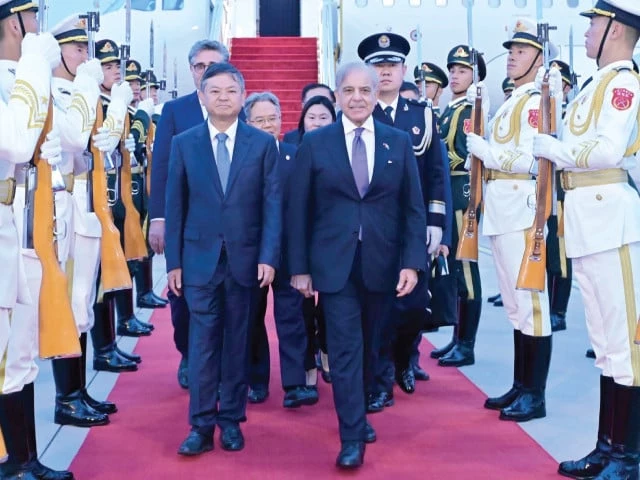
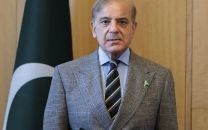
Pakistani and Chinese companies signed agreements and memorandums of understanding (MoUs) worth more than $7 billion during a series of high-level engagements led by Prime Minister Shehbaz Sharif in the Chinese city of Hangzhou on Sunday, as Islamabad sought to deepen technological and industrial cooperation with Beijing.
The agreements were signed during the Pakistan-China Business-to-Business Investment Conference
Pakistan, China, Page 6
Pakistan, China firms sign deals worth $7b
Pakistan, China from Page 1
focusing on information technology, telecom, battery energy storage systems, renewable energy and agriculture.
The prime minister, addressing investors, business leaders and government officials from both countries, invited Chinese companies to relocate industries to Pakistan and enter into joint ventures with local firms under a "win-win model" for both nations.
Shehbaz said rising labour costs and rapid industrial advancement in China had created opportunities for industries that were no longer cost-effective there to move manufacturing operations to Pakistan. He said Chinese firms could establish plants in Pakistan, partner with Pakistani entrepreneurs and export manufactured goods to third countries, particularly in sectors such as textiles, leather and industrial production.
He also invited Chinese investors to explore opportunities in Pakistan's export zones, especially a planned special economic zone in Karachi spread over more than 6,000 acres where, he said, modern infrastructure, one-window operations and long-term lease facilities would be provided to foreign investors. He assured Chinese companies of "red-carpet treatment" and said similar world-class economic zones would later be replicated elsewhere in Pakistan with Chinese cooperation.
A major agreement signed during the conference included a $1.12 billion deal between Haolu Engineering and Technology Company and Fauji Fertilizer for fertiliser production. Another MoU worth $100 million was signed between IBI Beijing United Information Technology and the RIC for cooperation in agrochemicals, agricultural machinery and the establishment of a regional office in Multan.
Officials said more than 200 MoUs worth over $20 billion had now been signed during five Pakistan-China business conferences held so far. The prime minister noted that nearly 30% of previously signed MoUs had already been converted into formal agreements running into billions of dollars, adding that implementation would remain the government's priority.
The conference was attended by Deputy Prime Minister and Foreign Minister Ishaq Dar, Governor of Zhejiang Province Liu Jie, Minister for IT and Telecommunication Shaza Fatima Khawaja, Minister for Information and Broadcasting Attaullah Tarar, Minister for National Food Security Rana Tanveer Hussain, Special Assistant to the Prime Minister on Industries and Production Haroon Akhtar, Pakistan's Ambassador to China Khalil Hashmi, and senior Pakistani and Chinese business executives.
Highlighting Pakistan's agricultural potential, the prime minister said Pakistan remained an agrarian economy but needed to improve per-acre yields through mechanisation, high-quality seeds and advanced farming practices.
Referring to China's annual import of around $100 billion worth of agricultural products, he said Pakistan's current share remained only a fraction and called for greater bilateral cooperation to increase exports. He also highlighted opportunities in mines and minerals, saying Pakistan possessed vast reserves of minerals and gemstones that could attract Chinese investment.
He stressed that Pakistan was seeking expertise, investment and industrial cooperation rather than aid or handouts, adding that sustainable development could only come through productive economic partnerships.
Addressing the role of technology, the prime minister said information technology and artificial intelligence represented enormous opportunities for Pakistan's youth. He said digitisation initiatives had already been launched at both federal and provincial levels to train students and provide internationally recognised certifications that could help them secure productive employment in global markets.
During his visit to Hangzhou, Prime Minister Shehbaz Sharif also attended a ceremony at the headquarters of Alibaba Group, where several strategic agreements and memorandums of understanding were signed between Alibaba and Pakistani public and private sector entities.
Alibaba Chairman Joe Tsai briefed the prime minister about the company's future cooperation plans with Pakistan. A long-term strategic framework agreement was signed between the Government of Pakistan and Alibaba Group aimed at accelerating Pakistan's digital transformation in areas including artificial intelligence, cloud computing, digital trade, financial technology, healthcare innovation and SME development.
Speaking at the ceremony, the prime minister said Pakistan fully supported Chinese President Xi Jinping's vision for regional peace and prosperity and believed technological cooperation with Alibaba would bring tangible benefits across industry, health, education and agriculture.
Joe Tsai, meanwhile, said Alibaba intended to expand cooperation in cloud infrastructure, data centres, trade facilitation, telemedicine, smart hospitals, pharmaceuticals, financial literacy and agriculture under the broader framework of China's Belt and Road Initiative.
Several additional agreements were signed during the Alibaba engagements. Under one arrangement, Pakistan's Ignite and Alibaba Cloud would collaborate on developing localised AI models for Urdu and regional languages while launching nationwide training programmes for 500,000 individuals. The two sides would also jointly organise AI hackathons and innovation initiatives.
In the healthcare sector, DAMO Academy and Sky47 agreed to deploy AI-powered disease screening systems across major Pakistani cities, while DAMO Academy and Ignite would work together on embodied intelligence and technology capacity-building programmes at Pakistani universities.
Another agreement between Alibaba and the Small and Medium Enterprises Development Authority would facilitate the onboarding of at least 2,000 Pakistani SMEs onto a dedicated "Pakistan Pavilion" to improve access to international markets through AI-driven business tools and e-commerce platforms.
In the financial technology sector, Koko Tech agreed to introduce a "Buy Now, Pay Later" solution in Pakistan backed by an initial investment of $3 million to support financial inclusion and digital commerce.
Separately, the prime minister met senior executives of major Chinese companies including Sheng Huo Neng Yuan Ke Ji Company, CATL, StarCharge and Xiuzheng Pharmaceutical Group to discuss investment opportunities and industrial cooperation.
In meetings with renewable energy companies, the prime minister highlighted Pakistan's growing demand for clean energy and outlined policy measures introduced to support solar energy and renewable power generation. Discussions with CATL focused on advanced batteries, solar-linked energy storage systems and clean energy transition projects.
Talks with StarCharge centered on electric vehicle charging infrastructure and smart mobility systems, while discussions with Xiuzheng Pharmaceutical Group focused on pharmaceutical manufacturing, healthcare cooperation and investment opportunities in Pakistan's medical sector.
Officials said the prime minister emphasised ease of doing business reforms and encouraged Chinese companies to establish manufacturing facilities and expand operations in Pakistan as part of broader business-to-business cooperation between the two countries.
Following the conclusion of his engagements in Hangzhou, Prime Minister Shehbaz Sharif arrived in Beijing, where he is expected to hold high-level meetings with Chinese President Xi Jinping and Chinese Premier Li Qiang to discuss trade, investment, agriculture, science and technology, industrial cooperation and the second phase of the China-Pakistan Economic Corridor.
The visit coincides with the 75th anniversary of diplomatic relations between Pakistan and China, a milestone repeatedly highlighted by the prime minister during his speeches in Hangzhou, where he described the relationship between the two countries as deeper than the oceans and higher than the Himalayas.





This material may not be published, broadcast, rewritten, redistributed or derived from. Unless otherwise stated, all content is copyrighted © 2026 The Express Tribune.








COMMENTS
Comments are moderated and generally will be posted if they are on-topic and not abusive.
For more information, please see our Comments FAQ