Israeli push to take more of Gaza raises alarm as Hamas warns against escalation
Updated 50 minutes ago

Ship reported seized off UAE, steered towards Iran
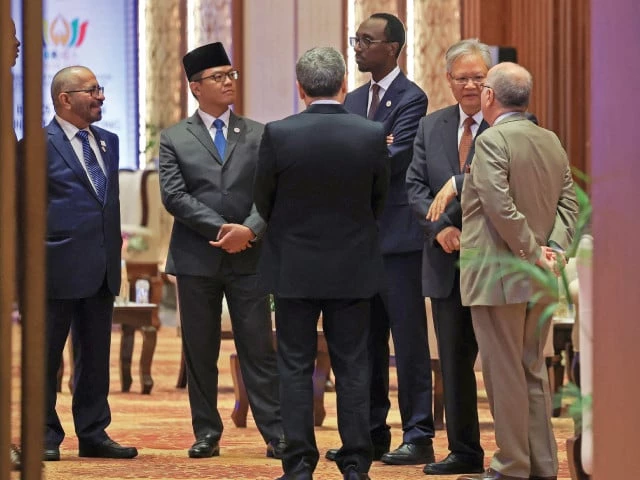
Iran's foreign minister urged BRICS nations on Thursday to condemn what he called violations of international law by the United States and Israel, as diplomats from emerging economies met for talks in Delhi in the shadow of war in the Middle East.
Foreign Minister Abbas Araqchi accused US ally the United Arab Emirates of direct involvement in military operations against Iran, in a rare moment when Iranian and Emirati officials have been in the same room since the US-Israeli war against Iran began on February 28.
Araqchi said Iran was a "victim of illegal expansionism and warmongering". He asked the BRICS+ grouping - comprising Brazil, Russia, India, China, South Africa, Egypt, Ethiopia, Indonesia, Iran and the UAEto resist "Western hegemony and the sense of impunity that the US believes it is entitled to". "Iran therefore calls upon BRICS member states and all responsible members of the international community to explicitly condemn violations of international law by the United States and Israel," he said.
Later, he told the gathering that the UAE was "directly involved in the aggression against my country", the Iranian semi-official Mehr news agency reported.
The UAE was represented by its Deputy Foreign Minister Khalifa Shaheen Al Marar. In response to the US and Israeli attacks on Iran, Tehran launched strikes on Gulf States including the UAE. Their differences could make it difficult for BRICS, which operates by consensus, to agree on a joint statement.
It was not immediately clear how or whether the UAE and other nations attending the BRICS+ meeting had responded to Araqchi's remarks.
India, whose partnership with the UAE is deepening, is the BRICS chair for 2026 and is one of the parties most affected by Iran's effective closure of the Strait of Hormuz since the war.
The waterway usually handles about a fifth of global oil shipments, and its blockade has triggered one of the biggest supply disruptions in recent history.
India, the world's third-biggest oil importer and a big user of the strait, has suffered big supply disruptions and lost sailors in attacks on ships in the Gulf.
Although a ceasefire is in place, sporadic attacks have continued. On Wednesday, an Indian-flagged vessel travelling from Somalia to the UAE and carrying cargo of live livestock sank in Omani waters after a fire on board, though all 14 crew members were rescued by the Omani Coast Guard.
India did not specify the nature of the attack or who was behind it, but British maritime risk management group Vanguard said it involved an explosion believed to have been caused by a drone or missile strike.
"Continuing tensions, risks to maritime traffic, and disruptions to energy infrastructure highlight the fragility of the situation," Indian Foreign Minister Subrahmanyam Jaishankar said.
"Safe and unimpeded maritime flows through international waterways, including the Strait of Hormuz and Red Sea, remain vital for global economic well-being."
Without naming any sides, he also noted the "increasing resort to unilateral coercive measures and sanctions inconsistent with international law and the UN Charter".
"Such measures disproportionately affect developing countries," he said. "These unjustifiable measures cannot substitute dialogue, nor can pressure replace diplomacy."
Meanwhile, a ship was reported seized by Iranian personnel off the United Arab Emirates and headed for Iranian waters on Thursday.
Separately, British maritime security agency UKMTO reported on Thursday that "unauthorised personnel" had boarded a ship anchored off the coast of the United Arab Emirates port of Fujairah, and were steering it towards Iran.
Vanguard said a company security officer had reported that "the vessel was taken by Iranian personnel while at anchor."
Fujairah is the UAE's sole oil port, on the Gulf of Oman just outside the Strait of Hormuz, and enables some shipments to reach markets without passing through the chokepoint. Iran included that part of the coast on an expanded map it released last week of waters it claimed were under its control.
Iran's Revolutionary Guards said 30 vessels had crossed since Wednesday evening, still far short of 140 that were typical daily before the war, but a substantial increase if confirmed.
According to shipping analytics firm Kpler, some 10 ships had sailed through the strait in the past 24 hours, against five to seven that have crossed daily in recent weeks.
Iran's Judiciary Spokesperson Asghar Jahangir said the seizure of "US tankers" violating Iranian regulations was being carried out under domestic and international law.
A senior US admiral told a US Senate committee on Thursday Iran's ability to threaten its neighbours and US regional interests had been "significantly degraded".
"They no longer threaten regional partners, or the United States, in ways that they were able to do before, across every domain," Admiral Brad Cooper said.
But Cooper declined to directly address reports by Reuters and other news organizations that Iran had retained significant missile and drone capabilities.
Iran's rulers, who used force to put down anti-government protests at the start of the year, have faced no organised opposition since the war began. And their closure of the strait has given them additional leverage in negotiations.
Washington wants Tehran to hand over the uranium and forgo further enrichment. Iran is seeking the lifting of sanctions, reparations for war damage and acknowledgment of its control over the strait.











This material may not be published, broadcast, rewritten, redistributed or derived from. Unless otherwise stated, all content is copyrighted © 2026 The Express Tribune.






COMMENTS
Comments are moderated and generally will be posted if they are on-topic and not abusive.
For more information, please see our Comments FAQ