Judge declares mistrial in Weinstein sex assault case
Updated 12 hours ago

DATALAND's digital rainforest blurs boundaries between human creativity and machine intelligence
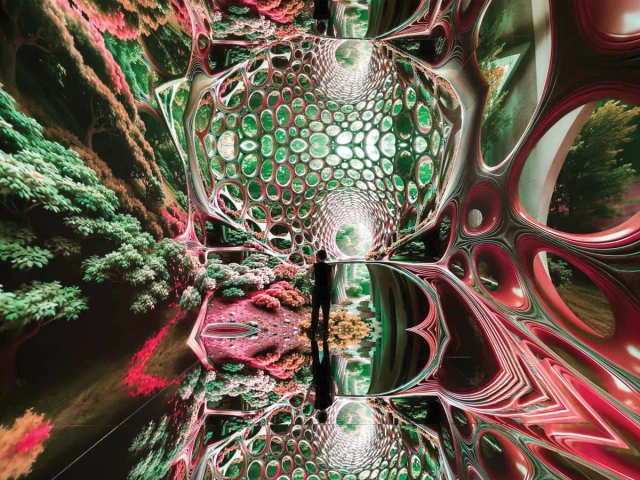
A bold new cultural experiment is set to open in Los Angeles this summer, promising to reshape how audiences encounter both art and artificial intelligence, while raising difficult questions about creativity, ethics, and the future of human expression.
DATALAND, described by its creators as the world's first museum dedicated entirely to AI-generated art, will open on June 20 in downtown Los Angeles, placing itself at the centre of a rapidly evolving cultural and technological conversation.
Co-founded by Turkish-American artist Refik Anadol and curator Efsun Erk?l?c, the project arrives amid a wave of high-profile museum developments across the city, signalling a renewed investment in immersive and experimental art spaces.
The 35,000-square-foot institution is housed in a Frank Gehry-designed complex in the city's Grand Avenue Cultural District. Designed as a fully immersive experience, the museum's five galleries will offer 360-degree environments that blur the boundaries between digital systems and sensory perception.
The inaugural exhibition, 'Machine Dreams: Rainforest', sets the tone for this ambitious vision. Built using what the creators describe as a "Large Nature Model," the installation draws on millions of images and sounds sourced from ecosystems around the world to construct a constantly shifting digital rainforest.
The result is less a static exhibition and more a living environment, where visuals, sound, and even atmospheric conditions respond dynamically to data and audience interaction. According to NPR, the project reflects Anadol's long-standing interest in translating complex datasets into experiential art.
His earlier works, including large-scale projections and museum collaborations, have already tested the boundaries of how machine learning can be used as a creative tool. With DATALAND, that approach expands into a permanent institutional form, one that positions AI not merely as a medium but as a central artistic collaborator.
Yet the museum's arrival comes at a moment of growing scepticism toward AI art. Critics argue that such works often lack genuine human agency, relying instead on algorithmic processes that repurpose existing material. Concerns over copyright, bias in training data, and the environmental cost of large-scale computing have intensified scrutiny of the field.
Artists and researchers have pointed to the limitations of current systems, noting that AI-generated outputs can reinforce stereotypes or produce distorted representations of reality. Others question whether machine-generated imagery can truly be considered art, or whether it functions more as a technologically advanced form of entertainment.
Anadol has sought to address these criticisms directly. He maintains that DATALAND's datasets are built through permission-based collaborations with institutions such as the Smithsonian and scientific organisations, as well as through fieldwork conducted in rainforests.
He has also emphasised transparency in how data is sourced and processed, arguing that ethical curation is central to the museum's mission.
Environmental concerns have similarly been factored into the project's design. The computing systems powering the exhibition operate on infrastructure that relies heavily on renewable energy, with the creators claiming that a visitor's experience consumes energy comparable to charging a smartphone. Whether such measures will satisfy critics remains to be seen.
As reported by secretlosangeles.com, the museum is also positioning itself as an experiential destination for a broader public, not just art-world insiders. Visitors can expect interactive environments that evolve in real time, spaces influenced by ecological data, and installations that incorporate ancestral knowledge and environmental narratives. One section, described as an "Infinity Room," reflects on ecological loss, underscoring the project's thematic focus on the relationship between technology and nature.
Membership programmes offering early access and exclusive works are already being marketed, signalling a blend of cultural ambition and commercial strategy. The approach reflects a wider trend in immersive art spaces, where audience engagement is as much about participation as observation.
DATALAND ultimately sits at the intersection of competing ideas: innovation and authenticity, spectacle and substance, machine intelligence and human creativity. Its success may depend not only on the scale of its installations but on its ability to convince audiences that AI-driven art can carry meaning beyond its technological novelty.
Whether it marks a genuine shift in artistic practice or a fleeting moment in the hype cycle surrounding artificial intelligence, the museum's opening is likely to intensify an already polarised debate. For now, it stands as both a showcase of possibility and a test case for the cultural limits of machine-made art.









This material may not be published, broadcast, rewritten, redistributed or derived from. Unless otherwise stated, all content is copyrighted © 2026 The Express Tribune.







COMMENTS
Comments are moderated and generally will be posted if they are on-topic and not abusive.
For more information, please see our Comments FAQ