Pakistan, China firms sign deals worth $7b
Updated 7 hours ago

Satellite successfully enters its planned orbit
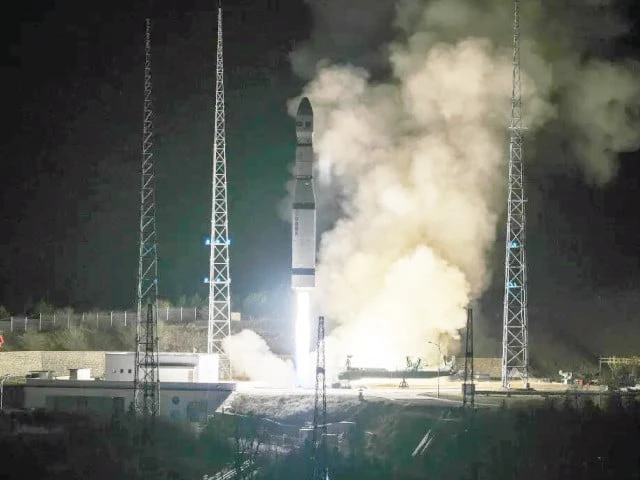
China on Saturday successfully launched a Pakistani remote sensing satellite from the Taiyuan Satellite Launch Center in north China's Shanxi province, state-run Xinhua News reported.
The satellite, named PRSC-EO3, was launched into space by a Long March-6 rocket at 8.15 pm (1215GMT).
It successfully entered its planned orbit, according to official reports.
The launch represents the 640th mission of China's Long March rocket series, a key component of the country's expanding space program.
PRSC-EO3 is expected to support Pakistan's capabilities in Earth observation, including monitoring natural resources, disaster management, and environmental changes.
"The Pakistan Space and Upper Atmosphere Research Commission (Suparco) has successfully launched its indigenous electro-optical satellite (EO-3) from the Taiyuan Satellite Launch Centre, marking another significant milestone in the nation's space capabilities," the Foreign Office said in a statement posted on the social media platform X.
"Beyond its core imaging mission, EO-3 carries advanced experimental payloads aimed at validating next-generation space technologies. These include a multi-geometry imaging module for enhanced imaging accuracy, an advanced energy storage system, and an onboard AI-powered data processing unit to enable real-time analysis and intelligent decision support," it said.
It said that the addition of EO-3 to Pakistan's Earth Observation satellite fleet "significantly enhances national capabilities in remote sensing".
"The integrated system will improve data continuity, imaging reliability, and analytical precision, supporting applications across Pakistan's socio-economic sectors," the Foreign Office said.
The military's media affairs wing, Inter-Services Public Relations, said the satellite would provide imaging data to "revolutionise urban planning, disaster management, food security and environment protection".
President Asif Ali Zardari, in a statement, termed the launch a "historic milestone".
He highlighted that it was a "clear manifestation of Pakistan's self-reliance, scientific expertise and growing capability in space technology".
The president praised the professional expertise of Suparco's scientists and engineers, saying their efforts were adapting Pakistan to modern requirements.
The president also hailed China's "consistent and trustworthy cooperation" in the space sector.
According to the FO statement, Prime Minister Shehbaz Sharif commended Suparco's scientists and engineers on the achievement.
"He reaffirmed the government's strong commitment to advancing Pakistan's space programme and expressed appreciation for China's continued cooperation in this domain," it said.
The launch of the EO-3 satellite marks a major step forward in Pakistan's pursuit of self-reliance and technological advancement in the space sector. Equipped with advanced imaging capabilities, the satellite is expected to play a vital role in transforming urban planning, disaster management, food security, and environmental protection across the country.
Officials said the EO-3 satellite will lay the foundation for a comprehensive Earth Observation System, aimed at supporting national priorities in multiple sectors and contributing to sustainable socio-economic development.








This material may not be published, broadcast, rewritten, redistributed or derived from. Unless otherwise stated, all content is copyrighted © 2026 The Express Tribune.
















COMMENTS (1)
Comments are moderated and generally will be posted if they are on-topic and not abusive.
For more information, please see our Comments FAQ