China's FM Wang Yi reiterates appreciation for Pakistan’s constructive role amid US-Iran talks in meeting with Dar
Updated 3 hours ago

FinMin holds series of high-level meetings, multilateral engagements at IMF–World Bank Spring Meetings 2026
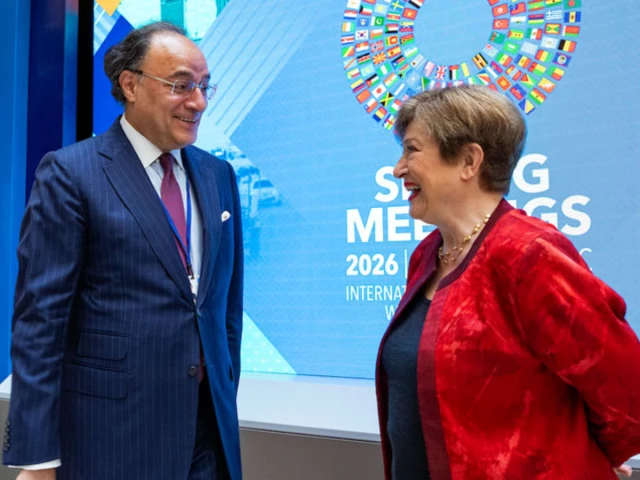
International Monetary Fund (IMF) Managing Director Kristalina Georgieva on Thursday appreciated Pakistan’s ongoing economic reform progress during her interaction with Finance Minister Muhammad Aurangzeb at the IMF–World Bank Spring Meetings 2026.
In a statement on X, she said, “Pakistan’s strong implementation of its reform programme has helped maintain macroeconomic stability and build investor confidence”. She added, “Sound economic policies, along with deeper structural reforms, will be critical for sustaining growth and improving the welfare of the people of Pakistan”.
IMF Managing Director Commends Pakistan’s Reform Progress and Economic Stability
— Ministry of Finance, Government of Pakistan (@Financegovpk) April 16, 2026
The Managing Director of the International Monetary Fund (IMF), Ms. Kristalina Georgieva, has appreciated Pakistan’s continued progress on economic reforms during her interaction with Federal… pic.twitter.com/ArcOyksI8D
The finance minister held a series of high-level meetings and multilateral engagements on the third day of the IMF–World Bank Spring Meetings 2026 in Washington, DC, highlighting the country’s economic stabilisation, reform trajectory and global economic engagement, the finance ministry said on X
Finance Minister Aurangzeb Highlights Pakistan’s Reform Momentum and Global Engagement at IMF–World Bank Spring Meetings
— Ministry of Finance, Government of Pakistan (@Financegovpk) April 16, 2026
On the third day of the IMF–World Bank Spring Meetings in Washington, D.C., Pakistan’s Federal Minister for Finance and Revenue, Senator Muhammad Aurangzeb,…
On the sidelines of the launch of the Borrowers’ Platform, the finance minister met United Nations Secretary-General António Guterres. The ministry said Aurangzeb appreciated his participation and support for the platform’s creation.
According to the statement, both sides exchanged views on global economic implications of the evolving Middle East situation, particularly its impact on food and energy security in developing countries.
Finance Minister Meets UN Secretary-General, Discusses Global Economic Challenges and Cooperation
— Ministry of Finance, Government of Pakistan (@Financegovpk) April 16, 2026
Federal Minister for Finance and Revenue, Senator Muhammad Aurangzeb, met with H.E. Mr. António Guterres, Secretary-General of the United Nations, on the sidelines of the launch of… pic.twitter.com/Ihxu0hTRAt
“The Secretary-General commended Pakistan’s constructive role in promoting peace and stability in the region and beyond,” the statement said.
Aurangzeb also participated in the 15th Ministerial Meeting of the Coalition of Finance Ministers for Climate Action (CFMCA) held under the theme “Climate Action as an Engine of Growth, Jobs and Competitiveness”.
He highlighted Pakistan’s fiscal resilience, noting that while the country required international assistance during the 2022 floods, it was able to mobilise domestic resources in response to a similar climate shock in 2025.
The finance minister outlined reforms in green finance, including the State Bank’s Green Taxonomy Guidelines, and said Pakistan had 8,000mw of installed solar power with a target of 90% renewable energy generation within the next decade.
Read: Aurangzeb hopeful of early IMF board approval
He also appreciated international partners, including the IMF’s Resilience and Sustainability Facility (RSF) and the World Bank’s Country Partnership Framework.
At the launch of the Borrowers’ Platform, the finance minister highlighted challenges faced by developing economies amid rising borrowing costs and limited fiscal space.
He said, “The platform fills a critical gap by providing a voluntary, member-driven forum for experience-sharing and amplifying the collective voice of borrowing nations in global financial governance”.
Finance Minister Participates in Launch of Borrowers’ Platform
— Ministry of Finance, Government of Pakistan (@Financegovpk) April 16, 2026
Federal Minister for Finance and Revenue, Senator Muhammad Aurangzeb, participated in the launch of the Borrowers’ Platform, held on the sidelines of the World Bank–IMF Spring Meetings in Washington, D.C.
In his… pic.twitter.com/HSostzXWwG
He also acknowledged leadership from Egypt and advocacy from the UN Secretary-General for reforming the global financial architecture.
Atlantic Council Policy Forum
At a policy forum titled “Pakistan’s Path to Reform and Resilience,” the finance minister highlighted macroeconomic stabilisation achieved through fiscal discipline and the IMF-supported reform programme.
Aurangzeb said Pakistan had played a constructive global role, including facilitating a ceasefire between the United States and Iran.
He also noted reforms including privatisation, rightsising of federal ministries and improvements in public financial management. “We are committed to strengthening governance through digital transformation to improve service delivery and reduce leakages,” he added.
He further said Pakistan–US relations were shifting from an aid-based to a trade-based partnership, with growing cooperation in critical minerals and infrastructure.
Meeting with Fitch Ratings
In meetings with Fitch Ratings, Aurangzeb thanked the agency for reaffirming Pakistan’s B- credit rating. He also highlighted the Staff-Level Agreement with the IMF under the Extended Fund Facility (EFF) and the second review under the RSF.
He said Pakistan had secured sufficient external financing to meet its FY2026 obligations and outlined plans to diversify international capital market access through Panda Bonds, Eurobonds, International Sukuk and ESG bonds.
Finance Minister Meets Fitch Ratings on Pakistan’s Credit Profile and Market Strategy
— Ministry of Finance, Government of Pakistan (@Financegovpk) April 16, 2026
Federal Minister for Finance and Revenue, Senator Muhammad Aurangzeb, held a constructive meeting with Fitch Ratings on the sidelines of the World Bank–IMF Spring Meetings in Washington, D.C.… pic.twitter.com/v0GS1ymnoR
Aurangzeb participated in a high-level session with the IMF Managing Director and finance ministers and central bank governors from the MENAP region.
He described the Middle East crisis as a global supply shock and detailed Pakistan’s policy response, including adjustments in procurement, pricing and logistics, and a shift towards targeted subsidies.
He also said coordination was ongoing with the State Bank of Pakistan (SBP) to assess macroeconomic spillovers.
Meeting with Asian Development Bank
Aurangzeb met Masato Kanda, President of the Asian Development Bank (ADB), where he highlighted the Country Partnership Strategy as a milestone in cooperation.
He appreciated ADB’s support, including credit enhancement for Pakistan’s inaugural Panda Bond, and discussed coordinated responses to global supply shocks.
Finance Minister Meets Masato Kanda, President Asian Development Bank, on Bilateral Cooperation
— Ministry of Finance, Government of Pakistan (@Financegovpk) April 16, 2026
Federal Minister for Finance and Revenue, Senator Muhammad Aurangzeb, held a meeting with Mr. Masato Kanda, President of the Asian Development Bank (ADB), on the sidelines of the… pic.twitter.com/okWxM8XbNZ
He also invited the ADB President to visit Pakistan.
The finance minister met senior leadership of Franklin Templeton on Privatisation and Capital Market and JPMorgan Chase, Capital Markets and Financing Strategy, updating them on the privatisation programme and noting that nearly 30 state-owned enterprises had been transferred to the Privatisation Commission.
He highlighted opportunities in infrastructure, aviation and energy, and outlined plans for return to international capital markets via the Global Medium-Term Note (GMTN) programme.
Finance Minister Meets Senior Leadership of Franklin Templeton on Privatization and Capital Markets
— Ministry of Finance, Government of Pakistan (@Financegovpk) April 16, 2026
Federal Minister for Finance and Revenue, Senator Muhammad Aurangzeb, held a meeting with the senior leadership of Franklin Templeton on the sidelines of the World Bank–IMF Spring… pic.twitter.com/e3zjHNjvL4
He also mentioned reforms, including the establishment of the Pakistan Virtual Assets Regulatory Authority (PVARA).
Finance Minister Meets Representatives of JPMorgan Chase on Capital Markets and Financing Strategy
— Ministry of Finance, Government of Pakistan (@Financegovpk) April 16, 2026
Federal Minister for Finance and Revenue, Senator Muhammad Aurangzeb, held a meeting with representatives of JP Morgan Chase on the sidelines of the World Bank–IMF Spring Meetings… pic.twitter.com/klYVJFcr3T
At the Citi Macro Forum, Aurangzeb said Pakistan had reached a Staff-Level Agreement with the IMF, with Executive Board approval expected shortly.
He highlighted Pakistan’s response to global supply shocks and emerging opportunities, including increased transit volumes at Karachi Port and Gwadar’s potential as a strategic trade corridor.
Finance Minister Addresses Citi Macro Forum, Briefs Investors on Economic Strategy
— Ministry of Finance, Government of Pakistan (@Financegovpk) April 16, 2026
Federal Minister for Finance and Revenue, Senator Muhammad Aurangzeb, addressed the Citi Macro Forum, attended by institutional investors.
The Finance Minister confirmed that a Staff-Level… pic.twitter.com/eL43qltPk9
He also stressed the importance of strategic reserves and accelerating the renewable energy transition.





This material may not be published, broadcast, rewritten, redistributed or derived from. Unless otherwise stated, all content is copyrighted © 2026 The Express Tribune.





COMMENTS
Comments are moderated and generally will be posted if they are on-topic and not abusive.
For more information, please see our Comments FAQ