Pakistan, China firms sign deals worth $7b
Updated 5 hours ago

.
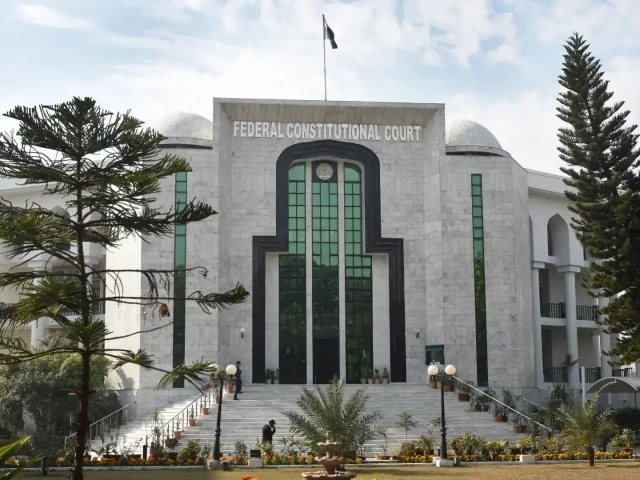
After 68 years, the Federal Constitutional Court (FCC) has restored the inheritance rights of the heirs of a pre-deceased daughter, rectifying a longstanding legal wrong arising from an omission in revenue records.
A division bench of the FCC, headed by Chief Justice Ameenuddin Khan, resolved the decades-old dispute by restoring the inheritance rights of the legal heirs of Sardar Begum, who had been unlawfully deprived of their share for nearly 68 years due to a critical omission in the revenue record.
The court allowed an application for impleadment filed by the legal heirs of Sardar Begum, declaring them necessary and proper parties to the proceedings concerning the consolidation of land in Mouza Dhaunkal, Tehsil Wazirabad.
Senior counsel Hafiz Ahsaan Ahmad Khokhar appeared on behalf of the applicants and argued the matter.
He pointed out that Sardar Begum had passed away in 1958, prior to the death of her father, Chaudhry Abdullah Khan, who died later in 1968. Upon his demise, the mutation of inheritance was attested in the same year; however, Sardar Begum, despite being his lawful daughter, was not entered in the mutation.
Consequently, her sons and daughter were also deprived of the share to which they were legally entitled.
This omission, he argued, was not merely clerical but resulted in the complete exclusion of an entire branch of lawful heirs.
Hafiz Khokhar contended that under settled principles of Muslim personal law, inheritance rights vest immediately upon the opening of succession and cannot be defeated by administrative omissions or defective revenue entries.
He stressed that even where a daughter predeceases the opening of succession, her legal heirs are entitled to represent her branch and claim the share she would have received. The continued exclusion of Sardar Begum's heirs, he argued, constituted a continuing legal wrong persisting across generations.
He further submitted that the consolidation proceedings initiated in 1969 and completed in 1989 were fundamentally flawed, having been conducted on the basis of an incomplete and incorrect pedigree table.
He argued that any consolidation scheme that fails to account for all lawful heirs is void ab initio and cannot confer valid title. He stressed that no consolidation could lawfully take place without recognising and incorporating the share of Sardar Begum and her heirs.
A significant development during the hearing was the statement on oath by Noreen Ahmad Tarrar, who unequivocally admitted before the court that Sardar Begum was indeed the daughter of Chaudhry Abdullah Khan and Fatima Bibi.
The admission conclusively resolved the longstanding dispute regarding her status as a legal heir.
Taking note of this admission, the court observed that there remained no dispute regarding Sardar Begum's lineage.
It held that her legal heirs were fully entitled to inherit from both her father and mother in accordance with the law.
The court further observed that although Sardar Begum had passed away prior to her father's death, her status as a daughter was required to be reflected in the inheritance mutation to determine the rightful distribution.









This material may not be published, broadcast, rewritten, redistributed or derived from. Unless otherwise stated, all content is copyrighted © 2026 The Express Tribune.














COMMENTS
Comments are moderated and generally will be posted if they are on-topic and not abusive.
For more information, please see our Comments FAQ