President Zardari felicitates Azerbaijan leadership on Independence Day
Updated 26 minutes ago

President hopes to deepen Pakistan–Vietnam cooperation, lauds ties and country’s progress under new leadership
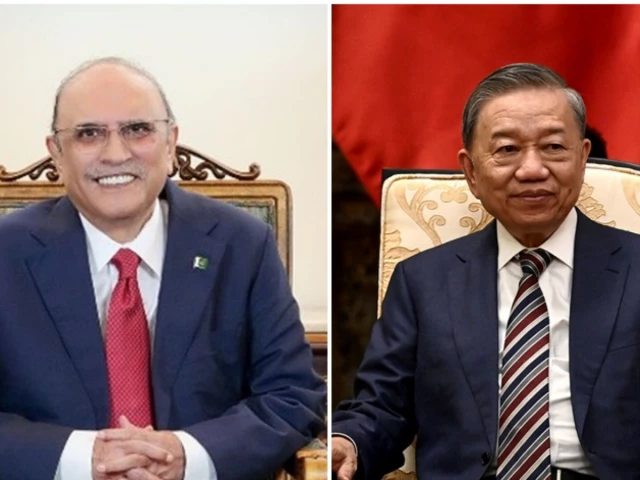
President Asif Ali Zardari on Friday congratulated To Lam on his election as president of Vietnam, saying the unanimous vote reflects the National Assembly’s “trust and confidence” in his leadership.
State broadcaaster Radio Pakistan reported that in a letter, President Zardari expressed confidence that under Lam’s stewardship, Vietnam would achieve “greater progress and prosperity”.
Referring to bilateral ties, the president said Pakistan and Vietnam enjoy “cordial and friendly relations based on mutual trust and goodwill”. He also conveyed his desire to work closely with Lam to further strengthen cooperation and advance shared goals of peace, stability and prosperity.
President Asif Ali Zardari congratulates President To Lam on his election, noting the unanimous mandate. Reaffirms Pakistan-Viet Nam ties & expresses commitment to deepen cooperation for shared peace, stability & prosperity. 🇵🇰🤝🇻🇳 @MOFAVietNam
— The President of Pakistan (@PresOfPakistan) April 10, 2026
Lam was unanimously elected president by Vietnam, consolidating power in a move that makes him the most dominant leader in Vietnam in decades. The 68-year-old, who already serves as chief of the Communist Party of Vietnam, now holds a dual mandate after securing a second term as party general secretary earlier this year.
The development marks a departure from Vietnam’s traditional collective leadership model, concentrating authority in a single figure. Analysts say this could enable faster and more decisive policymaking, though it also raises concerns about a shift towards greater authoritarianism in the one-party state.
Read: Vietnam's top leader To Lam wins state presidency, gets China-style mandate
In his post-election address, Lam pledged to pursue “a new growth model with science, technology, innovation, and digital transformation as the primary driving forces,” while prioritising stability and sustainable development.
Seen as broadly pro-business, he has backed private sector expansion and ambitious growth targets, but critics warn his policies could fuel favouritism, corruption risks and economic imbalances.
Meanwhile, parliament also elected Le Minh Hung as prime minister, replacing Pham Minh Chinh. A former central bank governor, Hung’s appointment is viewed as an effort to bring greater economic expertise into the leadership as Vietnam targets sustained high growth in the coming years.
With additional input from Reuters.





This material may not be published, broadcast, rewritten, redistributed or derived from. Unless otherwise stated, all content is copyrighted © 2026 The Express Tribune.





COMMENTS
Comments are moderated and generally will be posted if they are on-topic and not abusive.
For more information, please see our Comments FAQ