At least eight injured as car rams into pedestrians in Italian city of Modena
Updated 1 hour ago

Trump seeks 10% cut in non-defence spending, about $73B, while boosting military outlays
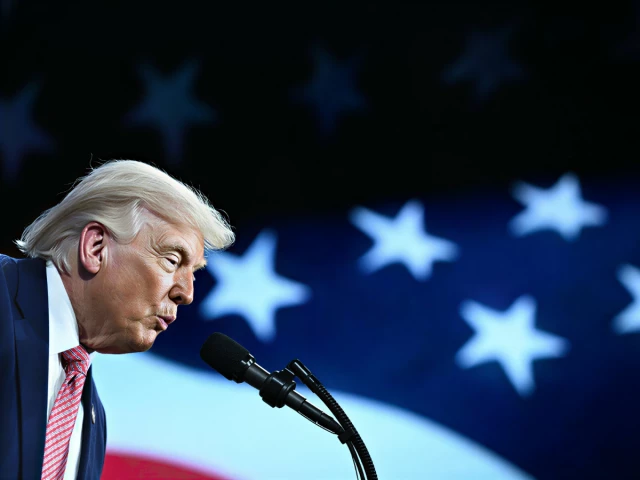
United States President Donald Trump on Friday proposed a record $1.5 trillion in defence resources for fiscal year 2027, marking the highest defence budget request in US history, while also calling for sharp cuts to domestic spending.
According to budget fact sheets released by the White House ahead of the annual budget proposal, the plan includes $1.15 trillion in discretionary defence spending and an additional $350 billion in mandatory resources, bringing the total defence budget to $1.5 trillion.
At the same time, the administration is seeking a 10% reduction in discretionary non-defence spending, equal to about $73b, as Trump renews his push to scale back domestic programs while expanding military outlays.
The proposed increase comes as the administration faces growing political pressure over the ongoing war with Iran.
Read More: Iran's Pezeshkian says Trump's 'Stone Age' threat amounts to war crime
The 2027 budget request comes as the president faces risky choices abroad, with the administration sending US servicemembers to the Middle East, and a weary public at home feeling the economic crunch of skyrocketing gas prices due to the conflict.
The request ultimately requires approval by the US Congress, where disagreement over Trump's spending decisions recently led to the longest government shutdown in US history.
The huge proposed surge in defence spending to $1.5 trillion, up from about $1 trillion in 2026, includes a 5% to 7% pay raise for military personnel at a time when thousands of servicemembers are actively deployed.
The White House boasted that this defence funding approaches the “historic increases just prior to World War II”. The hefty ask contrasts with the more sceptical view Trump took towards military spending in his first term, when he even once called the level of funding “crazy”.
Trump came into office vowing to cut federal spending and rein in the nation’s growing budget deficit, bringing in the world’s richest person, Elon Musk, to lead an effort that pushed about 300,000 people off the federal payroll.
Despite that, the nation’s deficit, the gap between the amount of money the federal government takes in and how much it spends, has continued to widen, with the nonpartisan Congressional Budget Office forecasting a $1.853 trillion shortfall in the fiscal year that ends on September 30, deeper than last year’s $1.775 trillion.
The nation’s $39.016 trillion debt has continued to grow under Republican and Democratic governments in part because most of the political battles around spending revolve around the relatively small amount that Congress directly controls, the roughly one-quarter of the budget known as “discretionary spending”.
The 2027 budget request did not grapple with the most expensive part of mandatory federal spending — Social Security retirement and Medicare health spending for senior citizens — where suggesting cuts is considered politically perilous.
If enacted, total federal spending would reach $2.2 trillion in 2027, compared with the roughly $1.8 trillion spent for the current fiscal year.
Defence cost
The military request will please defence hawks on Capitol Hill, but also highlights how Trump is trying to pay for doubling down on military pursuits, even after Republicans boosted defence spending last year in party-line legislation.
The Pentagon already requested $200b in extra funding to pay for the Iran war, but the White House has not yet officially made that request to Congress, where it is also likely to face scrutiny from lawmakers in both parties.
Other specific funding increases proposed by Trump include his controversial Golden Dome missile defence shield, money to build up critical mineral supplies for the defence industry and $65.8b to build 34 new combat and support ships.
Funds for shipbuilding, a priority for Trump since his first term, include initial funding for the so-called Trump-class battleship as well as submarines.
“Fiscal futility is ending,” White House budget director Russell Vought said in a letter to Congress, adding that “our fiscal ship has turned to face in the right direction".
Messaging in a mid-year
The president's budget also reflects the administration's political priorities ahead of the 2026 midterm elections in November, when Trump's Republicans hope to maintain their small majorities in both the US Senate and House of Representatives.
Lawmakers on Capitol Hill often treat White House budget requests as suggestive, as appropriators try to negotiate behind the scenes to maintain their own legislative priorities.
Also Read: Hegseth removes Army chief, two generals in sweeping shake-up
Top congressional Democrats said Trump’s defence-heavy proposal was “dead on arrival”.
“It’s just an out-of-touch plea for more money for guns and bombs, and less for the things people need, like housing, health care, education, roads, scientific research, and environmental protection,” Oregon Senator Jeff Merkley, the top Democrat on the budget committee, said in a statement.
It was unclear how this new spending would affect the US budget deficit because the projections were not included by the White House.
In a Friday social media post, Trump asserted that his administration’s pursuit against fraud could "balance our American Budget”, a claim that met with scepticism from budget experts.
However, the president and his team relish more funding fights with lawmakers, arguing in the documents that savings will be found "by reducing or eliminating woke, weaponised, and wasteful programs, and by returning state and local responsibilities to their respective governments".
Some proposed cuts follow the Trump administration's pursuit against "green energy" spending, as well as eliminating nearly 30 Justice Department programs that they deem "weaponised" against the American people, along with other initiatives, like cutting the $315 million National Endowment for Democracy.
NASA cuts after Artemis launch
There are also big cuts proposed to many major federal departments, including a 19% decrease for the US agriculture department, a 12.5% cut for the US health department and a 52% cut for the Environmental Protection Agency.
Elsewhere, Trump's budget requests a 13% increase to "maximise" the Justice Department's "capacity to bring violent criminals to justice", as well as maintaining high spending for homeland security and immigration enforcement at $2.2b, which the administration said will pay for US Immigration and Customs Enforcement operations, 41,500 detention beds, and 30,000 "family unit beds".
Two days after NASA launched its most ambitious mission in decades, sending four astronauts on a mission around the moon under its Artemis program, the White House asked for a 23% decrease for that agency, including a $3.6b cut to the agency's science unit that would cancel roughly 40 programmes.
The Trump budget also includes $481m to increase hiring of air traffic controllers to bulk up staffing in airport towers across the country amid rising concerns about understaffing and air safety.
Pet projects for Trump are also funded, like a $10b mandatory fund to establish the "Presidential Capital Stewardship Programme" within the National Park Service "to coordinate, plan, and execute targeted, priority construction and beautification projects in and around Washington, DC".







This material may not be published, broadcast, rewritten, redistributed or derived from. Unless otherwise stated, all content is copyrighted © 2026 The Express Tribune.












COMMENTS
Comments are moderated and generally will be posted if they are on-topic and not abusive.
For more information, please see our Comments FAQ