SC redefines digital justice benchmarks
Updated 2 hours ago

DG Ministry of Climate Change says Pakistan remains among the countries most vulnerable to climate change
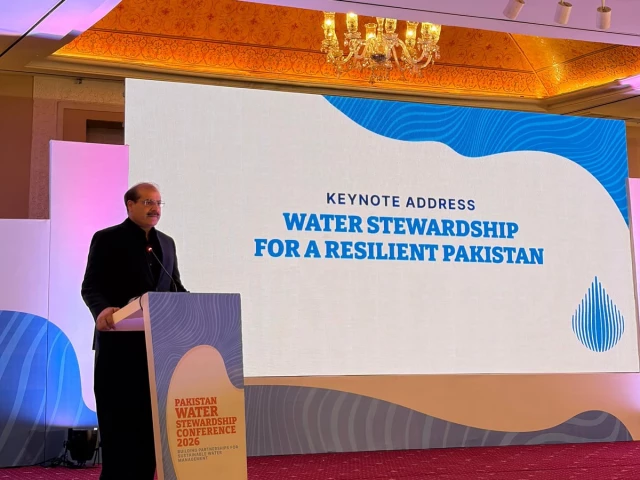
Leaders from government, industry, academia, and donor communities urged collective efforts to tackle the water crisis at the Pakistan Water Stewardship Conference 2026, held from March 31 to April 1 in Islamabad.
Organised by WWF-Pakistan, in collaboration with the Pakistan Council of Research in Water Resources (PCRWR) and the Overseas Investors Chamber of Commerce and Industry (OICCI), the conference focused on safeguarding freshwater resources and building resilient communities amidst Pakistan’s growing vulnerability to climate change.
Speaking at the event, Director-General (DG) of the Ministry of Climate Change and Environmental Coordination, Asif Sahibzada, said, “Pakistan remains among the countries most vulnerable to climate change. Over the past two decades, we have faced recurring extreme weather events and significant economic losses,” he said, referring to the devastating 2025 floods that affected an estimated 4 to 7 million people and caused large-scale economic damage.
“Water stewardship is not the responsibility of a single institution. It requires collective action. Platforms like today’s conference are essential for building partnerships, sharing knowledge, and identifying scalable solutions for sustainable water management,” he said.
DG and CEO WWF-Pakistan Hammad Naqi stressed the need for coordinated action, saying sustainable water management requires strong collaboration between government, industry and communities. He said nature-based solutions and responsible water use are key to building climate resilience, adding that WWF-Pakistan remains committed to promoting sustainable practices.
Director of the WWF-Pakistan Freshwater Programme, Sohail Ali Naqvi, added, “Water risks affect governments, industries, and communities alike, and cannot be addressed through standalone efforts. We need inclusive, multi-stakeholder approaches to manage water sustainably across basins, with corporate partnerships playing a critical role in advancing effective water stewardship.”
Head of the National Compliance Centre at the Ministry of Commerce, Dr Nabil Amin, highlighted the gap in translating Pakistan's industrial ambition into globally recognised standards. He emphasised that while Pakistan has the industrial base, workforce, and export ambition, it lacks the necessary infrastructure to convert this into verified, trusted performance.
DG of PCRWR, Dr Hifza Rasheed, highlighted the importance of strengthening water governance in Pakistan and outlined key dimensions of the country’s water governance landscape, with particular emphasis on enhancing coordination across institutions, sectors, and river basins.
Senior Director Programmes WWF-Pakistan, Dr Masood Arshad said, “Water is Pakistan’s future. The challenges are serious, but the solutions are within our reach through collective action. Let us move forward with commitment to act, collaborate, and scale practical solutions."
Key sessions covered integrated water resources management, sustainable agriculture, urban water resilience, and industrial water stewardship. The conference resulted in measurable outcomes, including recommendations for basin-level planning, public-private partnerships for groundwater recharge, irrigation modernisation, and wastewater reuse.















This material may not be published, broadcast, rewritten, redistributed or derived from. Unless otherwise stated, all content is copyrighted © 2026 The Express Tribune.








COMMENTS
Comments are moderated and generally will be posted if they are on-topic and not abusive.
For more information, please see our Comments FAQ