Somali Pirates begin direct contact with families of abducted Pakistani crew members
Updated 1 hour ago

Talks in the Chinese city of Urumqi between senior officials of the two countries
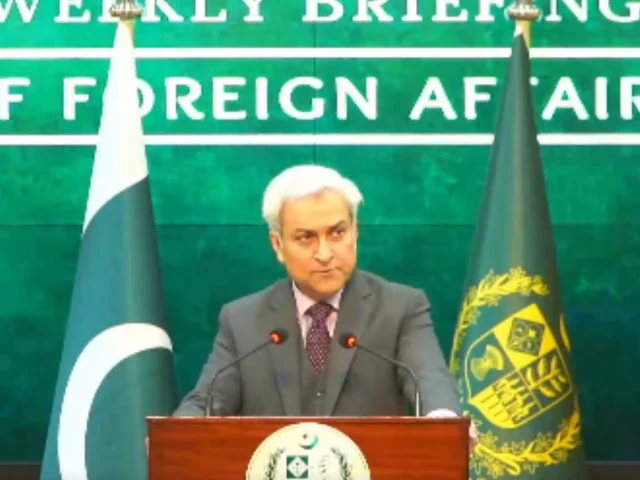
Pakistan is holding talks with Afghanistan to end the worst conflict between the South Asian neighbours since the Taliban returned to power in 2021, Foreign Office Spokesperson Tahir Andrabi confirmed in a weekly media briefing on Thursday.
The talks in the northwestern Chinese city of Urumqi were being held between senior officials of the two countries, the spokesperson said. He added that the purpose is to stop terrorism originating from Afghanistan.
“Our participation is a reiteration of our core concerns. The burden of real process, however, lies with Afghanistan, which must demonstrate visible and verifiable actions against terrorist groups using Afghan soil against Pakistan.”
To a question about the statement coming out from the telephone conversation between the UAE and Afghan foreign ministers, he said that the intent expressed by the Afghan side has to be backed by concrete, verifiable assurances in written format that their territories would not be used for cross-border terrorism.
Andrabi said that such an intent in a documented form was inked by the Taliban in Doha in 2021 but was not honoured.
He also told the media that Operation Ghazab-Lil Haq was going on as Pakistan security forces took some action a few days ago as well, and that there was no change in that operation with respect to any talks taking place.
Highlighting other diplomatic activities during the past week, the spokesperson mentioned Prime Minister Shehbaz Sharif’s telephone conversations with the Crown Prince of Kuwait, President of Iran Dr Masoud Pezeshkian, and President of the European Council António Costa. Similarly, DPM Dar also held telephone calls with the Foreign Ministers of China, Egypt, Qatar, Indonesia, and Iran and UN Secretary-General António Guterres.
During the conversations, the leaders discussed the regional issues as well as bilateral and global matters of mutual concern.
Andrabi made a note of Foreign Minister Ishaq Dar's recent visit to China, from which he returned on Wednesday. The spokesperson mentioned the 5-point peace plan jointly released by the two countries.
🔴LIVE: Spokesperson's Weekly Press Briefing 02-04-2026 at Ministry of Foreign Affairs, Islamabad https://t.co/2CIL4Nphhm
— Ministry of Foreign Affairs - Pakistan (@ForeignOfficePk) April 2, 2026
Pakistan and China on Tuesday jointly proposed a five-point initiative aimed at restoring peace and stability in the Gulf and the broader Middle East. The plan calls for an immediate ceasefire, urgent diplomatic engagement to prevent further escalation, and the restoration of normal maritime traffic through the Strait of Hormuz.
The briefing also highlighted China’s support. “The Chinese side expressed deep appreciation, conveying that China and Pakistan are strategic cooperative partners,” the spokesperson said.
Security of shipping lanes was also a key topic during Dars' visit to China. On this, the FO spokesperson noted that the government of Iran has allowed 20 more Pakistani-flagged ships passage through the Strait of Hormuz, calling the move a "harbinger of peace."
Andrabi also spoke on the meeting of the four foreign ministers of Pakistan, Saudi Arabia, Turkey, and Egypt in Islamabad last week to support Iran–US talks and discuss broader regional developments. “This was the second of the series; you will recall the first was held in Riyadh on March 19,” the spokesperson noted.
The four FMs arrived in Pakistan over the weekend to attend a quadrilateral foreign ministers' meeting focused on defusing tensions between the US and Iran. The foreign ministers also agreed on the need to contain the situation, reduce the risks of further military escalation and create conditions conducive to structured negotiations.
Also Read: Pakistan signals Iran-US talks in 'coming days'
They emphasised that dialogue and diplomacy remained the only viable path forward, while calling for adherence to the principles of the United Nations Charter, including respect for sovereignty and territorial integrity.
After the four-way talks on Sunday, Dar announced that Islamabad could host high-stakes talks between Iran and the US "in the coming days". "I briefed the visiting brother foreign ministers about the prospects of potential US-Iran talks in Islamabad. The visiting foreign ministers expressed their fullest support for this initiative," he said.
He added, "Pakistan will be honoured to host and facilitate meaningful talks between the two sides for a comprehensive and lasting settlement," adding that both Tehran and Washington had expressed confidence in Islamabad's role as a neutral facilitator.
Andrabi said that Pakistan had satisfaction over the confidence shown by the US and Iran in Pakistan to facilitate the talks. Pakistan had condemned the attacks carried out against the Gulf countries by Iran, and prior to that, the attack on Iran as well. “Our position is anchored on principles, on the principles of the human charter, and with the aim of promoting peace and stability in the region.”
The three visiting foreign ministers also called on Prime Minister Shehbaz Sharif, and media readouts were issued on the interactions. “The four foreign ministers in the MOFA reviewed the Gulf situation. Efforts to de-escalate tensions in the region were discussed, and the interactions provided an opportunity to address key regional challenges,” the briefing said.
Read more: IMF seeks Rs15.6tr tax target
On the phone diplomacy front, FM Dar has held multiple calls this week: On March 27, calls with the FM of Egypt, Qatar, and Indonesia, on March 29, a call with the FM of Iran to discuss the evolving regional situation, emphasising dialogue and diplomacy as the only viable path.
The spokesperson also reaffirmed Pakistan’s stance on the Israel–Palestine issue: “You must have seen the eight foreign ministers, including Pakistan, condemning Israel’s actions in Jerusalem,” the spokesperson said.
A joint statement issued by the foreign ministers of Pakistan, Egypt, Jordan, the United Arab Emirates, Indonesia, Turkiye, Saudi Arabia, and Qatar said the countries “condemn, in the strongest terms, and reject the continued restrictions imposed by Israel on the freedom of worship for Muslims and Christians in occupied Jerusalem,” read the statement shared on X.
He further addressed misinformation being circulated from India about Pakistan’s diplomacy in the Iran–US conflict.
“They are habitual liars. And in this situation where we have a delicate, sensitive process of facilitation of dialogue taking place, and in this age where hostilities and a practical war-like situation is prevailing in our region, such news peddling can be extremely dangerous," the spokesperson said.
He said that the European Council and the countries, including Malaysia and others, expressed their support for the seven-points of the Quad talks and the five-point peace plan issued during Deputy Prime Minister and Foreign Minister Ishaq Dar’s visit to Beijing.
“So, everybody wants peace. Everybody and any supporter of peace would appreciate this initiative by Pakistan…So, when there are ongoing hostilities, a certain level of rhetoric is also expected from the parties. We are not deterred by that sentiment… We will continue to do so despite the statements or positions expressed by relevant parties.”
Responding to the Indian government spokesperson’s statement about the Shia community in Pakistan, he said, “We emphatically reject India’s remarks as cynical and diversionary.”
WITH ADDITIONAL INPUT FROM REUTERS AND APP.







This material may not be published, broadcast, rewritten, redistributed or derived from. Unless otherwise stated, all content is copyrighted © 2026 The Express Tribune.








COMMENTS
Comments are moderated and generally will be posted if they are on-topic and not abusive.
For more information, please see our Comments FAQ