Iran can endure US blockade for months without major economic crisis: report
Updated 8 hours ago

No decision has been made to send troops into Iran, but they will build up capacity for potential future operations
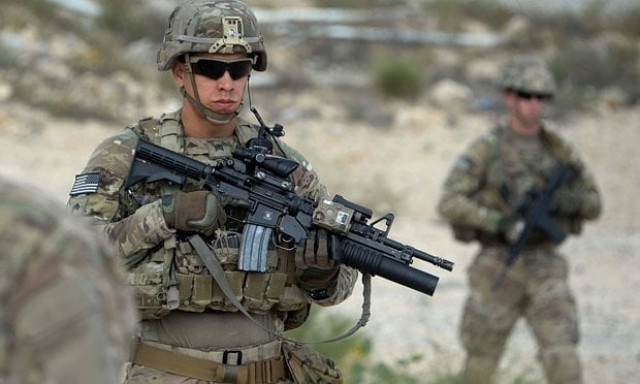
Thousands of soldiers from the United States Army's elite 82nd Airborne Division have started arriving in the Middle East, two US officials told Reuters on Monday, as President Donald Trump weighs his next steps in the war against Iran.
Reuters first reported on March 18 that Trump's administration was considering deploying thousands of additional US troops to the Middle East, a move that would expand options to include the deployment of forces inside Iranian territory.
The paratroopers, based out of Fort Bragg, North Carolina, add to the thousands of additional sailors, Marines and Special Operations forces sent to the region. Over the weekend, about 2,500 Marines arrived in the Middle East.
The officials, speaking on the condition of anonymity, did not say specifically where the soldiers were deploying to, but the move was expected.
The additional army soldiers include elements of the 82nd Airborne Division headquarters, some logistics and other support, and one brigade combat team.
No decision has been made to send troops into Iran, but they will build up capacity for potential future operations in the region, one of the sources said.
The soldiers could be used for several purposes in the Iran war, including an attempt to seize Kharg Island, the hub for 90% of Iran's oil exports.
Earlier this month, Reuters reported there had been discussions within the Trump administration about an operation to take the island. Such a move would be highly risky, since Iran can reach the island with missiles and drones.
Reuters has previously reported the administration has discussed using ground forces inside Iran to extract highly enriched uranium, though that option could mean US troops deeper inside Iran for potentially longer periods of time, trying to dig out material that is deep underground.
The internal Trump administration discussions have also included potentially putting US troops inside Iran to secure safe passage for oil tankers through the Strait of Hormuz. While that mission would be accomplished primarily through air and naval forces, it could also mean deploying US troops to Iran's shoreline.
Trump said today the US was in talks with a "more reasonable regime" to end the war in Iran, but repeated his warning to Tehran to open the Strait of Hormuz or risk US attacks on its oil wells and power plants.
Any use of US ground troops, even for a limited mission, could pose significant political risks for Trump, given low American public support for the Iran campaign and Trump's own pre-election promises to avoid entangling the US in new Middle East conflicts.
Since operations started on February 28, the US has carried out strikes against more than 11,000 targets. More than 300 US troops have been injured and 13 service members have been killed as part of Operation Epic Fury.
US could meet Iran war objectives in weeks, says Rubio
Earlier, United States Secretary of State Marco Rubio said that Washington was close to achieving its objectives in Iran “in a matter of weeks”, adding that President Donald Trump had “a number of options available” to prevent Iran from controlling the Strait of Hormuz.
During an interview with ABC News, Rubio said that the US was focused on the “destruction” of Iran’s air force, navy and factories where they make all their weapons, as well as the substantial reduction in the number of missiles they possess.
“All of those objectives are being met, on or ahead of schedule and should be able to achieve in a matter of weeks,” he said.
On the closure of the Strait of Hormuz, Rubio said Trump had “a number of options available” to prevent Iran from imposing control or a tolling system on the vital waterway.
“The president has a number of options available to him if he so chooses to prevent that from happening. … Obviously, I’m not going to discuss what those options are, and we’re not going to discuss military tactics,” he added.
He separately stated that Trump “always prefers diplomacy and always prefers to reach a result” regarding the war against Iran.
“There are direct messages and talks taking place between parties inside Iran and the United States, primarily through intermediaries,” Rubio said, according to a preview of an exclusive interview published on Al Jazeera's website.
“The Iranian regime has chosen to spend its country’s wealth to support Hezbollah, Hamas and Shia militias inside Iraq and to needlessly threaten its neighbours,” he said.
“We would always welcome a scenario in which Iran is led by people with a different vision for the future, and if such an opportunity arises we will seize it,” Rubio added.
Iran denies role in attack on Kuwait desalination plant, blames 'depravity of Zionist regime'
Earlier, Iran denied any role in the attack on a power generation and water desalination plant in Kuwait, casting the apparent blame for the attack on Israel.
A worker was killed and major material damage was caused after an Iranian attack late on Sunday on a service building at the power generation and water desalination plant in Kuwait, the country’s Electricity Ministry said earlier today.
The ministry said the fatality was an Indian national.
It said the strike caused extensive damage to the infrastructure at the facility. Technical and emergency teams were immediately dispatched under emergency plans to deal with the aftermath of the attack and ensure operations continue normally, the ministry said. It added that authorities are coordinating with security agencies and relevant bodies to secure the damaged site.
#Kuwait's Ministry of Electricity, Water and Renewable Energy: A service building at one of the power and water distillation plants was damaged in a brutal Iranian attack, resulting in the death of a worker of Indian nationality
— Kuwait News Agency - English Feed (@kuna_en) March 30, 2026
The technical and emergency teams have immediately… pic.twitter.com/CgHNhr959s
Iran's Islamic Revolutionary Guard Corps' Khatam al Anbiya Central Headquarters rubbished any role in the incident.
A statement issued today said: "The brutal aggression of the Zionist regime against Kuwait's desalination plant under the pretext of accusing Iran, which occurred in recent hours, is a sign of the depravity.
"Countries in West Asia must be vigilant against the provocations of the American-Zionists aimed at destabilising and destroying the region and must put an end to the presence of the criminal American army and Zionist occupiers in the region."
🚨 Spokesperson Khatam al-Anbiya HQ :
— True Promise - الوعد الصادق ✪🇮🇷 (@IRTruePromise) March 30, 2026
The brutal aggression of the Zionist regime against Kuwait's desalination plant under the pretext of accusing Iran, which occurred in recent hours, is a sign of the depravity.
Countries in West Asia must be vigilant against the provocations… pic.twitter.com/5yH36fmsZ1
Iran denies having direct talks with US, dismisses ‘unreasonable’ demands
Iran’s Foreign Ministry spokesperson Esmaeil Baghaei said on Monday that Tehran has “not had any direct negotiations with the US so far”.
“What has been discussed are messages we received through intermediaries stating that the US wants to negotiate,” Baghaei said in comments according to the semiofficial Tasnim news agency.
Regarding the meetings held in Pakistan :
— True Promise - الوعد الصادق ✪🇮🇷 (@IRTruePromise) March 30, 2026
"The meetings that Pakistan holds with neighboring countries are within a framework they themselves have designed, and we have not participated in this framework. It is obvious that if regional and neighboring countries are concerned… pic.twitter.com/5A6O6cUxcy
“I wonder how many people in America take the claims of American diplomacy seriously. Our task is clear, unlike the other side, which keeps changing its position," he said.
The foreign minister added, “Iran has been clear about its position from the beginning, and we know very well what the framework is that we are considering. The material conveyed to us has been excessive and unreasonable requests."
“The meetings that Pakistan has are a framework that they established themselves and we did not participate in. It is good for the countries of the region to be concerned about ending the war, but they should be careful about which side started the war,” Baghaei went on.
Iran defiant
Baghaei said Tehran had received messages via intermediaries indicating Washington's willingness to negotiate. This followed a meeting of the foreign ministers of Pakistan, Egypt, Saudi Arabia and Turkey in Islamabad on Sunday to discuss mediation efforts.
But Baghaei, criticising the US proposals, told a press conference on Monday: "Our position is clear. We are under military aggression. Therefore, all our efforts and strength are focused on defending ourselves."
Meanwhile, a Pakistani security official told Reuters that at this stage it appeared unlikely there would be direct US-Iran talks this week. "We are trying our best to make it happen as early as possible," the official added.
Read: Pakistan signals Iran-US talks in 'coming days'
Baghaei also said Iran's parliament was reviewing a possible exit from the Nuclear Non-Proliferation Treaty, which recognises the right to develop, research, produce and use nuclear energy as long as nuclear weapons are not pursued.
Trump has cited preventing Iran obtaining nuclear weapons as one of the reasons for attacking Iran on February 28. Tehran denies it is seeking a nuclear arsenal.
Trump calls Iran's current leaders 'very reasonable' as Pakistan prepares to host talks
US President Donald Trump said the US and Iran have been meeting "directly and indirectly" and that Iran's new leaders have been "very reasonable", as more US troops arrived in the region and Tehran warned it will not accept humiliation.
Trump's remarks on Sunday came after Pakistan, which is acting as an intermediary between Tehran and Washington, said it was preparing to host "meaningful talks" in the coming days aimed at ending the month-long Iran war.
"I think we'll make a deal with them, I'm pretty sure, but it's possible we won't," Trump told reporters on Sunday evening as he travelled aboard Air Force One to Washington.
.@POTUS: "We're ahead of schedule with Iran. We're weeks ahead of schedule... and we have a group, it's really a new regime. It's a new group of people — people that we've never dealt with before, that are acting very reasonable." pic.twitter.com/fcTLiAKnNx
— Rapid Response 47 (@RapidResponse47) March 30, 2026
Trump said he thought the US had already accomplished regime change in Tehran after strikes killed the country's supreme leader and other top officials, but said twice that their replacements seemed "reasonable."
In a social media post on Monday, Trump wrote: "Great progress has been made but, if for any reason a deal is not shortly reached, which it probably will be, and if the Hormuz Strait is not immediately 'Open for Business,' we will conclude our lovely 'stay' in Iran by blowing up and completely obliterating all of their Electric Generating Plants, Oil Wells and Kharg Island."
An initial Israeli strike on February 28 killed Iran's Supreme Leader Ayatollah Ali Khamenei, who was replaced by his son Mojtaba.
Foreign Minister Ishaq Dar said talks between regional foreign ministers on Sunday covered ways to bring an early end to the war, and potential US-Iran talks in Islamabad. "Pakistan will be honoured to host and facilitate meaningful talks between the two sides in the coming days, for a comprehensive and lasting settlement of the ongoing conflict," he said.
It was not clear whether the US and Iran had agreed to attend.
Iran's parliament speaker, Mohammad Baqer Qalibaf, earlier accused the US of sending messages about possible negotiations while at the same time planning a ground invasion. Tehran was ready to respond if US soldiers were deployed, he said.
"As long as the Americans seek Iran's surrender, our response is that we will never accept humiliation," he said in a message to the nation.
Iraq's Defence Ministry said on Monday that the Mohamad Alaa air base, located beside Baghdad International Airport, was hit by rockets in the early hours of Monday, destroying an aircraft but causing no casualties.
The ministry added that authorities are assessing the damage and tracking the source of the attack.
Spain closes airspace to US planes involved in Iran war
Spain has closed its airspace to US planes involved in attacks on Iran, a step beyond its previous denial of use of jointly-operated military bases, Spanish newspaper El País reported on Monday, citing military sources.
The closure of its airspace, which forces military planes to bypass NATO member Spain en route to their targets in the Middle East, does not include emergencies, El País added.
The Spanish Ministry of Defence did not immediately reply to a request for comment.
"This decision is part of the decision already made by the Spanish government not to participate in or contribute to a war which was initiated unilaterally and against international law," Economy Minister Carlos Cuerpo said during an interview with radio Cadena Ser when asked if the decision to close Spain's airspace could worsen relations with the United States.
Spanish Prime Minister Pedro Sanchez has been one of the most vocal opponents of the US and Israeli attacks on Iran, describing them as reckless and illegal.
President Donald Trump has threatened to cut trade with Madrid for denying the US use of Spain's bases in the war.
Suspected Iranian drones, rockets strike US bases in northeastern Syria
Suspected Iranian drones and rockets targeted bases hosting US forces in northeastern Syria on Sunday, causing material damage but no casualties, a war monitor said.
The Britain-based Syrian Observatory for Human Rights said a rocket struck the Qasrak base in Hasakah province, followed by drone attacks around midnight and at dawn. US air defences intercepted several drones, while other projectiles hit the site, causing damage, it said.
The monitor said the Kharab al-Jir base near Rmeilan was also hit by multiple rockets early Sunday, some intercepted and others reaching their targets, with no immediate reports of casualties. Two additional drones were shot down near residential areas in Hasakah, it added. The attacks prompted heightened alert and increased aerial activity.
UN Secretary-General strongly condemns killing of UN peacekeeper in Lebanon
UN Secretary-General Antonio Guterres strongly condemned the killing of an Indonesian peacekeeper of the UN Interim Force in Lebanon (UNIFIL) amid hostilities late Sunday between Israel and Hezbollah.
"This is just one of a number of recent incidents that have jeopardised the safety & security of peacekeepers," he said on the US social media company X’s platform.
Guterres called on all parties to uphold their obligations under international law and to ensure the safety and security of UN personnel and property.
Earlier, UNIFIL said in a statement that a peacekeeper was "tragically" killed Sunday when a projectile exploded at a UNIFIL position near the southern Lebanese village of Adchit al-Qusayr. Another was critically injured.
UNIFIL said it does not know the origin of the projectile.
"We have launched an investigation to determine all of the circumstances," it said.
Israel has pounded Lebanon with airstrikes and launched a ground offensive in southern Lebanon since a cross-border attack by the Hezbollah group on March 2.
The region has been on alert since the US and Israel launched an air offensive on Iran on Feb. 28, killing more than 1,340 people so far, including then-Supreme Leader Ayatollah Ali Khamenei.
Iran has retaliated with drone and missile strikes targeting Israel, along with Jordan, Iraq and Gulf countries hosting US military assets, causing casualties and damage to infrastructure while disrupting global markets and aviation.
EU reaffirms solidarity with Gulf countries amid Mideast conflict
European Council President Antonio Costa reaffirmed on Sunday the bloc's solidarity with Gulf countries amid the ongoing conflict in the Middle East.
"The EU stands in solidarity with the Gulf Cooperation Council countries in the face of continued Iranian airstrikes and drone attacks targeting civilians and infrastructure in the region. These attacks must stop immediately," Costa wrote on the US social media platform X.
His remarks came after he held a phone call with UAE President Sheikh Mohamed bin Zayed Al Nahyan, where he reiterated the EU's support for the oil-rich emirate.
"The EU continues to urge all parties to de-escalate and give diplomacy a chance, in the interest of security and stability in the Middle East," Costa added.
The US and Israel have launched airstrikes on Iran since Feb. 28, killing over 1,400 people, including then-Supreme Leader Ali Khamenei.
Iran has retaliated with drone and missile strikes targeting Israel, along with Jordan, Iraq, and Gulf countries hosting US military assets, causing casualties and damage to infrastructure while disrupting global markets and aviation.
Israel, Iran trade strikes as Trump eyes Kharg island
The Israeli military said its air defences were responding to "missiles launched from Iran" on Monday, as US President Donald Trump talks of seizing the export hub of Kharg Island.
"A short while ago, the IDF identified missiles launched from Iran toward the territory of the State of Israel," the military statement said, adding that "Defensive systems are operating to intercept the threat," and urging people to take shelter until further notice.
It said two drones from Yemen were intercepted early Monday but gave no further details. Yemen's Iran-backed Houthi militia entered the war on Saturday, firing missiles at Israel, escalating a conflict that has engulfed the Middle East.
Israel's military also said the Air Force was carrying out strikes on Tehran on Monday, targeting what it described as military infrastructure.
US President Donald Trump said he wants to "take the oil in Iran" and could seize the export hub of Kharg Island, in an interview with the Financial Times published on Sunday, as about 2,500 US Marines arrived in the region.
Kharg Island, located off the west coast of Iran, is a vital oil terminal for the Middle Eastern country and is being eyed by the Pentagon for ground operations, though the United States insisted it would stop short of a full-scale invasion.
When asked about the state of Iranian defence on the island, Trump said, "I don't think they have any defence. We could take it very easily."
The island handles 90% of Iran's oil exports, and seizing it would give the United States the ability to severely disrupt Iran's energy trade, placing enormous pressure on Tehran's economy.
The war has spread across the Middle East, killing thousands, causing the biggest disruption ever to energy supplies and hitting the global economy.
Iran's parliament speaker, Mohammad Baqer Qalibaf, earlier accused the US of sending messages about possible negotiations while at the same time planning a ground invasion. Tehran was ready to respond if US soldiers were deployed, he said.
The US Department of Defence has dispatched thousands of troops to the Middle East, giving Trump the option of launching a ground offensive.
Read More: 'No Kings' protests fill US streets against Trump
Several hundred special operations personnel have arrived in the region, the New York Times reported on Sunday, citing two military officials. That comes on top of thousands of US Marines that came on Friday aboard an amphibious assault ship, the first of two contingents, the US military has said.
Reuters has reported that the Pentagon has been considering military options that could include ground forces, although Trump has not approved any of those plans, according to multiple news outlets.
The majority of Americans are opposed to the war and a military escalation, which would risk a protracted crisis, would likely weigh further on Trump's already low approval ratings ahead of the November midterm elections for Congress.
Yemen's Iran-aligned Houthis joined the conflict on Saturday, launching their first attacks on Israel and raising the prospect they could target and thus block a second key shipping route, the Bab el-Mandeb Strait. Israeli authorities said on Sunday that they had intercepted two drones launched from Yemen.
An Israeli official said there was no intention to scale back attacks against Iran ahead of any possible talks between Washington and Tehran, and that Israel would continue carrying out strikes against what it described as military targets.
Israel's military said it had launched over 140 air strikes on central and western Iran, including Tehran, over the 24 hours to Sunday evening, hitting ballistic missile launch sites and storage facilities, among other targets.
Iranian state media reported strikes had hit Mehrabad airport and a petrochemical plant in the northern city of Tabriz.
A chemical plant in southern Israel near the city of Beersheba was hit by a missile or missile debris as Israel fended off multiple salvos from Iran, prompting official warnings to the public to stay away due to "hazardous materials".
Global economy struggling
Iran's effective blockade of the Strait of Hormuz, which carries 20% of global oil and gas shipments, has spiked oil prices and spread economic pain around the world.
Stocks slumped in Asia on Monday as investors dug in for a protracted Gulf conflict that already has oil prices heading for a record monthly rise, bringing a spike in inflation and the risk of recession to much of the globe. Japan's Nikkei index was down 4.7%.
Meanwhile, oil prices looked poised to extend their gains, with Brent headed for a record monthly rise. Brent crude futures jumped $3.09, or 2.74%, to $115.66 a barrel by 2353 GMT after settling 4.2% higher on Friday.












This material may not be published, broadcast, rewritten, redistributed or derived from. Unless otherwise stated, all content is copyrighted © 2026 The Express Tribune.






COMMENTS (4)
Comments are moderated and generally will be posted if they are on-topic and not abusive.
For more information, please see our Comments FAQ