President directs use of all possible measures to induce inflationary impact in meeting with PM Shehbaz
Updated 2 hours ago

Iran strikes Israeli industrial complex, aluminium plants in Bahrain, UAE; Qalibaf dismisses threat of ground assault
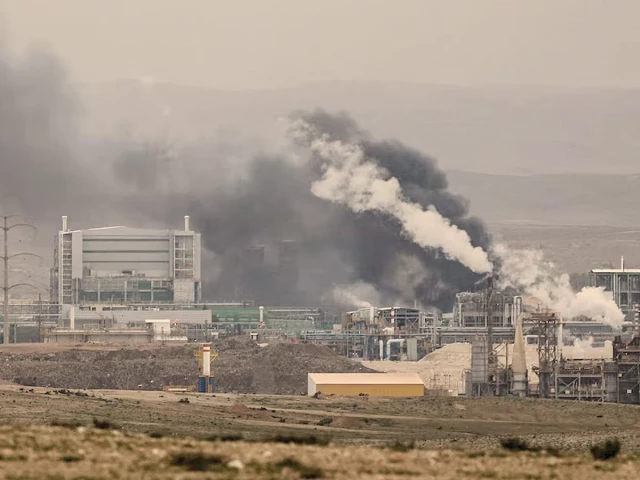
Israel said on Sunday that an industrial plant near Beer Sheva in the Negev desert was struck by a missile or debris, prompting a hazardous materials warning. Bahrain and the United Arab Emirates (UAE) reported Iranian attacks on their aluminium plants.
Israel also claimed it carried out more than 140 strikes on Tehran and elsewhere in Iran. Officials reported power cuts in Tehran and Alborz province after energy infrastructure was hit. A university in Isfahan said it has been hit by US-Israeli strikes for the second time this weekend.
One month into the US-Israel campaign against Iran, the conflict has intensified across the Middle East, disrupting global energy markets and sparking widespread protests in thousands of US cities on Sunday.
Footage verified by the BBC showed smoke rising from the Neot Hovav industrial complex in southern Israel. Iran's Islamic Revolutionary Guards Corps claimed responsibility for the attack. Images circulated by multiple media outlets showed fires burning and thick black smoke plumes rising from the site, which houses more than 30 factories.
Israel's fire and rescue service said crews worked to "prevent an explosion or additional leaks" and warned the public not to approach the area due to the "presence of hazardous materials."
Residents nearby were urged to "lock themselves in their homes, close windows and vents." The service added that the incident was confined "within the boundaries of the industrial zone" and posed no danger to anyone situated more than 800 metres away.
Later, Iran's Energy Ministry said attacks on "electricity infrastructure" in parts of the capital, Tehran, the wider Tehran Province and Alborz Province led to power being cut off.
"Shrapnel struck one of the electricity pylons at the entrance to the city of Karaj," deputy energy minister Mostafa Mashhadi said.
The Gulf region has also seen a surge in attacks. Kuwait's defence ministry reported detecting 14 ballistic missiles and 12 drones in its airspace, injuring 10 military personnel at an army camp.
Qatar intercepted several Iranian drones, averting casualties. The UAE defence ministry said its systems engaged 16 ballistic missiles and 42 drones. Emirates Global Aluminium confirmed significant damage at an Abu Dhabi site and six employees injured. Aluminium Bahrain reported minor injuries to two staff members.
The strikes come as US forces continue preparations for a possible ground intervention in Iran. The Pentagon has reportedly considered securing strategic locations, including the Kharg Island oil hub and military facilities.
According to CNN, US Central Command chief Admiral Brad Cooper met with Israeli military Chief of Staff Lt-Gen Eyal Zamir and other senior Israeli generals to discuss the conflict and efforts to halt Iranian weapons production.
Meanwhile, Iranian parliament speaker Mohammad Bagher Qalibaf reiterated Tehran's readiness to respond to any US ground attack, stating: "Our firing continues. Our missiles are in place. Our determination and faith have increased."
Israel reported more than 140 air strikes on central and western Iran in the past 24 hours, targeting missile launch sites, storage facilities, and military positions. Air strikes also hit Popular Mobilisation Forces sites in Mosul and Tuz Khurmatu in Iraq.
With Tehran maintaining pressure, US and Israeli air operations ongoing, and global oil markets on edge, the White House and Iran face a stark choice: escalate further or negotiate. Analysts warn that the next moves could reshape the Middle East and have lasting implications for global energy security.












This material may not be published, broadcast, rewritten, redistributed or derived from. Unless otherwise stated, all content is copyrighted © 2026 The Express Tribune.






COMMENTS
Comments are moderated and generally will be posted if they are on-topic and not abusive.
For more information, please see our Comments FAQ