Oil surges after Iran targets US airbase in retaliation
Updated 6 hours ago

Energy diversification and electrification shield Beijing from Gulf disruption
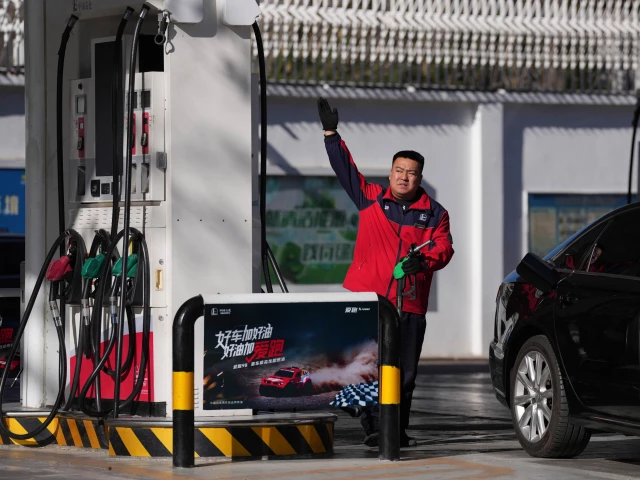
It has been a month since the United States and Israel unleashed an unlawful war on Iran. Donald Trump and Benjamin Netanyahu expected a quick victory by eliminating Iran’s top civil and military leadership, hoping that it would bring the regime to its knees. But that didn’t happen. Now, it’s either checkmate or stalemate.
The strategic and economic consequences aside, America’s “war of choice” has triggered a global energy shock. The closure of the Strait of Hormuz by Iran’s Revolutionary Guards has choked a vital oil shipping lane and pushed prices past $100, forcing the International Energy Agency to release some of its 1.8-billion-barrel emergency reserves in an unprecedented intervention. As countries scramble to curb fuel use, one country appears unusually insulated: China.
But how and why? It is because of a deliberate, decades-long restructuring of China’s energy system, industrial policy and strategic planning. While no major global economy is totally immune to an energy shock, China is less vulnerable and, in several respects, better placed than many others. This immunity is not accidental; it is the result of sustained investments in energy diversification, electrification, infrastructure and industrial capacity.
Primarily, massive strategic reserves buffer China against immediate supply shocks. An estimated 1.2 billion barrels of onshore stockpiles allow Beijing to delay the transmission of international price spikes into domestic economic stress. Conversely, countries with limited reserves are forced to react quickly to supply disruptions, often through emergency measures such as rationing or demand suppression.
However, this strategic stockpile alone does not explain China’s resilience. Equally important is the structural transformation of its energy system. China used to be heavily reliant on oil imports, particularly through chokepoints such as the Strait of Hormuz and the Strait of Malacca. This was a major strategic vulnerability. With this in mind, Chinese policymakers pursued diversification of both supply routes and energy sources.
Investments in overland pipelines, linking China to Russia and Central Asia, have minimised dependence on maritime oil flows. Today, only about 40% to 50% of China’s seaborne oil imports pass through the Strait of Hormuz, accounting for just 6.6% of China’s total energy consumption. This significantly reduces the direct impact of any disruption in the Persian Gulf.
Another factor shielding China from the Gulf energy shock is its strategic shift towards non-fossil fuels. Beijing has set a target for non-fossil fuels to account for 25% of its total energy consumption by 2030. The expansion of clean energy, especially solar and wind, has already begun to reshape China’s energy mix. Renewables supplied about 80% of the country’s new electricity demand in 2024, showing that incremental growth in energy consumption is increasingly decoupled from fossil fuels.
This transition is further reinforced by electrification across key sectors, particularly transportation. The electric vehicle (EV) revolution has reduced China’s vulnerability to oil price shocks. Data shows that more than 50% of all new passenger vehicles sold in China are now EVs or hybrids, while a growing number of heavy-duty trucks are fully electric. This shift has already reduced oil demand by over one million barrels per day. As road fuel demand peaks and begins to decline, fluctuations in global oil prices have a diminishing effect on the broader economy.
The composition of China’s power sector is another critical factor. Oil and natural gas account for only about 4% of China’s power generation, compared to 40% to 50% in many other Asian economies. China depends heavily on coal, which it has in abundance, alongside an expanding base of renewables. While coal dependence raises environmental concerns, it provides a degree of energy security during global crises. Electricity, rather than oil, is becoming the backbone of China’s energy consumption, and electricity can be generated from a diverse mix of domestic and imported sources.
The strategic implications of this shift become even more pronounced in the context of an increasingly electrified global economy. As industries, transportation and digital infrastructure, particularly artificial intelligence, require more electricity, countries with large, stable and scalable power systems gain a competitive edge. China’s vast power-generation capacity, together with its dominance in clean energy manufacturing and battery production, positions it as a central player in this transition.
That said, China, the world’s second-largest economy and largest crude importer, is not completely immune to an oil shock. It still faces higher input costs when global prices rise. Certain sectors, such as petrochemicals, manufacturing and households reliant on gas heating, remain exposed to price fluctuations. Also, a significant portion of China’s oil imports – around five million barrels per day – still flows from the Middle East through the Strait of Hormuz, representing a potential vulnerability in the event of prolonged disruption. Nevertheless, these exposures are mitigated by the broader structural trends shaping China’s economy.
The Gulf conflict may reinforce China’s long-term strategic direction. Rising oil prices highlight the risks of dependence on imported fossil fuels, strengthening the case for continued investment in renewable energy, electrification and energy storage. In this sense, short-term shocks speed up structural change, pushing China further along a path it has already committed to.
In the broader global context, China’s relative resilience signals a fundamental shift in how economic power is defined. Energy security is no longer solely about access to oil; it increasingly depends on the ability to generate, store and distribute electricity at scale. As the global economy becomes more electrified and digitally driven, the nations that control the technologies and infrastructure underpinning this system will hold a strategic advantage.
China’s experience clearly illustrates this transition. Beijing has built a multifaceted defence against external shocks. While challenges remain, particularly in balancing energy security with environmental goals, its current position suggests that it is better equipped than most of its peers to successfully navigate the uncertainties of a volatile global energy landscape.
China is not unaffected by the Gulf conflict, but it is uniquely prepared to withstand it. Its resilience stems not from any single factor, but from the cumulative effect of long-term strategic planning. As oil markets remain vulnerable to geopolitical tensions, China’s model of diversification and electrification may offer a blueprint for other economies seeking to reduce their exposure to future energy shocks.
THE WRITER IS AN INDEPENDENT JOURNALIST WITH A SPECIAL INTEREST IN GEO-ECONOMICS








This material may not be published, broadcast, rewritten, redistributed or derived from. Unless otherwise stated, all content is copyrighted © 2026 The Express Tribune.









COMMENTS
Comments are moderated and generally will be posted if they are on-topic and not abusive.
For more information, please see our Comments FAQ