Afghanistan evolving into terror exporter as ISIS-K recruiting people across Central Asia, Russia
Updated 1 hour ago

Heavy reliance has left stockpiles 'alarmingly low'
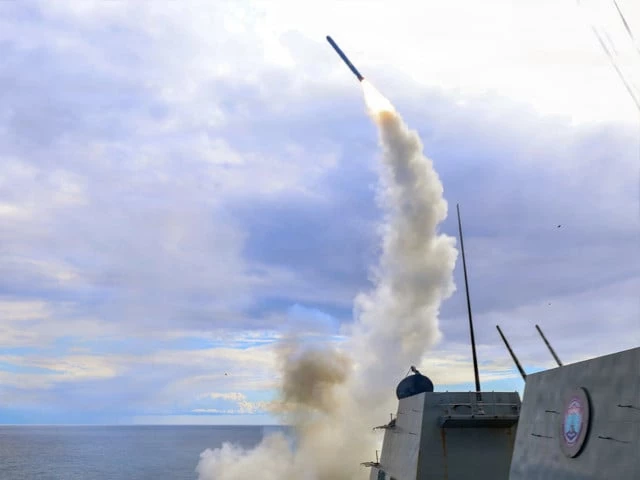
The United States has fired more than 850 Tomahawk cruise missiles during four weeks of conflict with Iran, significantly depleting its precision-guided weapons stockpile, The Washington Post reported on Saturday, citing Pentagon officials.
Launched from ships and submarines, Tomahawks - long central to US military operations since the Gulf War - have been heavily relied upon in the ongoing conflict. However, their limited annual production, estimated at only a few hundred, has raised concerns about dwindling reserves.
Officials told the newspaper that the Pentagon is closely tracking missile usage, with stockpiles in the Middle East described as "alarmingly low" and nearing "Winchester" - military slang for running out of ammunition - potentially affecting current and future operations.
The report said the heavy reliance on the missiles, known for their range of over 1,000 miles and precision strike capability, may force the US to consider repositioning assets from other regions, including the Indo-Pacific, alongside efforts to boost production.
Pentagon spokesman Sean Parnell, however, rejected concerns, saying the US military "has everything it needs to execute any mission at the time and place of the President's choosing and on any timeline". He criticised media coverage as "biased" and accused it of attempting to "frighten and sow doubt" among the public.
Many of the missiles were used in the early phase of Operation Epic Fury, sources said, with one strike reported near an elementary school in Minab, Iran.
The US has also launched more than 1,000 air defence interceptor missiles, including systems such as Patriot and Terminal High Altitude Area Defence (THAAD), in response to Iranian counterattacks. Officials noted that these inventories are also limited and not publicly disclosed.
Mark Cancian of the Centre for Strategic and International Studies (CSIS) said more than 800 Tomahawks used in Iran could represent about a quarter of the total stockpile, potentially leaving gaps for conflicts in the Western Pacific. His think tank estimated the US Navy had around 3,100 Tomahawks at the start of the war.
The navy has acquired nearly 9,000 Tomahawks over the programme's history, though many are older and now obsolete, according to a CSIS assessment.
Similarly, the ability of Israel's highly sophisticated air defences to keep intercepting Iranian attacks is also coming under scrutiny as the Middle East war drags on into a second month.
The military has dismissed reports that it is running low on the interceptors used to shoot down the steady stream of Iranian missiles and Hezbollah rockets fired at Israel.
However, some analysts suggest that the war against Iran has significantly drained allied resources, with long-range interceptors among the most severely depleted.
Israel has a multi-layered air defence array, with a variety of systems intercepting threats at different altitudes.
The top tier consists of the anti-ballistic missile Arrow systems, with Arrow 2 operating both within the Earth's atmosphere and in space and Arrow 3 intercepting above the Earth's atmosphere.
Below that sits David's Sling, which was created to target medium-range threats, including drones, shorter-range ballistic missiles and cruise missiles.
Israel's famed Iron Dome system is the third tier and was originally designed to intercept short-range rockets and artillery shells.
US systems also complement Israel's air defences with some THAAD anti-missile batteries reportedly in Israel.
"There is no area in Israel that is not under multi-layer defence," said reservist Brigadier General Pini Yungman, who played a key role in developing the country's air defences and is now president of defence company TSG.













This material may not be published, broadcast, rewritten, redistributed or derived from. Unless otherwise stated, all content is copyrighted © 2026 The Express Tribune.






COMMENTS
Comments are moderated and generally will be posted if they are on-topic and not abusive.
For more information, please see our Comments FAQ