Pakistan played 'very sincere role' in US-Iran mediation: PM Shehbaz
Updated 2 hours ago

Authorities sealed several factories for violating emission standards, registered thousands of legal cases
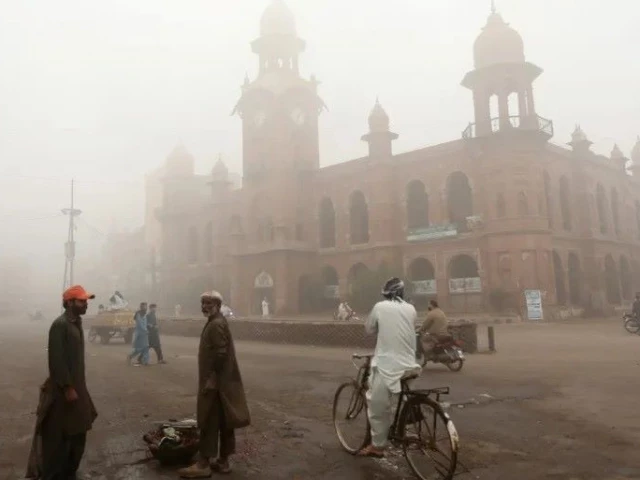
Lahore, often listed among the world’s most polluted cities, recorded a drop in PM2.5 levels, breaking a worrying trend of rising pollution seen between 2021 and 2024. Fine particulate matter (PM2.5), considered one of the most dangerous pollutants due to its ability to enter the bloodstream, declined across Punjab compared to previous years.
The progress is largely linked to aggressive action by the Environment Protection Agency, Punjab, which significantly expanded its operations during the year. Inspection drives increased across industrial units, construction sites, brick kilns and transport hubs.
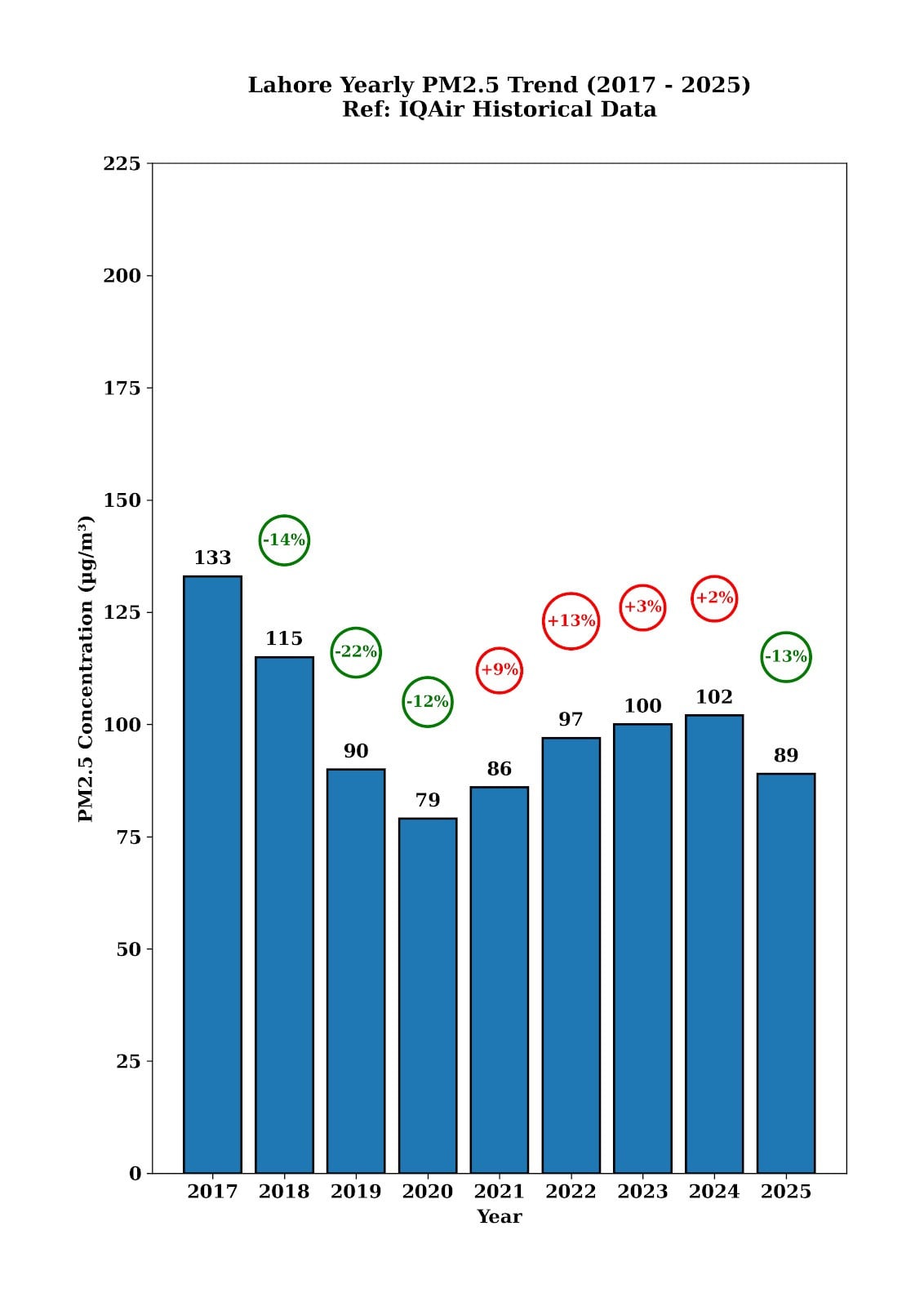
PHOTO: IQAIR
Officials carried out tens of thousands of visits to ensure compliance with environmental laws, reflecting a stronger presence on the ground.
Enforcement also became stricter. Authorities sealed several factories for violating emission standards, registered thousands of legal cases, and imposed heavy fines on polluters. This approach marked a shift from leniency to accountability, forcing industries and businesses to adopt cleaner practices.
In Lahore, special attention was given to controlling dust pollution, a major contributor to smog. Construction projects were directed to install water sprinklers and adopt dust control measures.
Hundreds of sites introduced water recycling systems, reducing both pollution and water waste. Anti-smog machines were also deployed in key areas, helping to control airborne particles during peak smog months.
Read: Thunderstorms, strong winds expected in Karachi today as western system approaches
One of the most important developments was the use of modern technology in environmental management. Digital monitoring systems were introduced to track emissions and identify violations in real time. This allowed authorities to respond quickly and take immediate action, improving overall enforcement efficiency.
Another key step was tackling crop residue burning, which has historically contributed to seasonal smog in Punjab.
"Environment ministry is doing its best to improve the situation of pollution, and day and night our efforts will be continuous and sure in the coming smog season, the situation will be better, said Sajid Bashir, Official Spokesman of Environment Protection Department.
In 2025, the city experienced a visible reduction in air pollution levels, offering rare relief to millions of residents who have long struggled with hazardous air. Officials and experts say this improvement is not temporary but the result of consistent policy action and stricter enforcement across sectors.
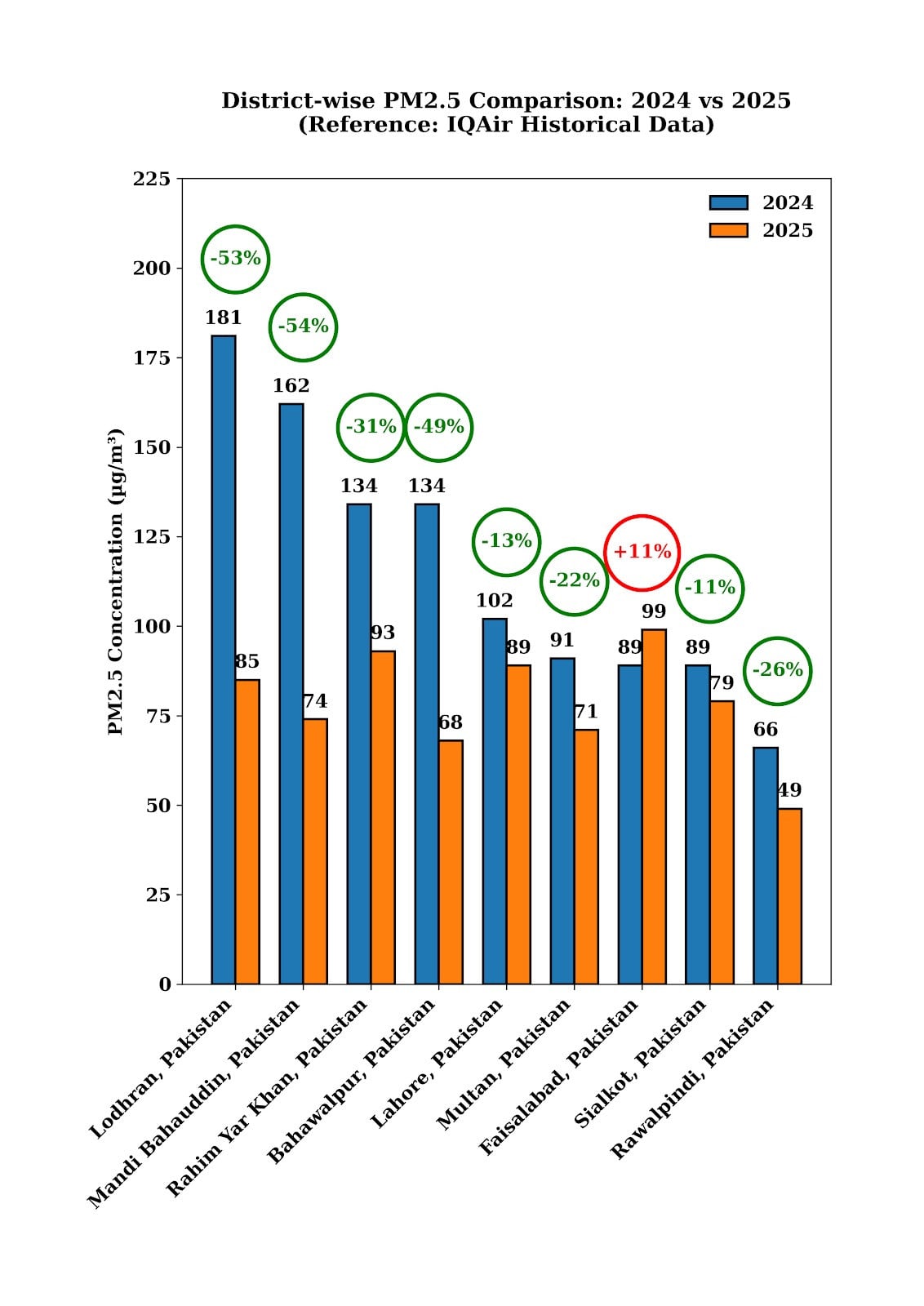
PHOTO: IQAIR
This marks the first time since the COVID-19 lockdown period that pollution levels have reduced in a steady and structured way, rather than due to external slowdowns.
Environmental experts believe this shift signals that government interventions are beginning to produce measurable results, especially in urban centres where pollution sources are concentrated.
"Although the situation of pollution improved in Lahore due to the recent actions, it is a fact that there are substandard vehicles on the road, while there are hundreds of small factories contributing the maximum to worsen the air quality of the city, said Prof Dr Munawar Sabir, Former Head of PU Geography Department.
For the first time, authorities introduced rapid response teams equipped with water bowsers to control fires in agricultural areas. These teams acted quickly to extinguish burning fields, preventing smoke from spreading towards major cities like Lahore.
Long-term structural reforms also supported the improvement. Traditional brick kilns were converted to zig-zag technology, which significantly reduces smoke emissions. Industrial units were required to install emission control systems while vehicle inspection campaigns were strengthened to reduce pollution from transport, one of the largest contributors to urban smog.
Read More: Mobile app-based fuel quota system on cards
The positive trend was not limited to Lahore alone, as several cities across Punjab reported improved air quality, indicating that the measures were effective on a broader scale. Cities like Rawalpindi, Multan and Bahawalpur also saw reductions in pollution levels, showing a province-wide impact.
However, experts caution that the situation is still far from ideal. Despite the improvements, pollution levels in Lahore and other cities remain above international safety standards. Health experts warn that long-term exposure to polluted air continues to pose serious risks, including respiratory and cardiovascular diseases.
Officials say the government will continue implementing the smog mitigation plan with greater focus and consistency. They stress that sustained efforts in regional cooperation and public awareness will be essential to maintain the current progress.
For Lahore’s residents, the cleaner air in 2025 has brought cautious optimism, while the city has not fully overcome its smog crisis, the recent improvement offers hope that with continued action and strong governance, a healthier environment is possible in the years ahead.










This material may not be published, broadcast, rewritten, redistributed or derived from. Unless otherwise stated, all content is copyrighted © 2026 The Express Tribune.









COMMENTS
Comments are moderated and generally will be posted if they are on-topic and not abusive.
For more information, please see our Comments FAQ