Ex-Prince Andrew continues to 'gripe' as royal fallout deepens
Updated 3 hours ago

Posthumous performance fuels debate as industry leaders insist technology cannot replace human storytelling
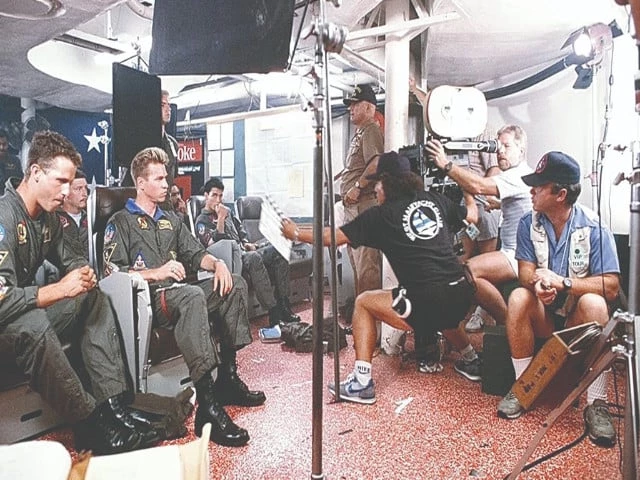
The late Val Kilmer is set to return to the big screen through artificial intelligence in what filmmakers describe as a groundbreaking cinematic experiment, even as industry leaders caution that technology must not eclipse human creativity.
The posthumous appearance, announced this week by First Line Films, will see Kilmer feature in the upcoming film 'As Deep as the Grave' using generative AI, marking what the studio claims is the first performance of its kind in Hollywood.
The move has reignited a broader debate unfolding across the industry, where rapid advances in AI are forcing creatives to confront questions about authorship, ethics and the future of filmmaking.
Kilmer, widely remembered for his roles in 'Top Gun', 'The Doors' and 'Batman Forever', had originally been cast as Father Fintan — a Catholic priest with Native American spiritual ties — before complications from throat cancer prevented him from completing the role. Kilmer died in April last year at the age of 65. Working in collaboration with his estate and his daughter Mercedes Kilmer, the production team said the decision to recreate his performance digitally was driven by a desire to honour the actor's personal connection to the character.
According to the filmmakers, Kilmer had felt a strong cultural and spiritual resonance with the role, linked in part to his Native American heritage and affinity for the American Southwest. The production company says advanced generative AI tools will allow Kilmer to "embody" what it calls a historically significant figure.
Yet even as filmmakers push technological boundaries, unease is spreading across Hollywood. At the South by Southwest conference in Austin, artificial intelligence dominated discussions among directors, executives and digital innovators grappling with the pace of change.
Veteran director Steven Spielberg drew a firm line, warning against the wholesale replacement of human creators. "I've never used AI on any of my films yet. We have a writer's room. All the seats are occupied," he said, underscoring his resistance to tools that could sideline writers and artists.
Industry figures acknowledge that the anxiety is not misplaced. Generative AI models are now capable of producing increasingly sophisticated video content, raising concerns about job losses among editors, visual effects specialists and other skilled professionals. The technology's rapid evolution has left many questioning how film and television production will look in the coming years.
Joshua Davies, chief innovation officer at Artlist, argued that while AI is disruptive, it remains a tool rather than a replacement for creativity. He said audiences would ultimately favour work shaped by human insight over purely machine-generated content.
"If given the choice between something made using AI by a techie and a creative, I know which one I would rather watch," Davies said, adding that the industry is still "working out" how best to integrate such tools into existing workflows.
Davies described AI's most practical role as filling production gaps — generating shots that could not be captured due to budget, time or logistical constraints — rather than replacing traditional filmmaking altogether.
Current models, he noted, still struggle with complex camera movements and consistency across scenes, limiting their ability to fully replicate human craftsmanship.
Nevertheless, experimentation is accelerating. Artlist itself drew attention earlier this year after producing a Super Bowl advertisement in under five days using its AI-driven tools, at a fraction of the cost typically associated with such high-profile campaigns. While the project showcased efficiency gains, Davies stressed it was still driven by creative professionals rather than automated processes alone.
The re-creation of Kilmer's performance sits at the intersection of these competing narratives — technological ambition and artistic caution. For some, it represents a respectful extension of an actor's legacy, enabled by careful collaboration with his family. For others, it raises difficult ethical questions about consent, authenticity and the boundaries of posthumous representation. Hollywood studios are increasingly exploring how AI can be embedded into production pipelines, a shift that could reshape the industry's labour structure following the disruptions of the pandemic and the writers' and actors' strikes of 2023.
The prospect of faster, cheaper content creation is appealing to studios, but it risks further inflaming tensions with creative communities wary of being sidelined.
Even proponents of AI concede that storytelling — the core of cinema — remains deeply human. The emotional nuance, cultural context and lived experience that define compelling narratives are not easily replicated by algorithms, however advanced.
As the industry experiments with new tools, the return of Val Kilmer to the screen offers a striking illustration of both the possibilities and the pitfalls of artificial intelligence in film. It is a technological feat that honours a celebrated actor, while simultaneously serving as a reminder that innovation in Hollywood rarely arrives without controversy.
Whether AI ultimately becomes a collaborator or a competitor to human creativity remains an open question. For now, the balance appears delicate — with filmmakers eager to harness new capabilities, yet determined, at least in principle, to keep the human voice at the heart of the story. Agencies














This material may not be published, broadcast, rewritten, redistributed or derived from. Unless otherwise stated, all content is copyrighted © 2026 The Express Tribune.






COMMENTS
Comments are moderated and generally will be posted if they are on-topic and not abusive.
For more information, please see our Comments FAQ