Iran inflicted ‘extensive’ damage to US bases than previously disclosed: report
Updated 3 hours ago

Bonn reportedly sent Israel 140–160m marks yearly which makes 2b total to set nuclear facilities
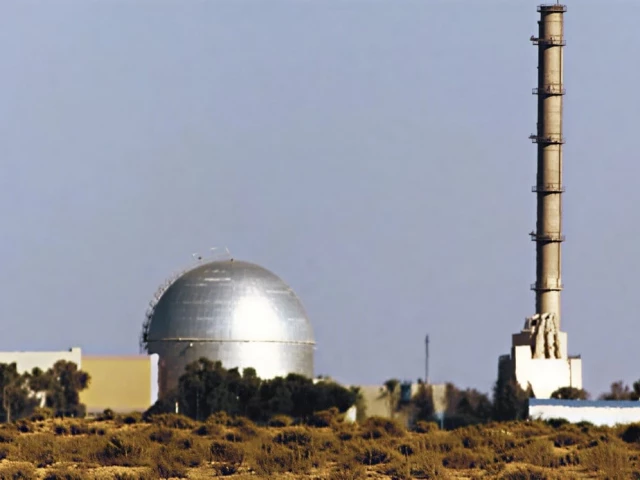
Since the Dimona nuclear reactor in Israel’s Negev Desert was first exposed in December 1960, the country’s nuclear project has remained the subject of extensive research, books, and investigative reporting, with a recent report claiming that Germany "secretly financed" the project.
The report by the Israeli daily Haaretz noted that seminal works, including Avner Cohen’s Israel and the Bomb, along with studies by Seymour Hersh, Zaki Shalom, and Adam Raz, have examined the origins, development, and secrecy surrounding the programme.
In 2024, journalist Shany Haziza’s documentary series The Atom and Me added a personal and social dimension to the story. Yet despite decades of research, two major questions have remained unresolved: how much the project cost, and who paid for it, according to Haaretz.
Also Read: Risk of Mushroom cloud in the Iran war
The report claimed that between 1961 and 1973, the government in Bonn transferred 140 million to 160 million German marks annually to Israel through a secret loan mechanism.
In total, the funding is estimated at nearly 2 billion marks, equivalent to roughly €5 billion (over $5.7 billion) today. A later repayment agreement signed in 1989 reportedly turned the loan, in practice, into a grant.
If accurate, this would mean that a substantial part of Israel’s nuclear project was financed not by Israeli taxpayers or private donors, but by German public funds, it argued.
France supports, with German backing
The roots of the story go back to 1957, when Israeli-French ties were especially close following the 1956 Sinai war, the report said, claiming that France supported Israel diplomatically and secretly agreed to assist it in acquiring a nuclear reactor through agreements between the two countries’ atomic energy bodies.
But then-prime minister of Israel David Ben-Gurion was not fully reassured by French backing alone, fearing that Israel faced a long-term existential threat, as he was concerned by the rise of then-Egyptian President Gamal Abdel Nasser and pan-Arab nationalism, the report explained.
Ben-Gurion then began looking for what he reportedly described as “an umbrella for a rainy day,” seeing West Germany as the most suitable candidate: a rising European power, hostile to Nasser, and led by officials, especially then-Chancellor Konrad Adenauer, who believed Germany had a moral responsibility toward Israel after the Holocaust, the report said.
Secret ties begin in Bonn
A key moment came on July 3, 1957, during a secret meeting in Bonn between Shimon Peres, then-director general of Israel’s Defense Ministry, and West Germany's Defense Minister Franz Josef Strauss.
Ben-Gurion worried that open ties with Germany would trigger a crisis inside Israel, while Bonn feared that visible cooperation with Israel would damage its position in the Arab world and strengthen East Germany diplomatically.
West Germany viewed aid to Israel as both a moral obligation and a strategic investment. Israel, for its part, sought military and political support.
During the talks, Peres made clear that ties between the two countries should go beyond the 1952 reparations agreement. Strauss responded positively, including to an Israeli request involving submarines. Although the submarines were not considered essential by the Israeli military, the request appears to have helped open the door to wider defense cooperation.
The submarines were ultimately purchased from Britain with German financing. West Germany also bought around $30 million worth of military equipment from Israel, helping support the development of Israel’s defense industry.
1960 meeting seen as turning point
The most important breakthrough came on March 14, 1960, when Ben-Gurion and Adenauer met at the Waldorf Astoria hotel in New York.
Although the meeting was public, the substance of their talks remained secret for years. No official transcript exists, but the meeting is widely viewed as a major moment in the history of Israeli-German security relations, the report noted.
During the discussion, Ben-Gurion reportedly linked Israel’s security directly to the Holocaust, arguing that the destruction of European Jewry had also severely weakened the Zionist project.
In that context, he appears to have framed German support not only as compensation for past crimes, but also as a contribution to Israel’s future survival, according to Haaretz.
'Negev development' as cover
While German military assistance drew attention, the more significant component was a covert financial arrangement reportedly described as aid for “Negev development.”
The plan was given the code name Aktion Geschaftsfreund (“Operation Business Friend”) by Adenauer’s office. Under the arrangement, Israel was to receive $50 million annually for 10 years, at an interest rate of 3.6%.
Although Bonn initially expected the arrangement to begin only after reparations payments ended in 1965, Israel pushed for earlier implementation. The first transfer was eventually made in December 1961.
Because secrecy was considered essential, no formal treaty was signed. Instead, Israel's representative at the time, Felix Shinnar, and Adenauer adviser Hermann Abs reportedly created a mechanism in which the funds were transferred as commercial-style loans through a state-owned development bank in Frankfurt, Germany.
To conceal the purpose of the payments, the transfers were reportedly described in official paperwork as financial arrangements linked to bilateral agreements with unnamed developing countries. Germany’s economy and finance ministers approved the mechanism, while the foreign minister was reportedly kept uninformed, the report said.
Eichmann trial added pressure
The situation became even more sensitive in May 1960, when Ben-Gurion announced the capture of Nazi official Adolf Eichmann and plans to try him in Jerusalem.
West German officials feared the trial could draw attention to senior figures in Adenauer’s government who had served in the Nazi era. Among them was Hans Globke, Adenauer’s chief of staff, who had helped formulate the Nuremberg Laws and was also aware of the emerging ties with Israel.
Hermann Abs, who played a central role in the secret funding mechanism, had also been a leading banker during the Nazi period.
A hidden pillar of the project
Taken together, the account suggests that Israel’s Dimona project was built not only on French technological support, but also on secret West German financial backing, the report claimed.
The arrangement, if confirmed in full, would represent one of the most consequential and least publicly acknowledged aspects of Israel’s nuclear history — one shaped by the Holocaust memory, regional security fears, and covert diplomacy, it noted.











This material may not be published, broadcast, rewritten, redistributed or derived from. Unless otherwise stated, all content is copyrighted © 2026 The Express Tribune.






COMMENTS
Comments are moderated and generally will be posted if they are on-topic and not abusive.
For more information, please see our Comments FAQ