PM Shehbaz hopes of peace deal soon as Iran's Pezeshkian expresses appreciation for Pakistan role in negotiations
Updated 1 hour ago

President Asif Zardari also conveys his good wishes to Iran's new supreme leader
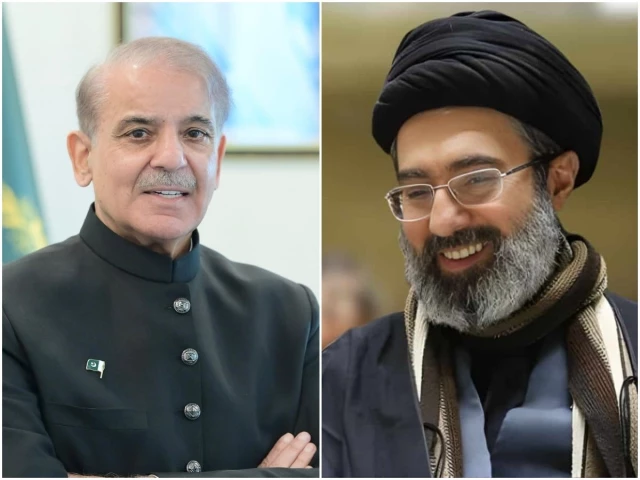
Pakistan on Tuesday congratulated Iran’s new Supreme Leader Mojtaba Khamenei in a move aimed at maintaining a delicate balance at a time when raging conflict between Tehran and the US-Israel alliance continues to reshape the regional security landscape.
Prime Minister Shehbaz Sharif wrote to Mojtaba Khamenei following his assumption of the position of supreme leader after the assasination of his father, Ali Khamenei.
The message conveyed condolences as well as congratulations, a carefully calibrated move at a time when Islamabad is attempting to maintain neutrality in a rapidly escalating regional war.
The letter, released by the Prime Minister’s Office, expressed Pakistan’s “deepest condolences and prayers” over Ali's death while extending best wishes to Mojtaba as he assumed the leadership of the Islamic republic.
“The martyrdom of Ayatollah Seyyed Ali Khamenei has deeply saddened the people of Pakistan, who stand in solidarity with the leadership and people of Iran during this difficult time,” the prime minister said.
At the same time, PM Shehbaz expressed hope that the new Iranian leader would guide the country “towards peace, stability, dignity and prosperity in the years ahead".
Prime Minister's letter to His Eminence Mojtaba Khamenei
— PTV News (@PTVNewsOfficial) March 10, 2026
Prime Minister Muhammad Shehbaz Sharif has written a letter to His Eminence Mojtaba Khamenei, conveying condolences on the martyrdom of his revered father, the Supreme Leader of the Islamic Republic of Iran, Ayatollah… pic.twitter.com/WxiBNFudZ7
In a separate post on X, the prime minister reiterated Pakistan’s condolences and congratulated Mojtaba on assuming what he described as an “onerous responsibility”.
I congratulate His Eminence Ayatollah Mojtaba Khamenei on his assumption of the responsibilities of Supreme Leader of the Islamic Republic of Iran. I also reiterate deepest condolences and prayers on behalf of the people of Pakistan on the martyrdom of his father, Ayatollah Ali…
— Shehbaz Sharif (@CMShehbaz) March 10, 2026
Without naming the US, the carefully worded message reflected Pakistan’s attempt to maintain diplomatic balance as tensions in the Middle East intensify amid an ongoing military confrontation between Iran and the US-Israel alliance.
Islamabad has so far avoided taking sides publicly in the conflict, urging restraint and calling for dialogue while closely monitoring developments that could have major implications for regional stability and Pakistan’s own economic security.
However, while Islamabad condemened attack on Iran, at the same time it denounced Tehran for sending drones and missiles to Gulf countries.
Pakistan also reminded Iran about its mutual defence pact with Saudi Arabia. Behind the scenes, Islamabad, nevertheless has been working to seek de-escalation between Iran and Gulf countries.
Analysts say the prime minister’s message was significant because it reaffirmed Pakistan’s longstanding ties with Iran without signalling alignment with Tehran in the current conflict.
Pakistan and Iran share a nearly 900-kilometre border and maintain deep historical, cultural and religious connections.
However, Pakistan also maintains close strategic relations with the US and strong political and economic ties with Gulf Arab states, many of whom remain wary of Iran’s regional ambitions.
This complex geopolitical positioning means Islamabad must walk a fine diplomatic line during crises involving Tehran.
“The message of condolence and congratulations was necessary from a diplomatic standpoint,” a senior Pakistani official familiar with the matter said. “Iran is a neighbour and an important regional country. But at the same time Pakistan has to maintain a balanced posture in the ongoing conflict.”
The letter also emphasised that relations between Pakistan and Iran were rooted in shared faith, culture, language and history, reaffirming Islamabad’s commitment to strengthening bilateral cooperation across areas of mutual interest.
Observers say such messaging signals continuity in Pakistan’s policy toward Iran even as regional tensions escalate. The development comes at a particularly volatile moment for Pakistan.
The ongoing war has already triggered fears of disruptions to global energy supplies, especially if tensions affect shipping through the strategically vital Strait of Hormuz, a key maritime chokepoint through which a significant portion of the world’s oil passes.
Pakistan, heavily dependent on imported energy, remains particularly vulnerable to any prolonged disruption.
The conflict has already pushed international oil prices upward, adding pressure on Pakistan’s fragile economy and forcing the government to pass on rising fuel costs to consumers.
Against this backdrop, Islamabad’s diplomatic engagement with Tehran also reflects concerns about preventing the regional crisis from spilling over into neighbouring states.
Officials say Pakistan hopes the new Iranian leadership will pursue policies that reduce tensions and help stabilise the region.
“Pakistan desires peace and stability in the region,” the prime minister wrote, expressing hope that Mojtaba’s leadership would guide Iran toward prosperity and stability.
President Asif Ali Zardari also conveyed his good wishes to Mojtaba following his elevation, the President’s Secretariat said.
President Zardari extended his greetings to Iran’s new leader and expressed hope for stability in the region amid ongoing tensions.
He expressed hope that the situation would stabilise and that conditions would improve for the people of the region.
President Asif Ali Zardari extended good wishes to His Eminence Ayatollah Seyyed Mojtaba Hosseini Khamenei on his appointment as Supreme Leader of Iran and expressed hope for improved conditions and stability in the region. @khamenei_ir
— The President of Pakistan (@PresOfPakistan) March 10, 2026




This material may not be published, broadcast, rewritten, redistributed or derived from. Unless otherwise stated, all content is copyrighted © 2026 The Express Tribune.



COMMENTS
Comments are moderated and generally will be posted if they are on-topic and not abusive.
For more information, please see our Comments FAQ