UN says destruction of Jesus statue by Israeli soldier in Lebanon 'shocking'
Updated 1 hour ago

Foreign Minister Wang Yi says China will work with regional countries to restore peace and stability in Middle East
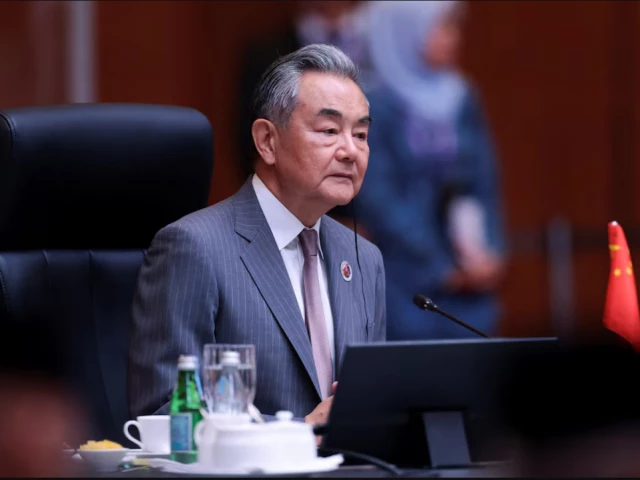
China has proposed a five-point approach to address the escalating situation involving Iran, with Chinese Foreign Minister Wang Yi urging an immediate ceasefire, respect for sovereignty and a return to political dialogue to prevent further instability in the Middle East.
Speaking at a press conference on the sidelines of the Fourth Session of the 14th National People's Congress, Wang outlined China’s five-point position for resolving conflict in the volatile region.
The press conference — one of the most important diplomatic events held during the NPC each year — provides insight into how China views its role amid rising geopolitical tensions and shifting global power dynamics.
At a press conference, Chinese FM Wang Yi stated China's stance on the issues related to Iran and the Middle East. #TwoSessions pic.twitter.com/dZAo0PU0bO
— China Xinhua News (@XHNews) March 9, 2026
The framework, according to the transcript issued by China’s foreign ministry, includes respecting national sovereignty, rejecting the abuse of force, adhering to non-interference in internal affairs, promoting political settlement through dialogue and encouraging major powers to play a constructive role in restoring peace.
“The Middle East is engulfed in flames. This is a war that should not have happened — it is a war that does no one any good,” Wang said while addressing journalists from China and abroad at the NPC media centre in Beijing.
He stressed that China’s stance on the issue remains objective and impartial, stressing that the immediate priority should be to bring about a ceasefire and end hostilities.
Wang warned that the use of force would not provide a lasting solution, adding that conflicts in the Middle East have historically led only to deeper divisions and prolonged crises. He urged all sides to halt military operations to avoid further escalation and prevent the conflict from spreading across the region.
Outlining China’s approach to resolving the conflict involving Iran and the broader Middle East, the Chinese foreign minister listed five fundamental principles that should guide international efforts.
First, he stressed the importance of respecting national sovereignty. According to Wang, the sovereignty, security and territorial integrity of Iran and all countries in the Gulf region must be respected and protected.
Neighbors helping neighbors and building an amicable neighborhood is part of Chinese tradition and culture, said Chinese FM Wang Yi at a press conference. Click to see more. #TwoSessions pic.twitter.com/jmJKlPcVlM
— China Xinhua News (@XHNews) March 9, 2026
Second, he cautioned against what he described as the abuse of force, saying that military might should not determine international outcomes. Civilians, he added, must not become victims of armed conflict.
Third, Wang underlined the principle of non-interference in internal affairs. He said countries in the Middle East should determine their own future without outside intervention, warning that attempts to instigate political upheaval or regime change would not gain public support.
Fourth, he urged all parties to pursue a political solution to the crisis. China believes disputes should be resolved through dialogue and negotiations rather than military confrontation, he said.
Finally, Wang called on major global powers to play a constructive role in promoting peace. Influential countries, he added, should contribute positively to regional stability rather than intensifying tensions.
China, he said, stands ready to work with Middle Eastern nations to implement the Global Security Initiative, a framework proposed by Chinese President Xi Jinping aimed at addressing international conflicts through dialogue, cooperation and collective security.
Read More: China moves to ease Pak-Afghan tensions
“As a sincere friend and strategic partner, China is willing to work with countries in the Middle East to restore order to the region, bring peace to its people and contribute to global stability,” Wang said.
Beyond the Iran issue, Wang used the press conference to outline China’s broader diplomatic priorities and its role in an increasingly volatile global environment. He said China will continue to position itself as a stabilising force in international affairs while promoting multilateral cooperation and strengthening ties with developing countries.
Wang presented China’s view of global affairs and Beijing’s foreign policy direction for the coming year. Throughout the presser, he stressed that China seeks to promote peace, stability and cooperation while opposing unilateralism and what he described as hegemonic behaviour in international relations.
“Today’s world is undergoing changes unseen in a century,” he said, adding that geopolitical tensions, economic uncertainty and regional conflicts are reshaping the global landscape. “In such circumstances, China’s diplomacy will remain committed to safeguarding global peace and advancing common development,” he added.
The Chinese foreign minister described the international situation as complex and uncertain. He pointed to the rise of regional conflicts, geopolitical rivalry among major powers and economic fragmentation as key factors contributing to global instability.
Despite these challenges, he said China’s development continues to create new opportunities for international cooperation.
Read More: China says US talks vital as Trump targets Beijing's key partners
“China’s modernisation is not only a development path for its own people but also an opportunity for the world,” Wang said. “Our country remains committed to openness, cooperation and mutually beneficial partnerships.”
According to him, China’s diplomatic strategy aims to balance the protection of national interests with broader global responsibilities. He stressed that China will continue defending its sovereignty and security while strengthening international cooperation through multilateral institutions.
China’s diplomatic approach centres on building what Beijing describes as a “community with a shared future for humanity”, a concept promoted by President Xi Jinping as a framework for global governance based on cooperation, inclusiveness and respect for sovereignty.
Wang also addressed China’s relations with major global powers.
He described ties with the United States as one of the most important bilateral relationships in the world and stressed that cooperation between the two countries is essential for global stability.
“China and the United States share broad common interests and responsibilities,” he said. “If the two countries choose cooperation, both sides and the world will benefit. If they choose confrontation, it will harm not only the two nations but also global peace and prosperity.”
Read More: China urges US to manage differences
FM Wang reiterated that mutual respect should form the basis of bilateral relations and urged both sides to focus on dialogue and cooperation.
He also addressed China’s ties with Russia, describing the partnership between the two countries as stable and resilient. According to Wang, both countries maintain strong political trust and close coordination in international affairs. “Our relationship is based on equality, mutual benefit and respect for each other’s interests,” he said. “It is not directed against any third party.”
Wang described China’s relations with neighbouring Asian countries as a priority of its foreign policy. He added that Asia remains one of the most dynamic regions in the world, contributing significantly to global economic growth. China aims to strengthen regional cooperation through trade, infrastructure development and cultural exchanges.
China’s Belt and Road Initiative continues to play an important role in improving connectivity and development across many countries, he added.
As the press conference concluded, Wang reiterated China’s commitment to working with other nations to address shared global challenges. “In a world full of uncertainty, China will remain a force for stability,” he said.
He urged countries to strengthen dialogue, respect each other’s interests and cooperate in building a more peaceful and prosperous global order. “The future of humanity depends on cooperation rather than confrontation,” Wang said, adding that the principle will continue guiding China’s diplomatic efforts in the years ahead.









This material may not be published, broadcast, rewritten, redistributed or derived from. Unless otherwise stated, all content is copyrighted © 2026 The Express Tribune.




COMMENTS
Comments are moderated and generally will be posted if they are on-topic and not abusive.
For more information, please see our Comments FAQ