PSX jumps nearly 1,400 points on sustained buying interest
Updated 6 hours ago

Loans, rollovers reach 40% of annual target as reserves stay thin, bond plan stalls
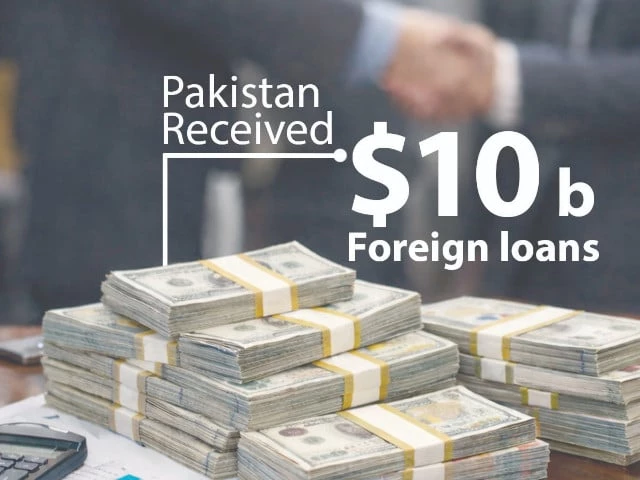
Pakistan has received over $10 billion in foreign loans, half of it in fresh disbursements and the remainder in rollovers of existing debts, but the central bank has yet to announce the status of the $2 billion rollover by the United Arab Emirates (UAE).
According to Ministry of Economic Affairs data, the federal government received $5.1 billion in fresh loans during the July-January period of the current fiscal year. In addition, Saudi Arabia, China and the International Monetary Fund (IMF) either disbursed funds or rolled over $5 billion worth of existing debt.
Pakistan's total external debt is not booked at a single point, and the Ministry of Economic Affairs and the State Bank of Pakistan (SBP) separately report debt figures, depending on the nature of the borrowing.
The debt bulletin and a separate announcement by the central bank showed that combined foreign loan receipts and rollovers increased to $10.1 billion during the July-January period, which is $1.4 billion less than the same period of the last fiscal year.
The key reason behind the lower disbursement is the status of the UAE's $2 billion debt, which first matured in January and then again this month. However, the central bank has remained silent, and, departing from its past practice, has not yet made a formal announcement about the rollover.
In contrast, in December last year, the central bank announced that Saudi Arabia had extended the maturity of its $3 billion deposit placed with it for another year. The extension, made through the Saudi Fund for Development (SFD), maintains a facility that has been in place since 2021 and has been rolled over repeatedly in support of Pakistan's macroeconomic stability.
China has also extended a $1 billion cash deposit for one year earlier in the current fiscal year, in addition to the IMF's $1 billion tranche.
For the current fiscal year, the federal government and the central bank have estimated inflows of over $25 billion in the form of fresh borrowing and rollovers of existing loans. Pakistan remains dependent on foreign loan disbursements and rollovers, as the country finds it difficult to repay $12.5 billion in cash deposits maturing this year.
Disbursements and rollovers during the July-January period accounted for 40% of the annual estimates.
The government remains hopeful that international creditors will roll over $12.5 billion in cash deposits during the current fiscal year. There is no appetite within the Ministry of Finance to repay the debtdue to thin foreign exchange reserves of $16 billion. These reserves include cash deposits, indicating that the country's net reserves are in negative territory.
The finance ministry's plan to float $250 million worth of Eurobonds has hit a snag due to mismanagement of the entire issue.
Details showed that Pakistan received $269 million in loans for the construction of the Chashma Nuclear Power Plant, known as C-5.
According to the debt bulletin, Pakistan received only $142 million in foreign commercial loans, far below its annual estimates. However, it has recently accepted loan conditions for a $600 million facility from Standard Chartered Bank, London, at an interest rate of 6.3%. Saudi Arabia also disbursed a $705 million oil facility at a 6% interest rate.
Data from the Ministry of Economic Affairs showed that multilateral creditors released $2.1 billion from July to January. The Asian Development Bank provided $622 million in loans during the past seven months, about 38% less than in the comparable period.
The World Bank provided $828 million during the first seven months. The Ministry of Economic Affairs reported that the Islamic Development Bank released $502 million, including $484 million for an oil facility, over the same period.
Pakistan had also budgeted to raise $400 million by issuing sovereign bonds, but no progress has been made so far. The finance minister had earlier announced that Panda bonds would be issued by the end of February, marking the sixth such announcement that failed to materialise.
The Ministry of Economic Affairs' report stated that the country received $1.5 billion in investment through Naya Pakistan Certificates.
The government is facing criticism over its continued reliance on foreign loans and its failure to boost exports. The Ministry of Planning had presented a plan to Prime Minister Shehbaz Sharif to increase exports, but no decision has been taken so far.
Responding to the growing criticism, the Ministry of Finance said on Sunday that Pakistan's total external debt and liabilities currently stand at $138 billion. It said nearly 75% of the total external public debt comprises concessional and long-term financing obtained from multilateral institutions, excluding the IMF, and bilateral development partners.
About 7% of the debt consists of commercial loans, while another 7% relates to long-term Eurobonds, it added. The ministry said interest payments were rising in absolute terms due to prevailing global interest rate dynamics.






This material may not be published, broadcast, rewritten, redistributed or derived from. Unless otherwise stated, all content is copyrighted © 2026 The Express Tribune.












COMMENTS (1)
Comments are moderated and generally will be posted if they are on-topic and not abusive.
For more information, please see our Comments FAQ