Forces kill terrorists' ringleader in Bannu
Updated 9 minutes ago

Foreign Minister to deliver strong condemnation of Israel's unlawful decisions, policies on behalf of Pakistan
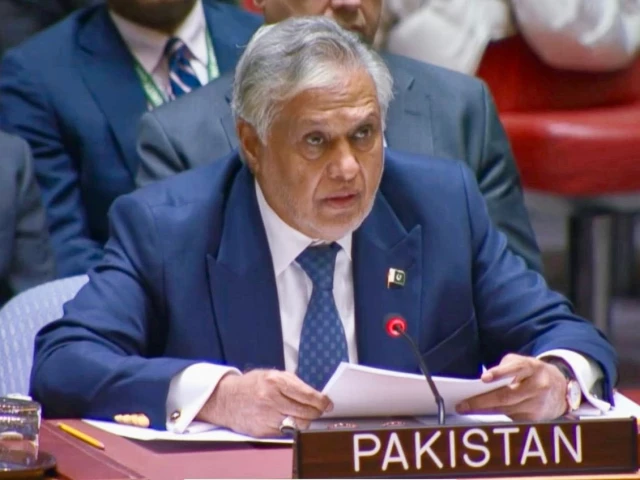
Deputy Prime Minister and Foreign Minister Ishaq Dar will travel to Jeddah on Wednesday to participate in an emergency meeting of the Organisation of Islamic Cooperation (OIC) Executive Committee to discuss the situation in the Middle East and Israel's actions in Palestine.
The meeting, scheduled for February 26, will take place at the OIC General Secretariat and will be held at the Foreign Ministers' level.
According to diplomatic sources, the meeting comes in response to recent developments in the Middle East and Palestinian territories. It is expected that the session will strongly condemn Israel's recent actions to declare lands in the occupied West Bank as illegal Israeli property.
Sources indicate that the Muslim countries will collectively denounce Israel's legal, political, and demographic changes in the occupied Palestinian areas.
Dar is expected to deliver a strong condemnation of Israel's unlawful decisions and policies on behalf of Pakistan, while participating nations will discuss a coordinated strategy to oppose Israeli measures.
During his visit, Dar is also anticipated to meet with Saudi FM Faisal bin Farhan Al Saud, along with other key leaders attending the meeting.
Also Read: Israeli minister says army will occupy all Gaza if Hamas does not disarm
Israel's atrocities in Palestine have been escalating at an alarming rate in recent years, with the situation worsening day by day. The continued expansion of illegal settlements in the occupied West Bank, the destruction of Palestinian homes, and the relentless displacement of families have become a daily reality for many Palestinians.
These actions, which are widely condemned as violations of international law, have exacerbated the humanitarian crisis and continue to fuel instability in the region, leaving Palestinians with little hope for peace or justice.
Last week, Israel's cabinet approved further measures to tighten Israel's control over the occupied West Bank and make it easier for settlers to buy land, a move Palestinians called a "de-facto annexation".
The West Bank is among the territories that Palestinians seek for a future independent state. Much of it is under Israeli military control, with limited Palestinian self-rule in some areas run by the Western-backed Palestinian Authority.
Read More: Israel moves to tighten West Bank control
In response, the foreign ministers of Brazil, France, Spain, Turkey and various other states condemned Israeli decisions.
"Changes are wide-ranging, reclassifying Palestinian land as so-called Israeli ‘state land’, accelerating illegal settlement activity, and further entrenching Israeli administration," said the joint statement, issued late by the Turkish Foreign Ministry.
Mirroring the same aggressive stance and intentions, Israeli Prime Minister Netanyahu during a Cabinet meeting on Sunday ahead of Indian Prime Minister Narendra Modi's visit to Tel Aviv, said that Israel “will create an entire system — essentially a kind of hexagon of alliances — around or within the Middle East”.
Modi will arrive on Wednesday and deliver a speech before the Knesset, or Israeli parliament. Netanyahu listed India, Greece, the Greek Cypriot Administration and unnamed Arab, African and Asian countries as members of the proposed alliance.
Read More: US envoy says Israel could take ‘entire Middle East’
The aim is “to create an axis of countries that see reality, the challenges, and the goals in the same way, in contrast to the radical axes", he said. “Both the radical Shia axis, which we have hit very hard, and also the emerging axis — the radical Sunni axis.”
In response, the Senate unanimously passed a resolution today strongly condemning and rejecting Netanyahu’s remarks and expressing concern over what it described as provocative narratives that threaten the unity of the Muslim Ummah.
The Senate strongly criticised any attempts to alter the legal or historical status of occupied Palestinian territories, including holy sites, and condemned Israel’s settlement expansion and the displacement of Palestinians.












This material may not be published, broadcast, rewritten, redistributed or derived from. Unless otherwise stated, all content is copyrighted © 2026 The Express Tribune.







COMMENTS (1)
Comments are moderated and generally will be posted if they are on-topic and not abusive.
For more information, please see our Comments FAQ