Nationwide heatwave warning issued
Updated 7 hours ago

4,000 unregistered coaching centres are operating across the province
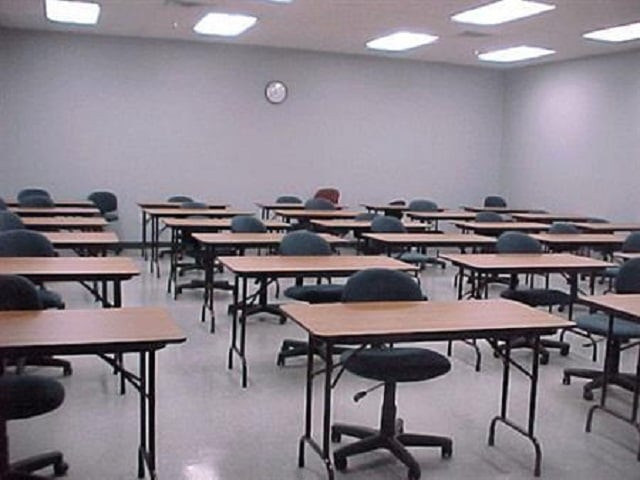
Punjab’s education system is increasingly being taken over by the private sector, as government policies falter and public institutions are pushed toward privatization. In recent years, academies have become essential for matric and intermediate exam preparation, fostering a marks-driven culture and leaving students heavily reliant on what is now a sprawling coaching cartel.
The rising number of tuition centres is alarming educationists and parents alike. Poor teaching quality in government schools, heavy curricular loads, and the perception of marks as the only measure of success have made private coaching almost essential, especially for struggling students. Many parents fear that without tuition, their children will fall behind in the competitive academic race, driving the rapid expansion of coaching centres across both urban and semi-urban areas.
Students interviewed confirmed the trend. Hussain Khalid, a student attending a private academy, informed that professors in government colleges did not provide sufficient instruction or guidance, leaving students no choice but to seek private coaching. Another student, Zafir Mushaq, revealed that he was officially enrolled in a government college but relied entirely on a coaching centre since he could not afford better quality education offered at private institutions.
The mental toll of this double academic burden is significant. Continuous study from morning to evening leaves little time for sports, creative activities, or leisure. Psychologist, Professor Dr Shahzad Tahir warned that excessive academic pressure at a young age could cause irritability, loss of confidence, and aversion to learning. “Tuition centres are placing a heavy financial burden on families, particularly middle- and low-income households, worsening social inequality. Education is increasingly seen as a costly commodity rather than a fundamental right,” implored Dr Tahir.
According to data from the Education Department, Punjab has 205 government colleges and over 9,000 schools, including 8,081 high schools and around 900 higher secondary schools. In comparison, the province has more than 570 registered private coaching centres and academies, including nearly 120 in Lahore. Unregistered centres are estimated to exceed 4,000 across the province, with over 1,000 operating in Lahore alone.
The government has taken limited steps to curb the trend. Teachers in government schools and colleges are prohibited from running tuition during official hours, and district authorities are working to shut down unregistered centres. Despite this, the private sector continues to expand, as parents prioritize securing high marks over the quality of formal education. Experts argue that weak enforcement and a lack of long-term planning have allowed coaching centres to thrive.
Punjab Teachers’ Union Secretary Rana Liaqat Ali Khan criticized the government for promoting privatization, arguing that declining standards in public schools were pushing students toward private coaching. Educationist, Professor Asif Tanveer opined that the popularity of coaching centres reflected both economic uncertainty and a societal focus on exam results rather than learning. “Many centers offer “guaranteed marks” packages, some promising 90 to 98 per cent scores, and promotions such as sibling discounts or buy-one-get-one deals to attract students,” explained Tanveer.
While the Education Department seeks to enforce regulations, the combination of parental pressure, exam-focused culture, and inadequate public schooling has allowed coaching centers to establish a near-monopoly over academic preparation. Unless the government strengthens public education, invests in teacher training, and enforces stricter oversight of private centers, tuition-driven learning will remain the dominant model in Punjab, widening inequalities and shaping a generation dependent on spoon-fed crash courses.
Experts warned that the unchecked growth of coaching centres undermined public education. “If the government does not regulate this sector, the formal education systemmay eventually stagnate, leaving students dependent on private centres for years. Many students are forced to compromise on extracurricular activities, creativity, and physical health in order to cope with the intense coaching schedules,” noted Professor Tanveer.















This material may not be published, broadcast, rewritten, redistributed or derived from. Unless otherwise stated, all content is copyrighted © 2026 The Express Tribune.







COMMENTS
Comments are moderated and generally will be posted if they are on-topic and not abusive.
For more information, please see our Comments FAQ