Zardari greets South Africa on National Day
Updated 8 hours ago

Parliament discusses security situation
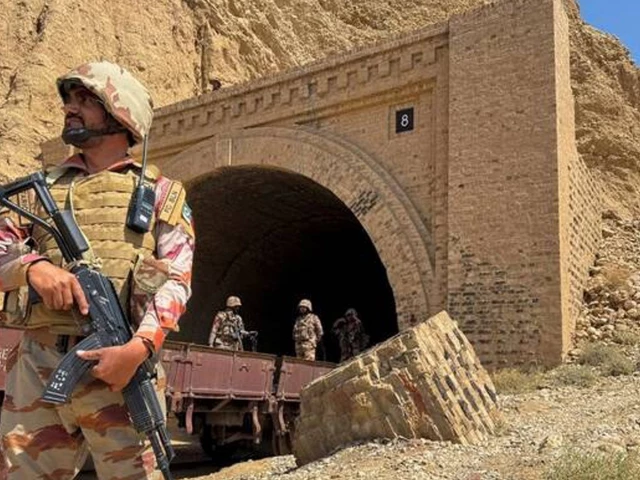
Lawmakers in both the National Assembly and the Senate adopted a firm and uncompromising stand on the escalating security crisis in Balochistan on Monday, following a wave of coordinated attacks across the province that killed dozens of civilians and security personnel.
During the debate in the National Assembly, that highlighted a rare consensus on the need for national unity, Defence Minister Khawaja Asif urged large-scale troop deployment to cover Balochistan's vast terrain, stressing that combating terrorism was a national responsibility.
National Assembly Opposition leader Mahmood Khan Achakzai and Senate Opposition Leader Raja Nasir Abbas acknowledged the scale of the terrorist threat but linked it to past policy failures. They stressed political maturity, accountability, and respect for constitutional rights.
The recent wave of deadly attacks in Balochistan sparked a wide-ranging debate in both the houses, which saw a rare consensus across political lines on the seriousness of the threat, even as differences over policy approaches and accountability emerged.
Khawaja Asif told the National Assembly that Pakistan faced a serious security challenge in Balochistan due to its vast geography, noting that large-scale troop deployment was necessary to ensure the province's stability.
He said security forces had killed over 177 terrorists over the past few days, while 17 security personnel and 33 civilians were martyred. He said Indian-backed groups, operating through the banned Baloch Liberation Army (BLA), had orchestrated the attacks to destabilise the province.
"The fight against terrorism is not the responsibility of any single institution or the government alone, instead it is a struggle of the entire nation," Asif told the house, urging political parties to support the armed forces and avoid politicising the funerals of martyrs.
He rejected any narrative portraying violence as a legitimate struggle for autonomy, calling such claims a cover for criminal activity. He also highlighted development initiatives in the province, asserting that the government's efforts were being overshadowed by narratives of deprivation.
Achakzai, the opposition leader, acknowledged the scale of the threat but linked it to historical policy failures, particularly Pakistan's involvement in Afghanistan. He questioned intelligence lapses that allowed attackers to operate across multiple districts.
Achakzai emphasised that sustainable peace required political dialogue, constitutional safeguards, and equal rights for all provinces, including Balochistan. His views were echoed by Pakistan Tehreek-e-Insaf (PTI) Chairman Barrister Gohar Ali Khan.
Describing attacks in Balochistan as attacks on the whole nation, Barrister Gohar urged the government to adopt a comprehensive counter-terrorism framework and take the provincial governments into confidence. "The blood of martyrs will not go in vain."
Other lawmakers, including former prime minister Raja Pervez Ashraf of the Pakistan Peoples Party (PPP) and former speaker Asad Qaiser of the PTI, stressed the need for parliamentary oversight of the security policy, transparency in counter-terrorism measures, and national unity.
Ashraf recalled the devastating Quetta attacks in previous years, urging political restraint and practical solutions rather than blame games. He cited past initiatives 'Aaghaz-e-Huqooq-e-Balochistan' and called for renewed focus on addressing local grievances to restore public trust.
Senate resolution
In the Senate, the debate echoed the NA's concerns. Special Assistant to Prime Minister Rana Sanaullah said terrorists responsible for the attacks were acting on instructions from hostile foreign elements and had no political mandate.
He highlighted the brutal nature of the attacks on buses, trains, and residential areas, rejecting claims that terrorists were merely aggrieved groups. He recalled Pakistan's unity following the Army Public School attack, calling for a similar collective stance against terrorism.
Earlier, Opposition Leader Abbas said that justice was essential for peace and called for peaceful protests on February 8. He demanded the release of the PTI founder, citing his illness and lack of access to his personal doctor.
Later, the Senate unanimously passed a resolution condemning the Balochistan attacks, expressing solidarity with victims' families, and paying tribute to the sacrifices of law-enforcement personnel.
Moved by Law Minister Azam Nazeer Tarar, the resolution reaffirmed commitment to peace, development, and constitutional rights, while demanding that terrorists, facilitators, and their local and international backers be brought to justice.
It also called for strengthened intelligence coordination, enhanced border security, and improved counter-terrorism systems, with a particular focus on Balochistan.
The National Assembly adjourned its session with the commitment to continue discussions on security, development, and governance in Balochistan, while the Senate scheduled further debates to ensure comprehensive oversight of ongoing operations and policy responses.




This material may not be published, broadcast, rewritten, redistributed or derived from. Unless otherwise stated, all content is copyrighted © 2026 The Express Tribune.












COMMENTS
Comments are moderated and generally will be posted if they are on-topic and not abusive.
For more information, please see our Comments FAQ