Forces kill terrorists' ringleader in Bannu
Updated 15 minutes ago

Sanaullah calls on parties to unite against militancy; Senate passes resolution condemning Balochistan attacks
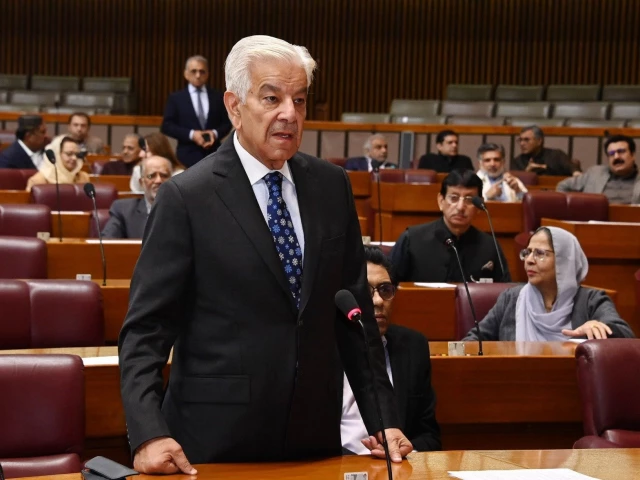
Defence Minister Khawaja Asif said on Monday that Pakistan needed to deploy large numbers of troops in Balochistan because of the province’s vast geography amid the serious security situation and recent spate of attacks.
The statement comes after a series of coordinated attacks at multiple locations in Balochistan that occurred a day earlier. According to the Inter-Services Public Relations (ISPR), 92 terrorists were killed as security forces repelled the attacks across the province on Saturday, while 15 security personnel were also martyred in combat.
“Terrorists of Indian-sponsored Fitna al-Hindustan attempted to disturb the peace of Balochistan by conducting multiple terrorist activities around Quetta, Mastung, Nushki, Dalbandin, Kharan, Panjgur, Tump, Gwadar and Pasni,” the ISPR said in a statement on Saturday. Security sources said today that 22 more terrorists were killed during overnight follow-up actions with the latest casualties bringing the total number of terrorists killed in operations over the past three days to at least 177.
Speaking in the National Assembly (NA) on the matter, Asif said: "Balochistan constitutes over 40% of Pakistan geographically ... to control it is much difficult than a populated city or area and it needs deployment of massive forces. Our troops are deployed there and are in action against them (terrorists) but they are physically handicapped by guarding and patrolling such a big area."
The defence minister said the government tightened enforcement to curb smuggling, triggering a major protest at the Chaman border. He said some people argue the state should negotiate with nationalist movements, but claimed the protest movement was driven by commercial interests rather than politics or nationalism.
بلوچستان میں 177 دہشت گردوں کو جہنم واصل کیا گیا ہے، خواجہ محمد آصف#Balochistan #CounterTerrorism #KhawajaAsif #PakistanSecurity #AntiTerrorism #LawAndOrder #PakistanArmy #PakistanNews pic.twitter.com/zmWgfA0eq3
— APP (@appcsocialmedia) February 2, 2026
Asif alleged smugglers were previously earning up to Rs4 billion a day from oil smuggling, and said the agitation was aimed at recouping business losses.
He also alleged criminal groups were operating under the banner of the banned Baloch Liberation Army terrorist group and providing protection to smugglers, saying: “In Balochistan, tribal elders, the bureaucracy and those running separatist movements have formed a nexus.”
Asif said 177 terrorists had been killed in the last two days, while 16 security personnel and 33 civilians were killed.
The defence minister urged politicians to unite behind the Pakistan Army in the fight against terrorism, saying “we should set aside our differences and we all will have to be one on this issue.”
He also criticised political point-scoring around victims’ funerals, saying: “It cannot happen that we go to offer funeral prayers for martyrs and someone does not attend the funerals for political interests. We will absolutely not allow this.”
The efence minister said the state would not allow anyone to justify violence by framing it as a freedom struggle, calling such arguments a cover for criminal activity.
“Pakistan’s state narrative is that nobody in Pakistan will be allowed to rationalise violence,” Asif said. “When you try to rationalise violence — that this is a freedom movement — then it’s not acceptable, because it’s not true. It’s a cover to legitimise criminal activities.”
Asif said the government would not hold negotiations with those it considers terrorists, and vowed a forceful response to violence.
“I want to assure that there will be no negotiations with these people,” he said. “The way terrorists are using brutal force, we will answer them with the same force.
Turning to development and governance, Asif cited what he described as expanded public services in the province. He said Balochistan had 15,096 schools, 13 cadet colleges and 13 major hospitals, while arguing that a narrative of deprivation was being built around the province.
He said Balochistan’s National Finance Commission (NFC) Award share stood at Rs933 billion, and alleged that smuggled Iranian oil was openly sold, including at fuel pumps in central Quetta.
حکومت اسمگلنگ کی روک تھام کے لیے سخت اقدامات کر رہی ہے، خواجہ محمد آصف#Smuggling #AntiSmuggling #KhawajaAsif #PakistanGovernment #LawEnforcement #EconomicStability #PakistanEconomy #PakistanNews pic.twitter.com/eBdIaDen6g
— APP (@appcsocialmedia) February 2, 2026
He blamed the tribal chief system for looting the province’s resources and obstructing development, calling corruption “a termite” present in Balochistan, other provinces and the federal government. He said tackling corruption required national unity.
Asif said Balochistan had more airports than any other province and that non-operational facilities were being made functional. He also made claims about the missing persons issue, alleging that some people listed as missing were living outside the country and that their families were receiving money.
He questioned the source of weapons used by terrorists, saying: “Those fighting in Balochistan have weapons that even the security forces do not have. Can anyone tell where such advanced weapons are coming from?”
He added: “These terrorists have weapons worth $20,000. Someone should tell us who is supplying them weapons. They have American weapons.”
Referring to an incident involving the Jaffar Express, Asif said labourers had been killed and questioned the justification for attacking civilians. “Killing innocent people — what narrative is that?” he said.
Speaking to reporters in his hometown of Sialkot a day ago, Asif had said Pakistan’s findings showed that “all the linkages point towards India” in the recent attacks across Balochistan that were claimed by the BLA.
He said the BLA “is an internationally recognised terrorist organisation and banned internationally”, adding that it seeks to maintain its visibility “to get foreign funding by India”. He said the group had carried out attacks on civilians, including kidnappings of civilians and government employees.
Achakzai links terrorism challenge to past policy
Meanwhile, Leader of the Opposition in the NA Mahmood Khan Achakzai's speech was paused on YouTube, while the audio was also cut in the press lounge. Opposition lawmakers staged a protest and sought a ruling from the speaker that the speech be shown live.
Achakzai said he did not object if his speech was not shown, but insisted he needed to speak for the record. He said he was not a supporter of terrorism “in any form”, but questioned how attackers were able to operate and why the response was delayed.
“Tell me, there have been hundreds of attacks, they came and carried out attacks in place after place,” he said. “Why didn’t our security forces know that such a big attack was being planned?”
The opposition leader further questioned intelligence failures and said accountability was necessary. “How did people come and roam around in 15 districts?” he said. “If there was an intentional lapse, then a very big injustice was done.”
Achakzai also linked Pakistan’s terrorism challenge to past policy choices, raising questions about the country’s role in the Afghan conflict and the long-term impact of armed mobilisation. “We are fed up with terrorism today — didn’t we bring this terrorism by joining hands with America?” he said, referring to the United States. “Didn’t we train the Taliban?”
He said Ziaul Haq had described fighters in Afghanistan as “freedom fighters”, and argued that the “Kalashnikov culture” spread after the Afghan jihad.
Achakzai also called for access to Pakistan Tehreek-e-Insaaf (PTI) founder Imran Khan by his personal physicians, urging authorities to allow medical examination by independent doctors. “Send two doctors so they can examine Imran Khan,” he said.
He said he would write to Prime Minister Shehbaz Sharif asking that the detained PTI founder’s personal doctors be allowed to check him. “If a prisoner’s doctors examine him, what catastrophe will happen?” he said.
قومی اسمبلی کے اجلاس میں وزیرِ مملکت چوہدری ارمغان سبحانی کی والدہ مرحومہ، صدر آزاد جموں و کشمیر بیرسٹر سلطان محمود چوہدری مرحوم، رکن قومی اسمبلی ریاض فتیانہ کے سسر مرحوم، رکن قومی اسمبلی صوفیہ سعید شاہ کی ہمشیرہ مرحومہ، سابق رکن قومی اسمبلی محمد شاہ کھگہ مرحوم، ڈیرہ اسماعیل خان… pic.twitter.com/lkWhdQCTH7
— National Assembly 🇵🇰 (@NAofPakistan) February 2, 2026
Attack on Balochistan is an attack on all Pakistan: Gohar
PTI Chairman Barrister Gohar Ali Khan said an attack in Balochistan should be treated as an attack on the whole of Pakistan, as he called for political unity against militancy and urged an updated counter-terror framework.
“We are with the martyrs. Pakistan will fight until the elimination of the last terrorist,” he said. “Without any ifs or buts, there is no room for terrorism.”
He said authorities must act wherever terrorists are present. “Wherever the terrorist is, we will keep fighting him,” he said.
Gohar called on the government to take provincial administrations into confidence while pursuing counter-terror measures. He also urged a fresh review of the National Action Plan, saying it should be updated to meet current requirements.
He also raised concerns about the health and access of PTI’s jailed founder, Imran Khan, claiming he was brought to Pakistan Institute of Medical Sciences (PIMS) but that his family was not informed.
Gohar said government ministers issued contradictory accounts. “One minister was saying the founder was not brought to PIMS at all,” he said. “Another minister said the founder was brought to PIMS but taken back after 20 minutes.”
Senate passes resolution condemning terrorist attacks in Balochistan
Meanwhile, the Senate unanimously passed a resolution condemning recent terrorist attacks in Balochistan, offering condolences to victims’ families and wishing the injured a speedy recovery.
Moved by Law Minister Azam Nazeer Tarar, the resolution paid tribute to the “courage and sacrifices” of the security forces and law-enforcement agencies, saying they continue to lay down their lives in the line of duty to protect citizens and defend the country.
It also reaffirmed a commitment to “peace, development, and political inclusion in Balochistan”, recognising that sustainable security was tied to socio-economic progress, good governance and respect for constitutional rights.
The resolution stated “terrorism shall not be allowed to succeed”, and stressed that the unity of the state and the will of the people would prevail over violence and extremism.
It urged the government to ensure a “transparent, swift, and conclusive investigation” and to bring “perpetrators, facilitators, and local and international sponsors of terrorism to justice in accordance with law”.
The Senate also called on federal and provincial authorities to strengthen intelligence coordination, border security and counter-terrorism mechanisms, with a special focus on Balochistan.
Rana Sanaullah urges unified national stance
Special Assistant to the Prime Minister on Political Affairs Rana Sanaullah told the Senate that perpetrators of recent attacks in Balochistan were “enemies of Pakistan” acting on the directives of “anti-Pakistan elements”.
Responding to points raised by Leader of the Opposition in the Senate Allama Raja Nasir Abbas, Sanaullah said around 177 “terrorists” had been eliminated, while 17 law-enforcement personnel and 33 civilians had been killed in the recent wave of violence.
Providing details, Sanaullah said 10 of the 17 killed law-enforcement personnel were police, six were from the Frontier Corps and one was from the Levies. He said civilians were killed after terrorists stormed homes and residential areas. He added that such elements could not be portrayed as “angry” or aggrieved groups.
Sanaullah said small armed groups could carry out attacks even in relatively secure areas, but argued the pattern in Balochistan reflected organised militancy rather than isolated crime. He said terrorists had repeatedly stopped buses, checked passengers’ identity cards and executed people in front of their families, including women and children.
Prime Minister's Advisor on Political Affairs Senator Rana Sanaullah has reiterated the government's unwavering commitment to wiping out terrorism@RanaSanaullahPK @SenatePakistan #RadioPakistan #News https://t.co/Lr2TCrgz0Y pic.twitter.com/2SCJcD7a7P
— Radio Pakistan (@RadioPakistan) February 2, 2026
He said similar brutality had been seen in attacks on trains, including the Jaffar Express, where passengers were taken hostage, humiliated and then killed. “These are acts of extreme savagery that no sane human being can justify,” Sanaullah said, rejecting the narrative that the attackers were merely “disgruntled”.
The premier's aide said that after recent operations, bodies of killed terrorists were forcibly taken from hospitals in Quetta, which he said raised questions about the motives of those claiming to speak for “rights”.
Sanaullah said security forces had foiled attempts to breach Quetta Red Zone and had neutralised terrorists wherever they tried to operate. He recalled the Army Public School Peshawar tragedy and said the country had united under then prime minister Nawaz Sharif, leading to operations that pushed terrorism “close to zero”.
He rejected linking militancy to political demands such as elections, saying the attackers had no public mandate, no political agenda and no belief in democracy. He urged political parties to adopt a unified national stance against militancy, support law-enforcement agencies and the armed forces, and honour the sacrifices of those killed and their families.
TTAP condemns terrorism in Balochistan
Earlier in the day, opposition coalition Tehreek-e-Tahaffuz-e-Ain Pakistan (TTAP) also condemned terrorism in Balochistan and expressed grief over the deaths of security personnel and civilians, calling the violence a sign of deepening insecurity in the province.
In a statement on X, the TTAP offered condolences to families of those killed, saying it stood in solidarity with both security forces and civilians affected by the attack. It said the scale of violence amounted to a complete failure of the provincial government and law enforcement agencies.
“It shows how limited the writ of law has become in the province and that citizens’ lives and property have no protection,” the statement said.
تحریک تحفظِ آئین پاکستان کا بلوچستان میں دہشت گردی کی مذمت اور غم و رنج کا اظہار۔
— Tehreek-e-Tahafuz-e-Ayin-e-Pakistan (@TTAP_OFFICIAL) February 2, 2026
تحریک تحفظِ آئین پاکستان سیکیورٹی فورسز اور سویلینز کی شہادتوں پر اُن سے اِظہار ہمدردی کرتی ہے۔
بلوچستان میں اتنے بڑے پیمانہ پر دہشت گردی کا ہونا صوبائی حکومت اور لاء انفورسمنٹ کی مکمل ناکامی ہے۔… pic.twitter.com/CwdijaYRzi
TTAP also criticised the provincial administration, saying: “How long will we keep turning a blind eye to the fact that a Balochistan government lacking public support is only concerned with prolonging its rule, not with people’s lives.”
It said terrorism could only be confronted by a government and system whose “moral standing” was not in question. The statement added: “Then they say free and fair elections and representative governments are the solution — not rulers and systems imposed against the will of the people.”






This material may not be published, broadcast, rewritten, redistributed or derived from. Unless otherwise stated, all content is copyrighted © 2026 The Express Tribune.




COMMENTS (2)
Comments are moderated and generally will be posted if they are on-topic and not abusive.
For more information, please see our Comments FAQ