The Governor General and the numbered abuses
Updated 6 hours ago

Can CPEC reach Afghanistan if borders stay shut?

The prolonged closure of the Pakistan-Afghanistan border since October 11 is no longer just a security or diplomatic issue; it has evolved into a full-blown economic and humanitarian crisis for Khyber-Pakhtunkhwa as well as for those affected across the border.
Moreover, it has entailed reputational repercussions for Pakistan's commitment to multilateral trade mechanisms, placing the country in a paradoxical bind. Let us examine the economic cost specific to K-P.
The daily formal cross-border commercial activity via K-P — once estimated at $50-60 million — is almost frozen, although smuggling is thriving unchecked. Border town economies in K-P, which depend heavily on trade-linked services, have witnessed a sharp rise in unemployment, particularly among workers in transport, warehousing, freight handling and other allied services, as business turnover has collapsed.
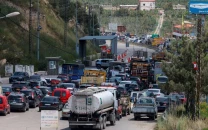
Nearly ten thousand small cargo and passenger vehicles remain stranded in the border towns of Torkham, Ghulam Khan and Kharlachi. Over 20,000 daily wage workers, vendors and shopkeepers have lost their livelihoods. Thousands of trucks involved in bilateral and transit trade between Karachi and the border are idle. Many vehicles carrying goods and equipment remain stranded at border crossings — a clear sign of the scale of disruption to cargo flows and supply chains.
Regarding sector-specific shocks, cement, sugar, wheat flour, edible oil and fresh produce exports - including perishable fruits and vegetables such as kinnows and potatoes - have faced significant disruption. This has caused spoilage and income losses for growers and factories in K-P, resulting in cumulative losses in the hundreds of millions of dollars.
The resultant contraction in industrial output and the cumulative losses worth millions of dollars in export revenues have caused widespread unemployment among daily wage and service workers, setbacks in agricultural exports and rising production costs for industry due to interrupted imports of essential inputs.
The suspension of bilateral trade and transit cargo has choked the province's commercial lifelines, leaving traders unable to receive payments for goods already exported and pushing many into a severe liquidity crunch. This has disrupted their ability to pay taxes and dues, slowed market activity and triggered knock-on effects across transport, logistics, warehousing and border services - sectors that employ tens of thousands.
Beyond the millions of dollars that the FBR has lost in customs tariffs, the province's Infrastructure Development Cess (IDC) has also taken a devastating hit. The IDC collection fell from Rs7.42 billion during July-January of the previous fiscal year to just Rs3.48 billion in the same period this year - a direct loss of Rs3.94 billion in only seven months. The collapse of the IDC by nearly 80 per cent is monumental for a province that is already struggling, facing a cash shortage and fighting to receive its due share from the Center.
However, the real damage extends far beyond government accounts. While the list of financial losses runs long, a much greater issue is at stake: the reputational damage to the state's commitment to bilateral and multilateral trade and transit cooperation mechanisms.
Let us first look at Pakistan's commitments to free trans-border trade. Currently, the state is a signatory to four bilateral transit trade agreements – with Afghanistan, Azerbaijan, Tajikistan and Uzbekistan.
Additionally, Pakistan is part of broader multilateral transit-related agreements involving multiple countries, including: a) Quadrilateral Traffic in Transit Agreement (QTTA) signed by Pakistan, China, Kazakhstan and Kyrgyzstan to facilitate transit trade among them; b) Ashgabat Agreement which is a multimodal transport and transit corridor agreement involving Kazakhstan, Uzbekistan, Turkmenistan, Iran, India, Pakistan and Oman.
These agreements underscore the strategic importance of Pakistan and the eagerness of partner countries to route their imports and exports via Pakistan, utilising the shortest access to the Arabian Sea ports of Karachi or Gwadar.
However, the current situation contradicts the goals and spirit of these partnerships.
Ironically, nothing explains this paradox better than a recent briefing to the Senate Standing Committee on Foreign Affairs. As part of Pakistan's foreign policy and strategic ties, the Foreign Secretary informed the committee that Pakistan and China are preparing to extend the China Pakistan Economic Corridor (CPEC) to Afghanistan. They are working to revive a broader Pakistan China Afghanistan cooperation framework to boost infrastructure and economic links with Afghanistan through CPEC, which could open new avenues for trade and regional integration.
Extending CPEC to Afghanistan is undisputedly beneficial for all — a noble goal. But does it align with current ground realities? Four border closures in 2025, including the current one, hardly lend credence to plans for linking China with Afghanistan via Pakistan. Nor will this ambitious plan inspire confidence in Afghanistan or beyond. Uzbekistan's foreign trade via Pakistan already took a massive hit during 2025, triggering worries regarding whether transit trade agreements mean anything at all if they are almost always accompanied by uncertainty. The Afghan government, for its part, wants to insulate border trade operations against the political tensions that have led to several closures in recent years.
In summary, what is unfolding is not just a revenue shortfall but a multi-faceted economic crisis for the border provinces and the central FBR. Pakistan's reputation as a reliable partner in transit trade agreements is on the line. Its credibility as a trustworthy, responsible state committed to trans-border trade is also at stake.












This material may not be published, broadcast, rewritten, redistributed or derived from. Unless otherwise stated, all content is copyrighted © 2026 The Express Tribune.



COMMENTS (1)
Comments are moderated and generally will be posted if they are on-topic and not abusive.
For more information, please see our Comments FAQ