US judge tosses Blake Lively's sexual harassment case against Justin Baldoni
Updated 5 hours ago

Uncertain economic conditions continue to affect many labels following several years of weak sales, notably in China
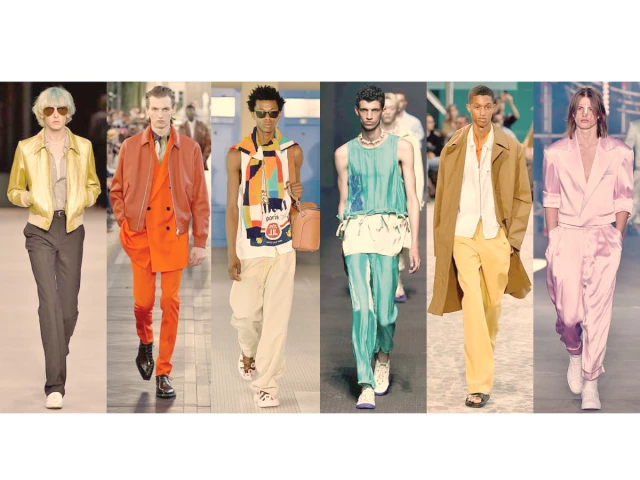
Paris Men's Fashion Week, which wrapped up Sunday, saw designers opt for often pragmatic and timeless styling, reflecting a low-risk approach at an uncertain time for the industry, experts said. After a 2025 marked by sweeping turnover among creative directors and numerous debuts, this Fall/Winter 2026 edition was more measured, in substance as well as in style.
"It's been a fairly conservative season, without any incredible propositions," Matthieu Morge Zucconi, head of men's fashion at France's Le Figaro newspaper, told AFP. "We're in a period where we zero in on what's essential. You can feel it in the shows," added Astrid Faguer, fashion journalist at Les Echos newspaper. Against a backdrop of worrying international news and economic turbulence in the luxury sector, brands are looking to reassure customers rather than risk unsettling them, experts agree.
Suits in force
The classic suit-and-tie duo stood out as one of the strongest markers on the runways.
The overall colour palette was fairly classic: black, gray, beige and brown, with a few brighter touches, like the purple seen from Dior to Vuitton, via Issey Miyake and Etudes Studio.
The extravagant over-sized jackets with large shoulder pads of previous seasons have become more fitted -- still loosely tailored, but more traditional.
"I think that with age and the way my view of the world is evolving now, I wanted to create a silhouette that's ... a bit more fitted," head of Paris-based 3.Paradis, Emeric Tchatchoua, told AFP.
Louis Vuitton chief designer Pharrell Williams wrote that his fairly conventional collection was "designed to endure rather than expire, it is a timeless expression."
For Adrien Communier, head of fashion at GQ magazine in France, the restraint signals a return to basics.
"There's really a phenomenon of creating clothes for the now, that will be able to last and take on everyday life," he observes.
According to him, both the public and designers are no longer looking for one-season pieces which are quickly out-of-date, instead opting for styling that will stand the test of time.
"It's impossible not to see a reference to the international context. I think there's something very responsive and pragmatic in relation to that," he told AFP.
The unstable state of the world has weighed on luxury sales over the last few years, crimping profits at luxury groups which had enjoyed a post-Covid sales bonanza.
'Normality'
It was not all sensible shapes and tasteful tailoring.
Dior designer Jonathan Anderson appeared keener than most to take some risks.
He said he didn't want "normality" as he reimagined modern-day aristocrats for his second men's collection, adding that his designs included some "angst and a kind of wrongness, engulfing wrong taste".
He sent out shirts with checks adorned with rhinestone-fringed epaulettes, while models wore yellow or spiked wigs.
The Bar jacket, a Dior signature item, was redesigned in a shrunken format
A grey cape-coat from Dries van Noten had tiny embedded jewels embedded in a gray cape-coat, while there were faux-fur coats for men at KidSuper and Willy Chavarria.
Embroidery showed up in several shows, while floral prints and patchwork bomber jackets also featured.
Simon Longland, chief fashion buyer for London luxury store Harrod's, also said that the past week had been about designers "offering flexibility, comfort and longevity."
"Broadly, collections felt less driven by trend and more focused on creating pieces with purpose -- clothing intended to be worn, lived in and valued over multiple seasons rather than defined by the moment alone," he said. In order to participate, the houses must fulfill the criteria that are set in place by the Chambre Syndicale de la Haute Couture, such as a requirement of 35 looks per year that need to include day and evening wear. Only a few houses are able to fulfill this requirement; therefore, this leaves few to participate in haute couture fashion shows. Since there are only a few spots left for those to participate, there are the well-known high-end fashion brands like Chanel and Alexander Mcqueen, but also the lesser-known ones like Maxime Simöens and Eymele Burgaud.
The Big 4
Paris Fashion Week is part of the global "Big 4" fashion weeks, the others being London Fashion Week, Milan Fashion Week and New York Fashion Week. The schedule begins with New York, followed by London, and then Milan and ends in Paris. New York was the first city to hold a "fashion week".
Although the first fashion week was held in New York, the event itself derives from "salon shows" ("défilés de mode" in French, literally "fashion parades") in Paris couture salons.








This material may not be published, broadcast, rewritten, redistributed or derived from. Unless otherwise stated, all content is copyrighted © 2026 The Express Tribune.






COMMENTS
Comments are moderated and generally will be posted if they are on-topic and not abusive.
For more information, please see our Comments FAQ