Pakistan denies Afghan policy U-turn
Updated 2 hours ago

Despite their stipulated roles in ensuring fire safety, SBCA and PDMA sprang into action after the incident
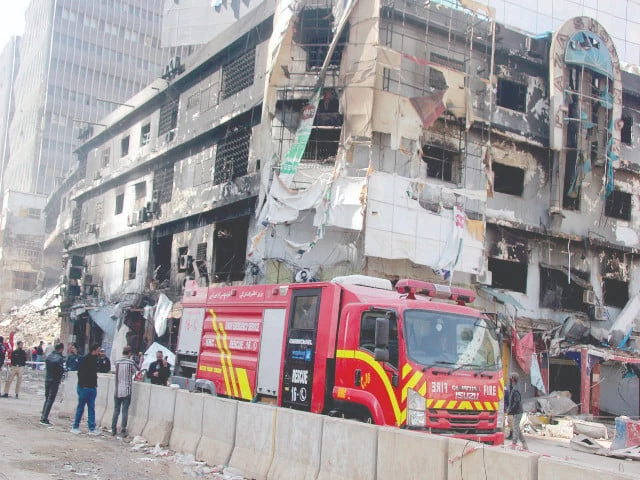
The Gul Plaza tragedy has once again exposed serious failures on part of key government institutions responsible for building safety and disaster response in Karachi. While the Sindh Building Control Authority (SBCA) was required to ensure preventive safety measures before the incident, the Provincial Disaster Management Authority (PDMA) was legally bound to lead coordination and relief efforts afterward.
Yet both institutions failed to discharge their responsibilities in a timely and effective manner. The SBCA only sprang into action after the incident caused heavy loss of life and property, while the PDMA remained largely absent even in the aftermath. The SBCA is responsible for ensuring that all buildings in the city comply with safety requirements, including the installation of fire safety systems and the safe evacuation of occupants during emergencies.
Despite these clear legal obligations, the authority's role effectively began only after the Gul Plaza tragedy had already occurred. SBCA officials became active in the immediate aftermath and launched surveys of various buildings across the city, highlighting a reactive rather than preventive approach. The SBCA initiated action on a list of unsafe buildings submitted by the Karachi Metropolitan Corporation (KMC) in 2024 only after the Gul Plaza incident.
According to this list, KMC conducted fire safety audits of 266 buildings located in District East and District South. Alarmingly, 90 per cent of these buildings were found to lack the required fire safety systems, especially in District East. The audited buildings included 121 located on Tariq Road, 77 on Shahrah-e-Faisal, 45 on I.I. Chundrigar Road, and 23 on Shahrah-e-Qaideen, underscoring the scale of regulatory neglect in some of the city's busiest commercial corridors.
In contrast to the SBCA's delayed response, PDMA Sindh was expected to immediately initiate relief operations following the tragedy and coordinate among government departments involved in rescue and emergency response. However, no visible role was played by the authority in the days following the incident.
Under the PDMA Sindh Act approved in 2014, the authority was obligated to step in after the Gul Plaza incident to ensure effective relief operations. A journalist who rigorously covered the tragedy revealed that no PDMA representative was seen at the site even four to five days after the incident. Efforts by The Express Tribune to seek clarification from PDMA Sindh chief Syed Salman Shah via WhatsApp also went unanswered.
Urban planner Zahid Farooq, associated with the Urban Resource Centre, stated that in incidents like Gul Plaza, the PDMA should work closely with other government institutions, but its absence in this case reflected a serious institutional failure.
"The SBCA's work should be monitored through a committee comprising members of the provincial assembly. The authority should include representation from institutions such as KMC and Karachi Police, and an additional monitoring body with a majority of civilian members, including engineers from the construction sector and representatives of non-governmental organizations. This could help improve transparency and accountability," said Farooq.
Associate Professor at Habib University and urban planner, Farhan Anwar, pointed out that the core issue was not the lack of policies or their legal strength, but rather weak and flawed implementation. "Laws and regulations governing fire safety protocols in buildings are relatively robust, yet ineffective enforcement and the failure to curb violations continue to undermine public safety, revealing clear shortcomings in SBCA's performance," noted Anwar.
"The Gul plaza tragedy also highlights the country's fragile emergency response system. Firefighting capacity, paramedical services, and first responders all suffer from systemic weaknesses. In the absence of a comprehensive and effective emergency action plan or contingency response framework, institutions that should be immediately mobilized in such crises fail to deliver a coordinated and timely response," said Anwar.










This material may not be published, broadcast, rewritten, redistributed or derived from. Unless otherwise stated, all content is copyrighted © 2026 The Express Tribune.







COMMENTS
Comments are moderated and generally will be posted if they are on-topic and not abusive.
For more information, please see our Comments FAQ