Govt to introduce single-point checking system at airports to cut delays
Updated 2 hours ago

President urges provincial consultation on Daanish Schools, calls domestic violence bill vague
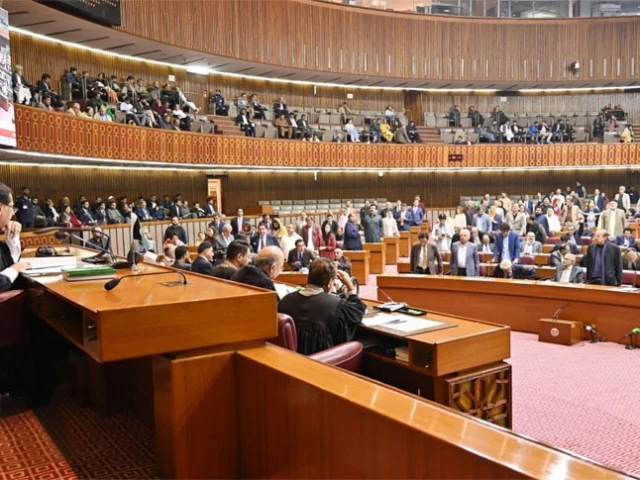
The joint sitting of Parliament on Thursday passed multiple bills despite presidential objections, opposition protests and sloganeering in the House, in proceedings chaired by National Assembly Speaker Ayaz Sadiq.
During the sitting, President Asif Ali Zardari's objections were raised on the Daanish Schools Authority Bill and the Domestic Violence Prevention and Protection Bill, with lawmakers from the opposition insisting that the advice should not be brushed aside.
On the Daanish Schools bill, the President objected that, “The federal government should consult the provinces before establishing the Daanish Schools Authority”.
On the domestic violence bill, the President’s objections included the assessment that “The domestic violence bill is vague,” along with objections to the proposed punishments. The President advised that “The domestic violence bill should be reconsidered instead of being approved in its present form”.
Daanish Schools bill approved, enacted
The Daanish Schools Authority Bill 2025 was then presented. The Bill sets up a dedicated Daanish Schools Authority as a formal legal body to establish and run Daanish Schools, with the law described as taking effect immediately and applying to the Islamabad Capital Territory (ICT).
The stated intent is to strengthen the administration and delivery of schooling, with priority given to children from low-income households. It shifts Daanish Schools to being handled like a structured authority-led system, with a defined governance setup and an internal mechanism to run operations through an Executive Committee.
Structurally, the Authority is created as a body corporate, meaning it has its own legal identity, perpetual succession, and an official seal, and can enter into contracts and sue or be sued. The Prime Minister is positioned as Chairman, with the relevant federal minister as Vice Chairman.
The framework gives the Authority oversight powers such as approving curriculum and related programmes, inspecting Daanish Schools, and coordinating with other educational institutions, alongside managing its operations through a dedicated Authority Fund.
Jamiat Ulema-e-Islam (JUI) Senator Kamran Murtaza read out the President’s advice in the House and said it was being ignored.
“The President asked for consultation with the provinces on the bills, which is being ignored,” he said, adding that “The federation has encroached upon the limits of the provinces”.
Read: Zardari returns Daanish Schools bill to Shehbaz
The Speaker proceeded with the approval process despite objections, triggering sloganeering by opposition members. Pakistan Tehreek-e-Insaaf (PTI) lawmakers protested in front of the Speaker’s dais, with Barrister Gohar chanting, “terrorist, terrorist, unacceptable”.
Parliament approved the bill and later passed the Daanish Schools Authority Act 2025, establishing a legal authority to administer Daanish Schools in the ICT, with immediate effect and with priority for children from low-income households.
JUI-F chief Maulana Fazlur Rehman also arrived in the House to attend the joint session.
Domestic violence bill moves to approval process
The Domestic Violence Prevention and Protection Bill 2025 was later presented in the joint session for approval, with JUI members again placing the President’s objections on record. “The President’s objections should not be ignored,” Senator Kamran Murtaza said.
The Bill creates a protection system covering domestic violence in the ICT, and broadly defines "aggrieved persons" as women, men, transgender individuals, children and other vulnerable persons.
During the debate, Minister of State Talal Chaudhry said, “Men have also been included for the first time in the domestic violence bill”.
“Poor men never used to be included in such a bill; it’s good that they will also get protection from domestic violence”.
The Bill treats “domestic violence” as physical, emotional/psychological, sexual and economic abuse within a domestic relationship, while also spelling out what counts as emotional/psychological abuse.
On enforcement, the bill routes cases through the family courts, allowing an aggrieved person (or someone authorised) to file a petition, and it sets timelines for early hearings and show-cause notices. Courts can issue interim orders, and then protection/residence orders requiring the respondent to stop violence, avoid contact, keep distance, and in grave cases even move out; the court can also restrain dispossession, restrict entry by the respondent or relatives, require a bond, and direct police to help implement orders.
It adds monetary relief for losses and expenses (including medical costs, loss of earnings, damage to property, maintenance, etc.), allows custody orders where needed, and makes breach of orders an offence punishable by up to one year and a fine of Rs100,000 payable to the aggrieved person. It also establishes a Protection Committee and Protection Officers, outlines their duties, and allows engaging service providers (including shelters/medical/legal support), with rule-making powers given to the federal government
Aalia Kamran said JUI-F chief Maulana Fazlur Rehman wanted to speak on the bill, but the Speaker responded, “I will not allow the member who did not move amendments to speak”.
As amendments were rejected, Senator Kamran Murtaza said, “There was no discussion on the President’s objection; there should be discussion on it,” and argued that, “Through this bill, you are destroying the domestic system”.
PTI members ended their protest and returned to their seats, though a separate protest by two lawmakers continued over the Tirah operation.
House unanimously adopts Gul Plaza resolution
During the sitting, MQM tabled a resolution on the Gul Plaza fire tragedy in Karachi, jointly presented by government and opposition members and carrying signatures from both sides. The House approved it unanimously.
PPP Senator Sherry Rehman said that they had no objection to the bill. She called the Gul Plaza incident serious, and said, “This is not an issue of one city for us, it is an issue of Pakistan,” calling for the federal government to also assist.
The resolution stated that “This House prays for forgiveness for those martyred in Gul Plaza...This House expresses solidarity with the victims of the Gul Plaza fire.” It also demanded improved fire-prevention arrangements and compensation for victims.
During her remarks, Sherry Rehman said, "Pakistan Peoples Party takes full responsibility for Karachi and its citizens”.
"This matter should not be made a political or ethnic issue”.
National Commission for Human Rights
The joint session approved the National Commission for Human Rights (Amendment) Bill 2025, presented by Federal Minister for Parliamentary Affairs Dr Tariq Fazal Chaudhry.
Read more: Ahsan Iqbal defends Pakistan’s decision to join Trump’s Board of Peace
Pakistan Peoples Party (PPP) lawmaker Shazia Marri moved an amendment, which the government supported, while amendments moved by JUI lawmakers Senator Kamran Murtaza and Aalia Kamran were rejected.
The joint session was later adjourned for an indefinite period.







This material may not be published, broadcast, rewritten, redistributed or derived from. Unless otherwise stated, all content is copyrighted © 2026 The Express Tribune.




COMMENTS (1)
Comments are moderated and generally will be posted if they are on-topic and not abusive.
For more information, please see our Comments FAQ