US stock futures fall after rally as Mideast tensions flare
Updated 1 hour ago

Low incomes, high density make rail viable backbone for inclusive mobility
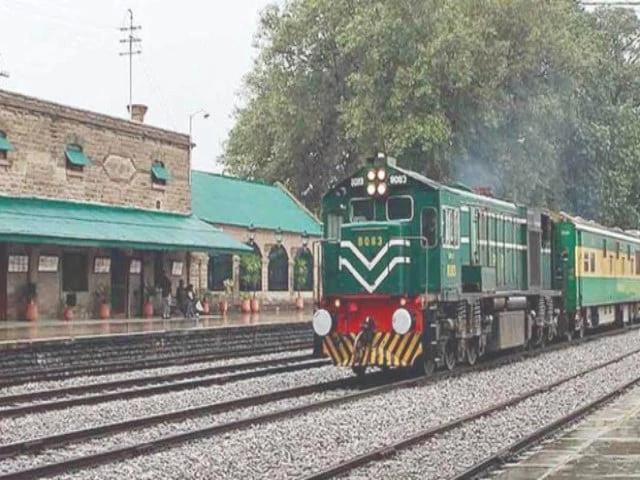
Pakistan has not one but two transport policies. The first, titled National Transport Policy of Pakistan 2018, was prepared by the Planning Commission. The second, the National Freight and Logistics Policy, was issued by the Ministry of Communications in 2020.
The first policy states that it "reflects the government of Pakistan's aim to create a world-class transport sector." The second offers up some more detail, "To drive economic growth and trade in Pakistan by increasing the country's competitiveness through an integrated, seamless, efficient, reliable and cost-effective freight transport and logistics network, leveraging best in class technology, processes and manpower."
These vision statements miss the point. What Pakistan needs is a transport sector that works for its people – all its people, rich and poor. It does not need it to be "world class" or leverage "best-in-class technology".
Reading the policies themselves, one is struck by a strange disconnect: There is a complete absence or discussion of factors critical to the design and implementation of any transport system. These include demographics, population density and distribution, topology – particularly for intercity transport – per capita income, and income distribution.
Transport systems do not exist in a vacuum. There must be a full understanding of the enabling environment. Without this understanding and specific design objectives, what is likely to emerge is an unstructured, inefficient and largely dysfunctional mix of transport modes. And this, sadly, is what has happened in Pakistan.
Of particular concern is the way rail has been marginalised in favour of road transport. Over the years, many impressive multilane intercity highways have been built. Billions of rupees have been spent constructing them, and billions more are spent every year maintaining them.
Yet Pakistan does not publish an official median per capita income figure. Based on global income patterns and Pakistan's GDP per capita – around $1,480 in 2024 and $1,820 in FY25 – the median income is likely in the range of $600 to $1,100 per year. In simple terms, even in a best-case scenario, half of Pakistan's population lives on less than $1,100 annually.
How many of these people can buy a car to make use of our magnificent highways? A cynic would say, "Well, they can always take a bus." And, indeed, this is what they are obliged to do. But here we run into another problem – the issue of cost, and in particular energy cost. Consider the following comparison between rail and road transport: Rail has a massive physics advantage: steel wheels on steel rails result in an extremely low rolling resistance.
A freight train requires less than one-third of the energy per tonne-kilometre compared to a truck. This is due to lower rolling resistance, better aerodynamics per unit of cargo, and the ability to move large volumes in a single consist. The same logic applies to intercity passenger rail, provided trains operate at high occupancy levels. Electrified rail systems (metros, suburban rail) are among the most energy-efficient passenger modes. Passenger buses and cars have higher per-passenger energy use unless operating at very high occupancy.
Rail also trumps road along other dimensions. Rail freight produces less than one-fifth of the greenhouse gas emissions of road freight per tonne-kilometre. Electric passenger rail systems again rank among the most efficient modes in terms of emissions.
Rail transport cost for freight can be higher than road on a per-shipment basis. But this is only the case when volumes are low. At high volumes, rail easily outcompetes road. The same argument applies to passenger transport costs. Operating costs per-passenger kilometre can only be lower when trains run at high occupancy.
Land usage in the case of rail is also much lower than road. The land needed for an up-and-down train track is a fraction of the land needed to build a dual-carriage six-lane highway. Not to mention the damage done to the environment and agriculture when forests and fields are replaced by six-lane highways.
Pakistan possesses all the characteristics that strongly favour rail over road. Almost all major cities and industrial activity lie along the Indus River basin. This basin, from Karachi to Peshawar, constitutes a natural high-density rail corridor, enabling the sort of volumes that make rail a better and cheaper alternative to road.
There is, of course, the issue of capital cost. In general, the cost per kilometre of rail is of the same order as road. Rail can be more expensive depending on other supporting infrastructure, such as stations and bridges that need to be designed to carry very heavy dynamic loads. Pakistan's geography, demographics and economic realities all point clearly in one direction: rail should be the preferred mode of transportation. Yet, for some reason, we seem to have marginalised rail in favour of road transport.
A sensible transport policy would look very different. At the intra-city level, Pakistan's cities are characterised by high population densities and generally low incomes. It is neither practical nor possible for everyone to own a car. Policy should, therefore, prioritise mass transit systems in all major cities. These systems would combine conventional rail, elevated rail, trams and buses. Trains should operate along high-density corridors, with trams and buses branching out to carry passengers to their final destinations.
Such systems would primarily be for people's movement. Freight movement within cities would still have to rely mainly on trucks. And for this purpose, roads should be built to the proper standards. Trucks operating on public roads would have to comply with maximum axle load limits to prevent damage to the roads.
At the intercity level, the logic is even clearer. Given the low-income levels of most of our citizens, the only sensible system that can provide transport to most of our public at a reasonable price is rail. To this end, we need to upgrade, develop and expand our rail networks and systems to cover all major cities. Rail must be the primary mode of transportation between cities for both people and freight. The objective is to provide fast, convenient and frequent services between most urban centres.
The focus on road networks should mainly be on 'farm to market' or 'farm to rail' roads. These should be upgraded and built wherever traffic densities do not justify a rail link. Such roads are critical to our primarily agricultural economy since produce must be moved quickly to minimise loss and wastage.
Pakistan has spent enormous time and money building a road network that ultimately serves only a small minority. It is time now to put the needs of the vast majority – the poor – over the needs of the few.
The writer is chairman of Mustaqbil Pakistan and holds an MBA from Harvard Business School





This material may not be published, broadcast, rewritten, redistributed or derived from. Unless otherwise stated, all content is copyrighted © 2026 The Express Tribune.


COMMENTS (6)
Comments are moderated and generally will be posted if they are on-topic and not abusive.
For more information, please see our Comments FAQ