Endangered vultures rebound in Punjab habitats
Updated 1 hour ago

Court cites cooperative federalism, labour welfare objectives
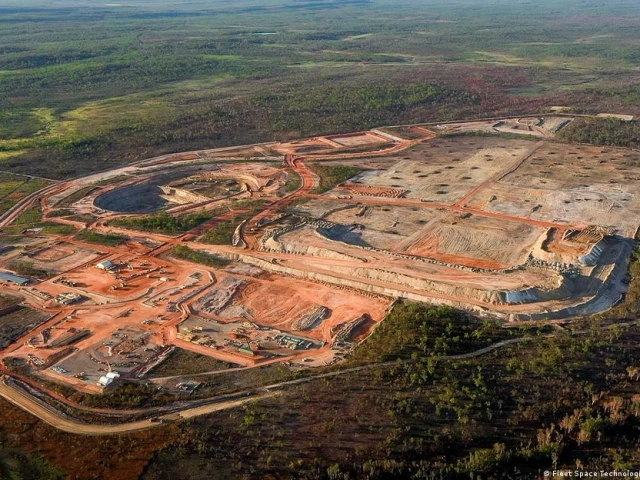
In a ruling with far-reaching implications for provincial fiscal autonomy and cooperative federalism, the Federal Constitutional Court (FCC) has upheld the validity of legislation enacted by the Balochistan Assembly empowering the provincial government to levy excise duty on minerals to fund labour welfare in the mining sector.
The decision settles a constitutional challenge to amendments introduced through the Balochistan Finance Act, 2020, affirming the province's legislative competence to impose the levy and reinforcing the post18th Amendment framework that broadens provincial authority over residual subjects.
A division bench of the FCC, headed by Justice Aamer Farooq, adjudicated the question of whether the Balochistan Assembly had the authority to amend Section 3 of the Excise Duty on Minerals (Labour Welfare) Act, 1967, through Section 7 of the Balochistan Finance Act, 2020.
The petitioner in the case was Attock Cement Pakistan, a cement manufacturer operating in Pakistan with its manufacturing facility located at Hub, Lasbela, Balochistan. In the course of its operations, the company undertakes the mining of raw materials, including limestone, shale and sand, which are essential for cement production.
On January 15, 2021, the petitioner was served with a notice by the Balochistan Mines Labour Welfare Department, requiring payment of excise duty on minerals to the labour welfare commissioner, Balochistan, at rates revised pursuant to the Balochistan Finance Act, 2020.
In response, the petitioner submitted three separate representations to the department seeking revision of the applicable rates; however, each representation was declined. The petitioner subsequently approached the Balochistan High Court, but its plea was rejected.
Before the FCC, the petitioner contended that the imposition of excise duty fell within the exclusive legislative domain of the federation, and that the Balochistan Assembly therefore lacked the authority to amend the 1967 Act, particularly where such amendment altered the rate or nature of excise duty, a matter it argued was beyond provincial legislative competence.
However, the FCC rejected this contention, holding that the Balochistan Finance Act, 2020 must be sustained by applying the settled doctrines of pith and substance and double-aspect legislation, read in light of the constitution's post18th commitment to cooperative federalism.
"The impugned statute neither encroaches upon nor displaces federal legislative authority; rather, it operates within a constitutionally permissible overlap to advance a legitimate provincial objective. Its fiscal mechanism serves as an ancillary means to realise a substantive purpose squarely rooted in labour welfare. To strike down such legislation would be to adopt a rigid and formalistic approach, inconsistent with constitutional design. The Act, therefore, represents a lawful and harmonious exercise of legislative power," the court held in a 14-page judgment authored by Justice Aamer Farooq.
The judgment further observed that courts must exercise restraint and avoid hastily invalidating legislation enacted by the Majlis-e-Shoora or provincial assemblies, noting that such enactments reflect the democratic will and public confidence reposed in elected representatives.
It also stated that the Eighteenth Amendment to the Constitution consciously embraced the ethos of cooperative federalism.
The court noted that under Pakistan's constitutional framework, legislative authority is exercised by provincial assemblies within their respective provinces and by Parliament at the federal level, through duly elected representatives who enjoy public confidence and legitimacy.
Explaining the constitutional evolution, the judgment stated, "Before the enactment of the Constitution (Eighteenth Amendment) Act, 2010, Article 141 of the Constitution conferred law-making powers on these bodies and structured the distribution of legislative competence on a subject-wise basis. The Constitution contained both a Federal Legislative List and a Concurrent Legislative List (comprising forty-seven subjects). The Parliament was authorised to legislate on matters enumerated in both lists, while subjects included in the Concurrent list or were not part of either list (referred to as residual matters), fell within the legislative domain of the Provincial Assemblies."
"Following the enactment of the Constitution (Eighteenth Amendment) Act, 2010, the Concurrent Legislative List contained in the Fourth Schedule of the 1973 Constitution was eliminated, thereby substantially broadening the legislative authority of the Provinces."
Elaborating further, the court held, "With only the Federal Legislative List remaining in the Fourth Schedule, all matters not specifically enumerated therein fell within the exclusive legislative jurisdiction of the Provincial assemblies. Article 142(a) confines the legislative authority of the Federal Legislature to the subjects listed in the Federal Legislative List, whereas Article 142(c) clearly provides that matters not included in that list fall exclusively within provincial jurisdiction and are beyond the scope of federal legislation."
"Any areas in which concurrent legislative powers may still exist are addressed under Article 142(b) of the Constitution of 1973. Thus, all 'residual powers' not assigned to the Federal Legislature rightfully belong to the provinces, forming a constitutional landscape where Provincial autonomy is affirmed. It is, in truth, impossible to delineate every legislative power with such precision that no ambiguity ever arises."
The judgment further observed, "Our courts have repeatedly encountered instances where the boundaries of legislative competence required careful interpretation. Though the Constitution, 1973 strives to draw these lines with clarity, there are moments when discerning whether authority lies with the Federation or the Provinces becomes far from straightforward."












This material may not be published, broadcast, rewritten, redistributed or derived from. Unless otherwise stated, all content is copyrighted © 2026 The Express Tribune.






COMMENTS
Comments are moderated and generally will be posted if they are on-topic and not abusive.
For more information, please see our Comments FAQ