Sanjay Dutt returns as villian in the role of Khalnayak
Updated 7 hours ago

Mexico's Claudia Sheinbaum backs Indigenous art and women's work — one dress at a time
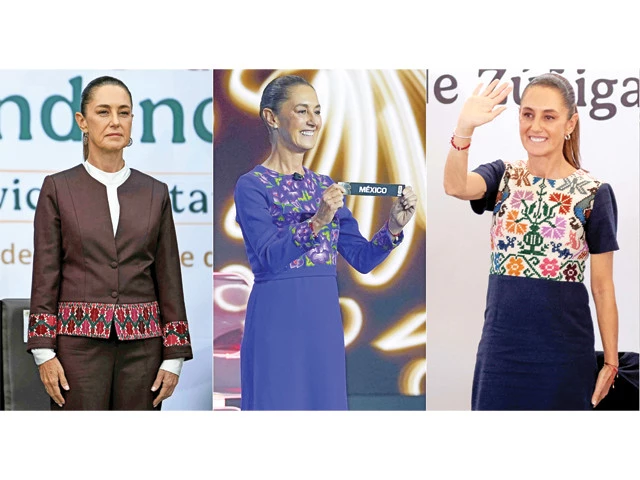
The wardrobe of Claudia Sheinbaum, Mexico's first woman president, is more than a statement of style; it has become a canvas for her political message of advancing women's and Indigenous rights, as well as local craftsmanship.
The leftist leader proudly uses small-scale, local tailors and shuns "those brands that are super expensive." Instead, she says she supports "the weavers, the embroiderers, all those who use backstrap looms in our country — mostly women — who are a source of national pride."
The Mexican government has taken on famous brands such as Adidas, Shein, Zara and Carolina Herrera over the alleged cultural appropriation of traditional designs. And in her own fashion choices, Sheinbaum has likewise chosen to give credit where she says it is due, and to uplift those she can along the way.
The 63-year-old leader was included on The New York Times list of 67 most stylish people of 2025 — the only politician featured. "Her ideology has always been very focused on people's rights, on equality; even in her style of dress," said Mexican image consultant Gabriela Medina.
One person responsible for her look is Olivia Trujillo, who runs a small tailor's shop from her home in the bustling neighbourhood of San Pedro Martir on the outskirts of Mexico City. "Her favourite colours, without a doubt, I would say are purple and burgundy," Trujillo told AFP.
Trujillo was recently called to the National Palace for the final fitting of a purple dress with finely embroidered flowers that Sheinbaum wore in December to her first face-to-face meeting with US President Donald Trump and Canadian Prime Minister Mark Carney in Washington.
"The colour purple is associated with power, authority, luxury, royalty, spirituality and sobriety," Medina said of Sheinbaum's choice. It is also the colour "that the feminist resistance movement has embraced," she added.
Another emblematic Sheinbaum choice was the dress she wore for her October 2024 swearing-in: a knee-length, ivory creation with embroidered wildflowers cascading down one side. The upper part was left plain "so that the presidential sash would stand out," recalled Trujillo.
The flowers were painstakingly hand-sewn onto the fabric by Claudia Vazquez, a 43-year-old Zapotec Indigenous woman who told AFP she had nearly given up on embroidery, her first love. She said Sheinbaum's interest in her art had "changed her life."
In the country's centre, in the village of San Isidro Buen Progreso, lives another embroiderer whose services the president has enlisted. Virginia Arce, 48, decorated the formal gown Sheinbaum wore in September when she became the first woman to give the Cry of Independence.
"The president chose the tones and a bird she really liked — it was a swallow," Arce recalled. The task took her two months, but the result was worth it when she saw the head of state step out onto the presidential balcony in her handiwork.
Gender analyst Laura Raquel Manzo points to the danger of stereotyping women by analysing what they wear — scrutiny traditionally not applied to male leaders. In this case, however, she says ignoring Sheinbaum's deliberate dress choices would be "to deny how image shapes authority."











This material may not be published, broadcast, rewritten, redistributed or derived from. Unless otherwise stated, all content is copyrighted © 2026 The Express Tribune.






COMMENTS
Comments are moderated and generally will be posted if they are on-topic and not abusive.
For more information, please see our Comments FAQ