BOI ramps up investor outreach in UK
Updated 1 hour ago

Experts say interest-free loans, value addition key to self-sufficiency
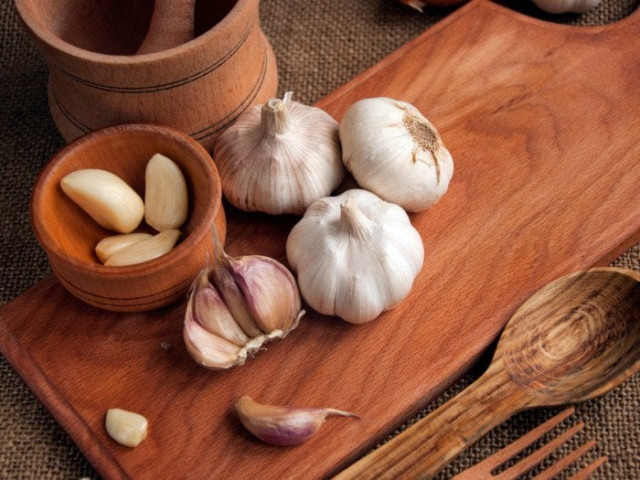
Pakistan's growing food import bill has once again triggered debate on better utilisation of indigenous resources, particularly in the agriculture sector, with business leaders arguing that smarter crop planning and value addition could save precious foreign exchange while creating jobs in rural areas.
Garlic, a staple kitchen item in Pakistan, has emerged as a striking example of how local production could replace imports and even open new export avenues. Convener of the Federation of Pakistan Chambers of Commerce and Industry (FPCCI) Regional Committee on Food, Shahid Imran, said Pakistan spent around $52 million, or nearly Rs14.5 billion, on garlic imports from China during 2024 alone. He said this entire amount could be saved if garlic cultivation is developed on a commercial scale in the Sahiwal division, which already has suitable soil and climate conditions and is widely known for potato farming.
He stressed that the biggest hurdle in shifting farmers towards garlic cultivation is the high upfront cost of quality seed. He proposed that the government select a few union councils in the Sahiwal division and provide interest-free loans ranging from Rs100,000 to Rs200,000 per acre for certified seed and essential farm inputs. Without such support, he said, small farmers remain reluctant to experiment with new but potentially lucrative crops.
Imran pointed out that China is the world's largest producer and exporter of garlic, with annual production exceeding 20 million tonnes and yields almost two-and-a-half times higher than Pakistan's average. He suggested that Pakistan could learn from the Chinese model by training agriculture graduates specifically in garlic farming and deploying them in selected union councils for the first two to three years to guide farmers on modern techniques, seed selection and post-harvest handling.
Beyond raw production, Imran emphasised the need for value addition. He said small and medium enterprises should be encouraged in targeted areas to produce garlic powder, paste, flakes and oil. These processing units require relatively low capital and can meet much of their energy needs through solar power, making them viable even in semi-rural locations. Such value-added products, he said, have a longer shelf life and better export potential than raw garlic. According to official data, agriculture still employs around one-third of Pakistan's labour force, yet contributes around 24% to GDP due to low productivity and limited value addition. Food group imports are increasing and have reached $7.7 billion in FY25. As per the State Bank of Pakistan, food imports during July-November FY26 stood at $3.31 billion, compared to $2.72 billion in the same period of FY25, an increase of 37%.
Experts believe that even modest progress in agro-based industrialisation could significantly reduce imports and improve export earnings, especially as global demand for processed food products continues to rise. Garlic could serve as a pilot project for a broader strategy. With the right policies, Pakistan's fertile land and large farming base could transform basic crops into export-oriented products, reducing import dependence and placing agriculture back at the centre of economic growth.
A Lahore-based agribusiness exporter, Faisal Naseer, said Pakistan's future export growth cannot rely solely on traditional sectors. "China has consistently encouraged Pakistan to focus on agriculture and livestock, add value, and then export finished or semi-finished products," he said. "If we develop agro-processing clusters for crops like garlic, onions and chillies, and even livestock products such as meat and dairy, we can generate foreign exchange, create rural employment and reduce migration to cities."
He added that success in garlic could encourage similar initiatives in other high-import or underperforming commodities such as pulses, edible oils and spices, where Pakistan spends billions of dollars annually. With climate-smart farming, improved storage facilities and stronger linkages between farmers and processors, rural areas could emerge as hubs of agro-based industrial activity. Such a shift, Naseer said, would help stabilise farm incomes, move Pakistan away from a consumption-led import model towards a production- and export-driven economy, strengthen food security and ease pressure on foreign exchange reserves over the long term.









This material may not be published, broadcast, rewritten, redistributed or derived from. Unless otherwise stated, all content is copyrighted © 2026 The Express Tribune.







COMMENTS
Comments are moderated and generally will be posted if they are on-topic and not abusive.
For more information, please see our Comments FAQ