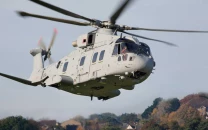
Three die in British navy helicopter crash
Updated 6 hours ago

He says no US troops died and warns Washington is ready for a second, much larger strike if needed

The US president says Washington will effectively oversee Venezuela until what he describes as a safe and orderly transition can be achieved. He added that no US service personnel were killed in the operation and warned the US was prepared to carry out a second, much larger strike if necessary.
Talking about the fate of Nicolas Maduro, he said the justice to be served.
Over 150 aircraft involved, US top military officer says
General Dan Caine, chairman of the Joint Chiefs of Staff, outlined key details of Operation Absolute Resolve.
He said the mission was "the culmination of months of planning and rehearsal" and noted there is always the possibility of similar operations in the future. Caine highlighted the interagency work, which "began months ago and built on decades of experience integrating complex air, ground, space, and maritime operations."
Describing the operation, he said, "We watched, we waited, we prepared. We remained patient and professional." The mission involved more than 150 aircraft across the Western Hemisphere, including F-22s, F-35s, F-18s, EA-18s, E-2s, B-1 bombers, support aircraft, and numerous drones.
Caine added that US forces arrived at President Maduro’s compound at 1:01 a.m. EST (2:01 a.m. Caracas time), quickly isolating the area and moving with "speed, precision and discipline" to secure the objective.
The US attacked Venezuela and deposed its long-serving President Nicolas Maduro in an overnight operation on Saturday, President Donald Trump said, in Washington's most direct intervention in Latin America since the 1989 invasion of Panama.
"This was one of the most stunning, effective and powerful displays of American might and competence in American history," Trump said at a press conference at his Mar-a-Lago resort in Florida, where he was flanked by senior officials, including Secretary of Defense Pete Hegseth and Secretary of State Marco Rubio.
Earlier, Donald Trump confirmed the US attack on Venezuela. "The United States of America has successfully carried out a large-scale strike against Venezuela and its leader, President Nicolas Maduro, who has been, along with his wife, captured and flown out of the country," Trump said in a Truth Social post.

Source: Donald Trump on Truth Social
There was no immediate confirmation from the Venezuelan government.
“This operation was done in conjunction with US law enforcement,” Trump said.
“A new dawn for Venezuela! The tyrant is gone. He will now — finally — face justice for his crimes,” US Deputy Secretary of State Christopher Landau said on X.
A new dawn for Venezuela! 🙏 The tyrant is gone. He will now—finally—face justice for his crimes. 🇺🇸🇻🇪 pic.twitter.com/oNhW6b9soh
— Christopher Landau (@DeputySecState) January 3, 2026
US Senator Mike Lee said the country had completed its military action, quoting Secretary of State Marco Rubio.
“He anticipates no further action in Venezuela now that Maduro is in US custody,” Lee, a Republican initially critical of the operation, wrote on X after what he said was a telephone call with Rubio.
Venezuela's opposition, headed by Maria Corina Machado, said in a statement on X that it had no official comment on the events.
Earlier, Venezuela accused the United States of attacking civilian and military sites after multiple explosions and low-flying aircraft were reported over Caracas, leaving several areas without electricity.
The Venezuelan government said at least seven explosions were heard around 2am local time in the capital, while aircraft flew at low altitude over several neighbourhoods. Authorities said civilian and military installations were targeted in multiple states.
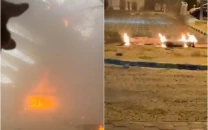
Smoke was seen rising from the hangar of a military base in Caracas, while another military installation in the capital was left without power. Residents in several neighbourhoods rushed into the streets following the explosions.

Left: A column of smoke rises following an explosion, as the sky is illuminated by another explosion in the distance in the early hours of the morning, in Caracas, Venezuela, January 3, 2026 in this screen grab obtained from video obtained by Reuters. Right: A column of smoke rises following an explosion, as the sky is illuminated by another explosion in the distance in the early hours of the morning, in Caracas. Source: Reuters
“The whole ground shook. This is horrible. We heard explosions and planes in the distance,” said Carmen Hidalgo, a 21-year-old office worker, her voice trembling. She was walking quickly with two relatives after returning from a birthday party. “We felt like the air was hitting us.”
Columns of smoke rose into the sky as flashes from further explosions were seen in the distance in the early hours of the morning. Venezuelan state television did not interrupt its programming and instead aired a report on Venezuelan music and art.
The explosions came as US President Donald Trump, who has deployed a naval task force to the Caribbean, has raised the possibility of ground strikes against Venezuela.
On Monday, Trump said the United States had hit and destroyed a docking area for what he described as Venezuelan drug boats. He did not say whether it was a military or CIA operation or where the strike took place, saying only that it was “along the shore.”
If confirmed, it would be the first known land strike on Venezuelan territory.
President Nicolas Maduro has neither confirmed nor denied Monday’s strike. On Thursday, however, he said he was open to cooperation with Washington after weeks of increased US military pressure.
Background of the strikes
On January 2, Maduro said that "the U.S. goal is to seize Venezuela’s oil, gold, rare earth elements, and all its mineral wealth."
He had said that the US agenda in Venezuela was simply to obtain and control these resources.
The Trump administration has accused Maduro of leading a drug cartel and says it is intensifying efforts to curb trafficking. Maduro has denied the allegations, saying Washington is seeking to overthrow him because Venezuela holds the world’s largest known oil reserves.
The United States has increased pressure on Caracas by informally closing Venezuela’s airspace, imposing additional sanctions and ordering the seizure of tankers carrying Venezuelan oil.
For weeks, Trump has threatened ground strikes against drug cartels in the region, saying they would begin “soon,” with Monday’s reported attack seen as the first example.
US forces have also carried out numerous strikes on boats in the Caribbean Sea and eastern Pacific Ocean since September, targeting what Washington claims are drug smugglers.



This material may not be published, broadcast, rewritten, redistributed or derived from. Unless otherwise stated, all content is copyrighted © 2026 The Express Tribune.





COMMENTS (3)
Comments are moderated and generally will be posted if they are on-topic and not abusive.
For more information, please see our Comments FAQ