Universities in twin cities go online ahead of expected Iran–US talks
Updated 1 hour ago

A rotating column of air rose from the ground towards the sky, attracting attention of people in the nearby areas
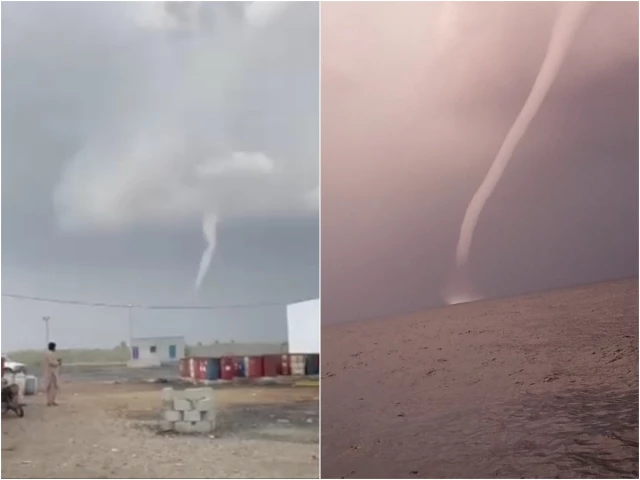
A rare landspout was sighted in the coastal city of Gwadar on Monday ahead of an approaching western disturbance expected to bring rainfall to parts of the country.
The unusual weather phenomenon was observed rising from the ground towards the sky, forming a visible column of rotating air that caught the attention of residents in nearby areas. The Pakistan Meteorological Department (PMD) has forecast rainfall from Tuesday under the influence of a western disturbance, with experts linking the landspout’s formation to the same weather system.
According to meteorologists, landspouts and waterspouts are rotating columns of air that form under similar atmospheric conditions. Weak tornado-like formations develop over land, while waterspouts form over water bodies.
Former PMD director Sardar Sarfraz said, the landspout observed in Gwadar was caused by a western low-pressure system entering Pakistan. “Landspouts in the south-western region of Balochistan have formed due to the arrival of a western disturbance,” Sarfraz said.
He noted that waterspouts had been reported several times in the past along Pakistan’s coastline, including near Gwadar. “The last reported waterspout was observed on January 20, 2019, around 57 nautical miles off the Gharo-Baari coastal belt in Sindh,” he said.
Sarfraz added that a similar meteorological event was reported earlier on February 28, 2016, off the coastal area of Sakooni, near Kalmat Khor in Balochistan. Despite their name, Sarfraz explained that landspouts and waterspouts do not contain water within them. “They are columns of air filled with cloud particles that begin rotating from the surface of the land or sea,” he said.
He further explained that waterspouts are broadly classified into two types — tornadic and fair-weather spouts. Clouds associated with fair-weather waterspouts move slowly, making such formations appear relatively stationary.
Technical adviser at WWF-Pakistan, Muhammad Moazzam Khan, said landspouts and waterspouts typically form beneath column-shaped clouds and are not usually associated with thunderstorms. “Such natural activity generally dissipates on its own within a short period,” Khan said.
He said waterspouts have long been recognised as a serious marine hazard, particularly for small fishing vessels. “They remain a threat at sea, which is why maintaining a safe distance is strongly recommended,” Khan said.
According to experts, waterspouts have an average diameter of about 50 metres, with wind speeds reaching up to 80 kilometres per hour. While some may persist for up to an hour, their average lifespan ranges between five and ten minutes.














This material may not be published, broadcast, rewritten, redistributed or derived from. Unless otherwise stated, all content is copyrighted © 2026 The Express Tribune.






COMMENTS
Comments are moderated and generally will be posted if they are on-topic and not abusive.
For more information, please see our Comments FAQ