King Charles honours 'darling mama' on what would have been her 100th birthday
Updated 2 hours ago

From pre-dawn drills to subsidised stages, a new generation is rescuing six-century-old Kunqu from the brink
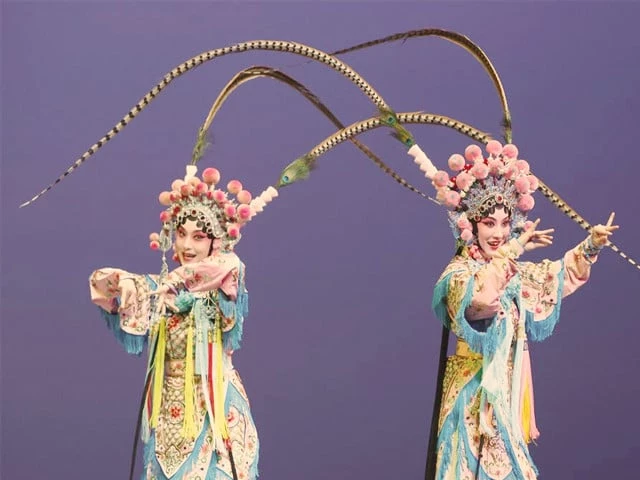
Centuries-old Kunqu opera is finding fresh energy in east China, where a new generation of performers is embracing the demanding art form with discipline and heart, determined to keep a 600-year tradition alive on the modern stage.
For 22-year-old student Zou Yu at Fuzhou Vocational Technical College in Jiangxi Province, the day starts at 5am, followed by eight relentless hours of training that cover basic skills, body movement, singing practice and disciplined stage rehearsals.
Her commitment has come at a price. Three years ago she fell face-first while attempting a back-throwing move, splitting her cheekbone and bleeding badly, yet she refused to quit the course despite her parents' fears and pleas.
She recalled being overwhelmed the first time she watched 'The Peony Pavilion', saying its beauty was worth protecting for life, a conviction that steadied her when her family urged her to abandon the punishing routine.
Written in 1598, the same year as Shakespeare's Romeo and Juliet, Tang Xianzu's drama follows Du Liniang, a young woman who dreams of love with scholar Liu Mengmei, and helped define Kunqu, which Unesco listed as intangible heritage in 2001.
Such rigour grows from love of the art and from urgency. Around 2010, officials in Fuzhou warned of a looming talent gap, with the average age of performers above 48 and fewer than 10% of actors under 30.
The city responded in 2016 with an innovation project centred on new opera classes at Fuzhou Vocational Technical College, designed to train performers for local troupes and rebuild the artistic pipeline from classroom to professional stage.
Between 2017 and 2024, the city allocated 6.8 million yuan, roughly $966,000, to support the scheme, sending 198 graduates into troupes and lifting the proportion of young practitioners in Fuzhou to about 40%.
Veteran performer Tang Guangming says the new generation is finally taking the stage. Local authorities now commission private troupes to stage free shows, including 190 in Linchuan District last year alone, backed by a government budget of ¥665,000.
Zhu Xudong's troupe has felt the change. When it began performing in the Wenchangli historic area in 2021, ticket prices discouraged elderly fans, but subsidies now allow grandparents and young parents alike to attend, babies balanced on their knees.
Residents call the shows a cultural feast that lifts the spirit. Zhu says his only goal is to share Fuzhou's deep theatrical culture and ensure it is carried forward by the students now stepping confidently into leading roles.
In 2016 a live production called 'Dreaming of the Peony Pavilion' turned Wenchangli's streets into a flowing stage, using immersive sets and technology across 12 locations. Since 2018 it has drawn over 450,000 viewers, many discovering Kunqu through short videos.
Young performer Zhou Zhiqian insists opera is not a sunset industry, arguing that vlogs, short clips and immersive experiences are helping traditional theatre speak to audiences raised on phones while preserving the precision and poetry that define Kunqu.












This material may not be published, broadcast, rewritten, redistributed or derived from. Unless otherwise stated, all content is copyrighted © 2026 The Express Tribune.






COMMENTS
Comments are moderated and generally will be posted if they are on-topic and not abusive.
For more information, please see our Comments FAQ