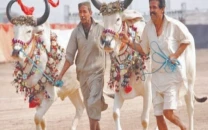
Cattle show at Karachi Expo Centre causes traffic chaos
Updated 13 hours ago

.

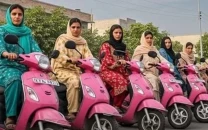
The year 2025 continued to be a disappointment for Sindh’s marginalized communities. Women, labourers, and children continued to face violence, economic exploitation, and deprivation, while government efforts to address these issues remained limited.
According to the Human Rights Commission of Pakistan (HRCP), while overall crimes against women in Sindh decreased in 2025 compared to 2024, incidents of honour killings and child marriages remained high. Nationwide, 300 honor killings were reported, with Sindh accounting for 113 cases, Punjab 102, Khyber-Pakhtunkhwa 55, and Balochistan 27. Azad Kashmir, Gilgit-Baltistan, and Islamabad each reported one case. Child marriages were reported 26 times across Pakistan, with 11 cases in Sindh, 10 in Punjab, three in Khyber-Pakhtunkhwa, and one in Balochistan.
Sindh also ranked second after Punjab in sexual violence, domestic abuse, and burning cases, reporting 152 sexual assaults, 77 cases of domestic violence, 267 femicides, and 11 burn incidents. For comparison, in 2024 Sindh recorded 217 sexual assaults, including 26 gang rapes, 156 honor killings, 250 cases of domestic abuse, and 23 child marriages. However, HRCP Sindh Chapter leader Qazi Khizer Hayat claimed that higher reporting in Sindh reflected greater awareness, rather than a higher prevalence of such crimes.
Violations of children’s rights also reportedly increased in 2025. Renowned social activist Kashif Mirza stated that in Sindh, violations of children’s rights rose by 18 per cent compared to the previous year, with cases of missing children seeing the highest increase. Sharing data with the Express Tribune, Mirza revealed that child trafficking cases in Sindh increased by 34 per cent while abductions rose by 42 per cent.
“Abuse of children was similar in rural and urban areas, whereas last year urban areas had reported more cases,” said Mirza.
Labour leader and member of the Sindh Minimum Wages Board, Nasir Mansoor, confirmed that workers’ rights also deteriorated further in 2025. “Although the Sindh government set a minimum monthly wage of Rs40,000 for unskilled laborers, 95 per cent of factories do not pay this amount. Most factory workers are not given permanent employment, leaving their jobs unprotected, and owners can dismiss them at any time. The Sindh government is strengthening the contract labour system in factories under the guise of labour codes, similar to Punjab, which could institutionalize economic exploitation of workers,” noted Mansoor.
Akram Ali Khaskheli, an activist for farmers’ rights in Sindh, told the Express Tribune that farmers’ economic conditions worsened in 2025 since most farmworkers were not even paid half the minimum wage set for labourers. “Although the government has issued “Hari Cards” in the name of farmers’ welfare, in reality, these provide no benefit to actual farmers. Only those with 1–25 acres of land qualify for the card, which excludes landless farmers. The benefits under the Hari Card largely go to small landowners, not real farmers,” said Khaskheli.
Khaskheli added that the Sindh Bonded Labour (Abolition) Act was enacted in 2015 to prevent bonded labour, which could also benefit farmers who are often subjected to forced labour, but no implementation has taken place. “Furthermore, most farmers in Sindh do not even have homes of their own. They usually build homes on land owned by landlords, which leaves them deprived of basic human freedoms since their livelihoods remain tied to the landlord’s land,” said Khaskheli.







This material may not be published, broadcast, rewritten, redistributed or derived from. Unless otherwise stated, all content is copyrighted © 2026 The Express Tribune.







COMMENTS
Comments are moderated and generally will be posted if they are on-topic and not abusive.
For more information, please see our Comments FAQ