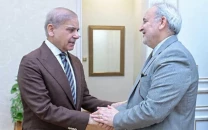
Iranian envoy meets PM Shehbaz, discusses regional situation
Updated 2 hours ago

Federal government wants to exclude customs duties from the purview of the divisible pool, say sources

The Centre has notified eight committees of the National Finance Commission (NFC), including one on debt utilisation and the transfer of expenditures to provinces, following the attorney general's support for the federal government against Sindh's objections.
The development came as Pakistan's top fiscal expert, Dr Hafiz Pasha, noted that despite the constitutional requirement to allocate 57.5% of the divisible pool to provinces, they received only 45.8% in the last fiscal year after accounting for petroleum levies and cash surpluses. Dr Pasha made these remarks at a seminar on the NFC organised by the Social Policy and Development Centre (SPDC).
Finance Minister Muhammad Aurangzeb, who had initially confirmed attendance, did not appear at the seminar; instead, he met SPDC representatives at his office. SPDC Managing Director Asif Iqbal said the finance minister had first confirmed his participation but expressed regret late the previous night.
Meanwhile, the finance ministry formed committees on eight critical issues that will shape the 11th NFC award. The last, 7th NFC award, was agreed upon unanimously 15 years ago for a five-year period. A working group, headed by Punjab's finance minister, was also constituted to make recommendations on sharing financial expenses incurred by the federation in areas under provincial jurisdiction. The group's formation followed a legal opinion from the attorney general, after Sindh had objected, arguing that expenditure-sharing falls outside the NFC's mandate.
Sources indicated that Sindh may seek its own legal opinion as the federal government continues spending in areas under provincial control. According to Dr Asad Sayeed, Sindh's technical member on the NFC, the federal government retains ministries linked to devolved subjects and spent Rs328 billion on them, as highlighted in a 2023 World Bank report.
Khyber-Pakhtunkhwa Finance Advisor Muzammil Aslam criticised the federal government's policies, citing energy mismanagement that contributed to over Rs5 trillion in circular debt in the power and gas sector and over Rs5.1 trillion in payments to Chinese power plants.
Headed by Finance Minister Muhammad Aurangzeb, the Centre constituted a working group to make recommendations on the composition of divisible pool taxes, suggesting inclusion or exclusion of certain taxes in the pool.
The sources said that the federal government wants to exclude customs duties from the purview of the divisible pool that is divided among the five governments.
Another working group is constituted to determine the percentage of resources that will be distributed between the centre and the four provinces -the vertical transfers. Currently, provinces get 57.5% while the rest goes to the Centre.
While speaking at the SPDC seminar, Dr Hafiz Pasha said that in the last fiscal year, the provinces got 45.8% compared to their guaranteed share of 57.5%. He added that nearly 12% share was withheld either by charging petroleum levy on products that are not part of the divisible pool or by getting back transferred money in the shape of cash surpluses.
In the last fiscal year, the federal government collected over Rs1.2 trillion in petroleum levy, and the provinces also saved Rs921 billion as cash surplus to meet IMF programme conditions.
Headed by the Balochistan finance minister, the federal government constituted a working group to decide the distribution of resources among the four provinces. Currently, over 82% of the resources are distributed based on population.
The seed of East Pakistan's separation was sown in the 1960s with the decisions of first withdrawing the right of provinces to collect sales tax and then denying the distribution of resources based on population, said Dr Asad Sayeed. Dr Sayeed said that soon after the separation of East Pakistan, the federal government started distributing resources based on population.
K-P's Muzammil Aslam said that there is a need to stop incentivising the population and more reliance should be placed on other indicators, including revenue generation.
The federal government has also notified a working group on "deliberating and suggesting measures for improving the overall tax-to-GDP ratio". K-P's finance minister will chair the working group.
FBR's tax to GDP ratio is hardly 10.3% while the provinces too collect taxes equal to 0.8% of the GDP. The FBR has miserably failed to perform its task, and the chairman FBR told the prime minister that the first half-year's tax target might be missed by Rs560 billion.
The finance ministry also notified a working group on straight transfers of resources to provinces that will be chaired by the Sindh finance minister.
The seventh working group is constituted to make recommendations on the merger of the erstwhile FATA and its share in the NFC. K-P finance minister would head the ground.
Muzammil Aslam said that over 5 million people have been added in K-P, and its one-third area has been expanded without an increase in resources. The finance advisor said that K-P's share in NFC should be further increased by over 4% based on the new population size.
The federal government has also set up a working group on national debt composition and its utilisation. This group will be headed by Balochistan's finance minister.









This material may not be published, broadcast, rewritten, redistributed or derived from. Unless otherwise stated, all content is copyrighted © 2026 The Express Tribune.





COMMENTS
Comments are moderated and generally will be posted if they are on-topic and not abusive.
For more information, please see our Comments FAQ