China's FM Wang Yi reiterates appreciation for Pakistan’s constructive role amid US-Iran talks in meeting with Dar
Updated 5 hours ago

Supreme Court says to prove guilt of an employee is a serious matter
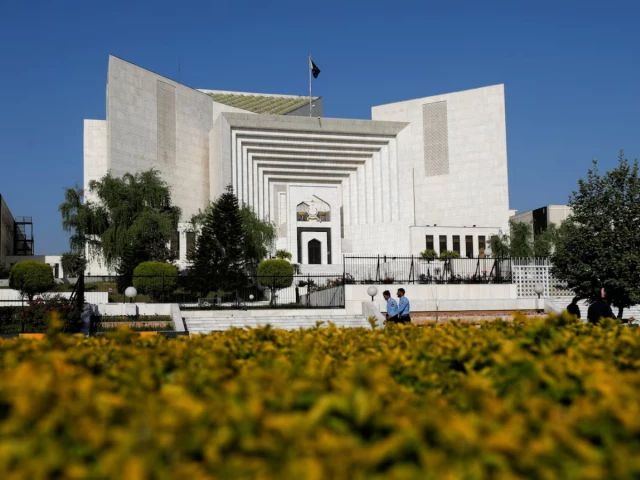
The Supreme Court has ruled that the primary burden rests on the employer to prove the misconduct of an employee in a dismissal case.
“The primary burden rests on the employer to prove the misconduct so that the matter may be decided on the preponderance of evidence which is clear, credible, and lends support to the final conclusion with little room for doubt.
“By and large, when any employee challenges his termination or dismissal from service, the burden often shifts upon the employer to establish that the action was based on independent, unbiased, and logical reasons, and that while terminating or dismissing the employee from service, the principles of natural justice and due process were religiously followed.
“The employer has to produce substantial evidence to persuade the court that the decision was not motivated by revenge, bias, and/or any prejudiced aspiration,” said a 12-page judgment authored by Justice Muhammad Ali Mazhar.
Due to a toothache, the petitioner visited a dental surgeon on September 1, 2015, where he was advised to undergo Root Canal Treatment. After the treatment, the petitioner applied for reimbursement of the medical bill as per the approved company policy.
However, he was issued a show-cause notice on December 1, 2015 by the HR manager with allegations that he had submitted a bogus medical bill amounting to Rs10,000.
The petitioner submitted his reply and denied the allegations. He participated in the inquiry and also submitted the verified bill on December 4, 2015 along with the receipt of payment of Rs10,000.
However, on the basis of adverse findings, the petitioner was dismissed from employment on March 8, 2016. The petitioner filed a grievance petition before the National Industrial Relations Commission (NIRC), which dismissed the plea.
Thereafter, he filed an appeal before a full bench of the NIRC, which allowed the appeal and set aside the order of the NIRC single bench.
It ordered that the petitioner be reinstated with all back benefits. The company then filed a constitutional petition before the Sindh High Court (SHC), which set aside the NIRC full bench order.
The petitioner later approached the Supreme Court whose three-member bench, led by Justice Muhammad Ali Mazhar, set aside the SHC order.
In its verdict, the SC noted that when contradictory receipts were available on record, it was obligatory for the inquiry officer to call a witness from the hospital for evidence and verification, with the right of cross-examination afforded to the petitioner, without which the truth could not be unearthed.
“The purpose of a domestic inquiry under labour laws, if taken so lightly, destroys the whole substratum.
“Regardless of the fact that an inquiry officer in a domestic inquiry cannot be equated with a well-trained judicial officer, the bare minimum requirements of natural justice and due process are commonsensical and essential elements for the conscience of the inquiry officer before finding an employee guilty of misconduct and forwarding the inquiry report or recommendations to the management.”
The judgment noted that it is the prerogative and inherent right of the employer to initiate disciplinary proceedings in accordance with the law to address misconduct, if committed by any employee.
However, the course of action for dealing with any act of misconduct must adhere to the principles of natural justice and the prescribed guidelines to ensure due process of law.
“The mishandling of misconduct cases results in a negative impact on industrial relations and also tyrannizes the level of trust between management and workers.
“Therefore, it is essential for employers to maintain transparency, uniformity, and egalitarianism, which implies compliance with all legal requirements and equal treatment of employees without any discrimination or favouritism.”
The judgement also noted that to prove the guilt on the charges of misconduct is a serious matter and at least for the employee, the stakes are much higher than the employer.
“Therefore, before declaring guilty, due diligence should have been made. In the present case, the evidence of the representative of dental clinic/doctor
was inevitable for proving the guilt whether the petitioner paid Rs7000 or Rs10,000 and whether he really submitted a bill of excess amount or not.
“So, in our view, the witness from the hospital could be the star witness in this case who was ignored and no efforts were made by the management representative to call him before the inquiry officer as management’s witness.
“No burden should be shifted on the employee to call him if the management did not want to verify or confront those medical bills to their star/key witness, which by their own mistake lost its evidentiary value and nothing proved on record which bill of hospital/clinic was genuine.
“Indeed, the expression ‘star witness’ or ‘key witness’ refers to a witness whose evidence is contemplated utmost ascendant for the prosecution and the defence both.
“His testimony in fact proves vital for corroborating key facts. It is somewhat a common benchmark that the doctrine of presumption of innocence casts the burden on the prosecution to prove its case beyond reasonable doubt.
“The scale and extent of probability of guilt may be based on interdependence of evidence, therefore, even in the domestic inquiries triggered under the Industrial Relations Laws and Civil Servant Laws and Rules, it is onerous duty of the inquiry officer/inquiry committee, that they should provide ample opportunity of fair trial and due process,” the judgement said.














This material may not be published, broadcast, rewritten, redistributed or derived from. Unless otherwise stated, all content is copyrighted © 2026 The Express Tribune.






COMMENTS (1)
Comments are moderated and generally will be posted if they are on-topic and not abusive.
For more information, please see our Comments FAQ