FO slams storming of Al-Aqsa Mosque, raising of Israeli flag
Updated 1 hour ago

Aurangzeb says remittances, which hit $38b last year, are expected to reach $41b this year
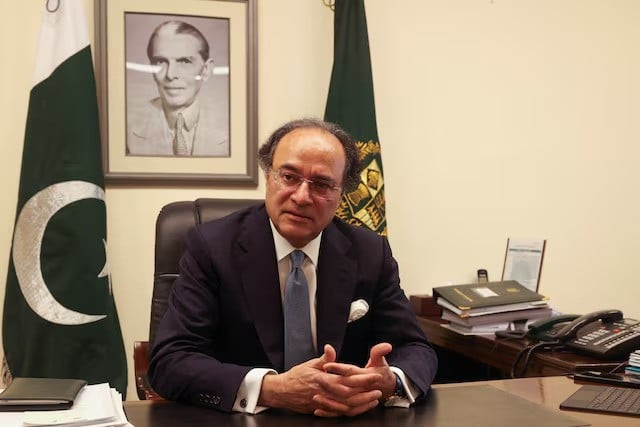
Federal Finance Minister Muhammad Aurangzeb has said Pakistan’s future lies not in aid but in partnerships based on trade and investment. Foreign direct investment in productive sectors would not only boost GDP but also create employment opportunities and generate shared economic benefits for Pakistan and its partners.
Speaking in an interview with CNN Business Arabia, the minister said that over the past 18 months, Pakistan has implemented a comprehensive economic stabilisation programme, which has delivered positive and measurable results.
He said inflation, which had peaked at 38%, has now fallen to single digits. On the fiscal front, Pakistan has achieved primary surpluses, while the current account deficit has remained within set targets.
He added that the exchange rate has stabilised and foreign exchange reserves have improved to a level equivalent to around two and a half months of imports, indicating stronger external resilience.
Aurangzeb also referred to two major international endorsements of Pakistan’s improving economic outlook, noting that all three global credit rating agencies have upgraded Pakistan’s rating and outlook this year. He added that the IMF Executive Board has recently approved the second review under the Extended Fund Facility (EFF) following its successful completion.
He said these developments reflect growing international confidence in Pakistan’s economic policies and reform agenda.
The finance minister said economic stability has been achieved through disciplined fiscal and monetary policies, alongside wide-ranging structural reforms. He added that reforms are underway in key areas, including taxation, energy, state-owned enterprises, public financial management and privatisation, aimed at strengthening stability and laying the foundation for sustainable economic growth.
Read: Govt price lists fail to rein in runaway market rates
Speaking about tax reforms, he said Pakistan’s tax-to-GDP ratio stood at 8.8% at the start of the reform programme and increased to 10.3% in the last fiscal year, with a clear roadmap in place to raise it to 11%.
He said the government’s objective is to develop a tax system that ensures fiscal self-reliance in the medium and long term. To this end, economically significant but undertaxed sectors such as real estate, agriculture, and wholesale and retail are being brought into the tax net.
Measures are also being taken to reduce tax evasion and leakages through production monitoring and artificial intelligence-based technologies, alongside reforms in tax administration covering personnel, processes and technology.
On the energy sector, the finance minister said steps are being taken to improve governance in distribution companies, encourage private sector participation, advance privatisation and reduce circular debt, a long-standing challenge for the sector.
He stressed that tariff reforms are essential to make energy competitive for industry and to promote industrial activity.
Read more: The myth of stability and Pakistan’s economic underperformance
FinMin praised the longstanding support of GCC countries, including Saudi Arabia, the United Arab Emirates and Qatar, noting their assistance through financial support, investment and cooperation at international financial institutions such as the IMF. He said the relationship is now entering a new phase focused on expanding trade and investment flows.
He said remittances remain the backbone of Pakistan’s current account, amounting to around $38b last year and expected to reach $41b to $42b this year, with more than half coming from GCC countries.
The finance minister said Pakistan is actively engaging with GCC countries to attract investment in priority sectors, including energy, oil and gas, minerals and mining, artificial intelligence, digital infrastructure, pharmaceuticals and agriculture. He also expressed optimism about a free trade agreement (FTA) with the GCC, saying negotiations have entered their final stages.





This material may not be published, broadcast, rewritten, redistributed or derived from. Unless otherwise stated, all content is copyrighted © 2026 The Express Tribune.




COMMENTS (1)
Comments are moderated and generally will be posted if they are on-topic and not abusive.
For more information, please see our Comments FAQ