BOI ramps up investor outreach in UK
Updated 12 hours ago

Experts highlight potential, if backed by reforms, certification & export strategy
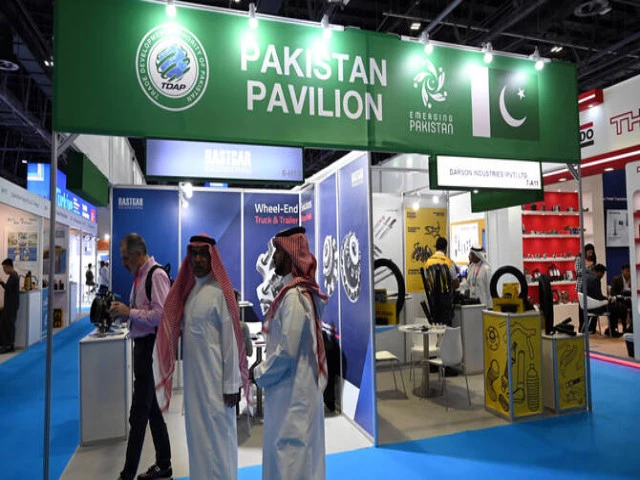
With Pakistani manufacturers actively engaging at Automechanika Dubai 2025, experts stressed that the nation stands at a crucial crossroads: opportunity is expanding, but real progress will require structural reforms, improved export readiness and a coordinated, sector-wide strategy.
Automechanika Dubai 2025, underway from December 9-11 at the Dubai World Trade Centre, is witnessing one of its most dynamic editions to date, drawing more than 2,300 exhibitors from over 60 countries. Global manufacturers, technology developers, EV innovators and after-market suppliers have converged to showcase next-generation automotive solutions, with Pakistan marking a relatively prominent presence through both pavilion representation and independent corporate participation.
This year, the Trade Development Authority of Pakistan (TDAP) has facilitated 10 leading domestic manufacturers under the Pakistan Pavilion, enabling them to engage international distributors and benchmark against global competitors. Among the exhibitors are Ghauri Tyres & Tubes, Multi Tech Engineering, Thermosole Industries, Super Horn, Rastgar Engineering, Sanpak Engineering, Darson Industries, United Auto Industries and Diamond Tyres. In parallel, major national brands such as Panther Tyres, Pakistan Accumulators and Atlas Battery are participating independently, signalling increased confidence and ambition within Pakistan's automotive component industry.
While the Pakistani booths have recorded strong footfall and encouraging business-to-business activity, voices from the sector warn that presence alone is not enough. Among them, noted industry expert and former PAAPAM Chairman Mashood Ali Khan stresses that Pakistan is at a turning point, a moment of heightened opportunity, but also one demanding structural change, export discipline and collective strategy. In his commentary on Pakistan's global automotive positioning, Khan highlighted that although the country hosts more than 250 established parts manufacturers, only 28 consistently export, a gap that limits Pakistan's footprint at global forums.
He argued that participation in fairs like Automechanika Dubai, AAPEX USA and Automechanika Frankfurt is critical, but high participation costs, certification deficits and the lack of coordinated marketing weaken export conversion. "Events like Automechanika Dubai are launchpads," Khan asserts. "But unless Pakistan builds clusters, pools marketing costs and jointly approaches buyers, most manufacturers will struggle to convert exposure into sustained export orders."
The need for sector-wide export readiness was echoed by multiple Pakistani exhibitors at the fair. Qasim Rastagar, Director of Rastgar Engineering, reported an active response from buyers, describing the event as "far beyond expectations in productivity and outreach." Sanpak Engineering Supply Chain Manager Tariq Mehmood similarly stated that engagement levels were "highly energising and commercially promising."
Yet industry analysts caution that enthusiasm must translate into compliance. International buyers, particularly in Europe and North America, demand certified production systems, traceable quality control, eco-compliant materials and modern packaging. Khan outlines that without ISO/TS certification, digital catalogues, structured pricing and professional branding, Pakistan cannot compete sustainably, regardless of talent or engineering strength.
He also warned that rising global participation costs, currency fluctuations and logistics expenses increasingly push smaller suppliers out of international markets. Khan proposed a solution rooted in clustering, where companies co-develop products, share marketing teams and jointly book exhibition space, reducing expense while amplifying visibility. Despite these concerns, Automechanika Dubai 2025 has already strengthened Pakistan's linkages with distributors from the Gulf, Africa and Latin America, markets currently seen as more accessible than the compliance-heavy EU. Pakistani booths have engaged actively in lead exchange, sourcing discussions and technology comparison, especially around tyres, batteries, rubber-metal components, wiring, filters and light engineering parts.
Industry insiders note that demand signals this year are shifting towards EV-compatible components, lithium battery solutions, lightweight composites and energy-efficient rubber compounds. Pakistani manufacturers are participating in these conversations, but capability upgradation and testing infrastructure will be essential if they aim to meet global supply-chain requirements.
As the exhibition enters its closing day, Mashood Ali Khan reiterated that Pakistan must not let momentum fade once exhibitors return home. "We have the engineering base. What we need now is structure," he urges. "If we collaborate rather than compete internally, upgrade certification, and plan jointly for global fairs, Pakistan's auto sector can begin capturing serious export share over the next two years."
Automechanika Dubai 2025 may therefore prove more than an exhibition; it could be the inflexion point where Pakistan shifts from participation to export penetration, provided stakeholders move together with a unified strategy and long-term market discipline, he said.







This material may not be published, broadcast, rewritten, redistributed or derived from. Unless otherwise stated, all content is copyrighted © 2026 The Express Tribune.





COMMENTS (1)
Comments are moderated and generally will be posted if they are on-topic and not abusive.
For more information, please see our Comments FAQ