Romance bestseller 'Beach Read' sets lead pairing
Updated 5 hours ago

Sufi Festival 2025 draws thousands of visitors, blending spirituality, art, and music to reclaim the city's cultural
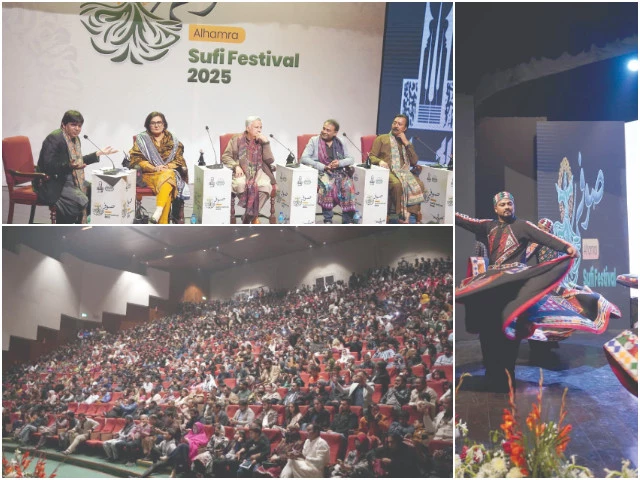
Lahore has its own rhythm, a mix of noise, commerce, history, and chaos. But for three days in late November 2025, that rhythm changed. Inside the red-brick walls of the Alhamra Arts Council on Mall Road, the city's usual clatter gave way to Qawwali, the whirl of dervishes, and the quiet of 30,000 people seeking a deeper connection.
The Alhamra Sufi Festival 2025 was more than an event; it was a statement. In a time when public spaces are often commercialised or overlooked, Alhamra reaffirmed its role as Pakistan's cultural hub. Across three days, it showcased why UNESCO named Lahore a 'City of Literature', combining music, poetry, and art into a living celebration of heritage.
The Alhamra Sufi Festival began with the exhibition 'Whirling Lines of Sufi Wisdom' at the Ustad Allah Bakhsh Art Gallery, featuring 100 works by 65 artists. Calligraphy served as a visual guide to the spiritual experience ahead.
The spoken word followed. In the 'Tehtul Lafz' segment, Imran Jafri recited Sufi poetry without accompaniment, letting the words resonate directly with the audience. Poetry became a vessel of reflection, proving that Sufi wisdom remains powerful in modern times.
The festival also engaged the mind. Sessions explored the relevance of Sufi thought in contemporary society. Qasim Ali Shah's talk on 'Iqbal ka Payam' filled Hall 2, connecting Allama Iqbal's ideas to a generation seeking purpose.
Panels featuring Dr Sughra Sadaf, Dr Moin Nizami, and Sahibzada Kashif Mehmood debated the role of Wasif Ali Wasif, poetry's influence on identity, and Sufism's role in social cohesion. Moderated by Dr Fatima Fayyaz, discussions emphasised compassion as a tool to address societal divisions, showing the City of Literature in action.
Night-time performances combined theatre, music, and movement. 'Maqsood e Kul Main Hoon', in collaboration with the International Iqbal Society, brought Iqbal's philosophy to life. The Versatile Group's Raqs-e-Dervish performance illustrated spiritual motion, robes twirling like celestial bodies.
The finale, Sher Miandad's Grand Qawwali, drew the largest crowd. Halls overflowed, lawns filled, and balconies became vantage points. As voices rose in praise, thousands of people united in rhythm and devotion, echoing the spirit of historic Urs gatherings.
The festival also highlighted the economic value of the culture. The book fair, supported by Bazm-e-Iqbal, the National Book Foundation, and Sang-e-Meel, saw strong sales. Craft stalls, food vendors, and artisans found a platform, while technicians and staff ensured smooth operations. Alhamra became a micro-economy, demonstrating culture's potential for income generation.
Managing such crowds in a busy city was complex. Coordination between Alhamra and district officials ensured safety and smooth movement. Overflow management via LED screens turned gardens into open-air venues, illustrating efficient, quiet governance.
As the festival ended, one question arose: why not every year? Public response was overwhelming, with social media engagement in the millions. The event proved that Lahore's heritage is alive, dynamic, and relevant.
Alhamra has long been the city's cultural heart. This festival confirmed it beats stronger than ever. It is no longer a suggestion but a necessity: the Alhamra Sufi Festival should become an annual celebration, keeping Lahore, the City of Literature, radiant in its spiritual and cultural legacy.
Overall, the scale of the festival was remarkable. Large international events typically require months of planning; Alhamra managed it in days, blending artistry with efficient administration. Chief Minister Maryam Nawaz, advocating a creative economy and heritage preservation, provided vision.
Minister Azma Zahid Bokhari and Secretary Syed Tahir Raza Hamdani ensured policy translated into action. Executive Director Mahboob Alam turned this plan into reality, delivering a festival that felt both grand and intimate.
More than 30,000 visitors attended between November 28 and 30, filling halls, lawns, and corridors. The crowd was young — nearly half aged 25 to 35 — and included university students, professionals, and digital natives. Gender representation was balanced, with 55% men and 45% women, creating a space where social and cultural divides faded under shared Sufi wisdom.






This material may not be published, broadcast, rewritten, redistributed or derived from. Unless otherwise stated, all content is copyrighted © 2026 The Express Tribune.




COMMENTS
Comments are moderated and generally will be posted if they are on-topic and not abusive.
For more information, please see our Comments FAQ