Rockstar holds ‘GTA VI’ November release window
Updated 4 hours ago

Families, artists and youth transform public spaces into a living canvas of tradition on Culture Day
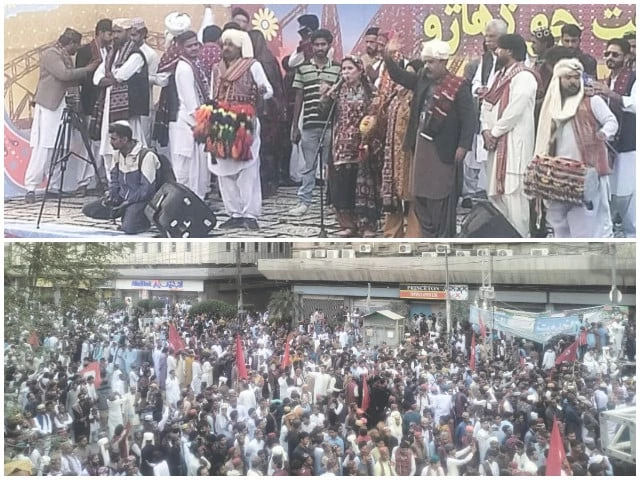
The annual celebration of Sindh Cultural Day unfolded across the province with a scale and fervour that once again underlined how deeply Sindh's traditions remain woven into the daily rhythm of the province, drawing thousands into a shared expression of pride, memory and identity.
What began as a symbolic tribute years ago has steadily transformed into one of the region's most spirited cultural observances, uniting residents from different backgrounds under the colours of the Ajrak and the Sindhi cap.
From the early hours of the morning, neighbourhoods across the Karachi city burst into activity as families stepped out in traditional attire and community organisations prepared rallies tracing routes through old quarters and new districts alike.
The Karachi Press Club, which has become a focal point for the day's main activities, quickly turned into a sea of patterned Ajraks, embroidered caps, drums and folk music that carried over the traffic noise and the city's vast bustle.
Events marking the occasion were not limited to the press club vicinity. Around Fawara Chowk and other public spaces, organisers arranged cultural programmes featuring dance and musical performances that highlighted the continuity of Sindhi heritage.
At the seaside also, families formed long, colourful streams along the beach sand. Many said the act of wearing the Sindhi cap and Ajrak was itself a statement of belonging, a reminder of cultural depth in a rapidly shifting urban environment.
Throughout Karachi, the day coincided with a surge of pride expressed through tableaus and impromptu performances staged by students, community troupes and volunteer groups. Participants danced to folk songs, posed for photographs in traditional attire, and repeated chants celebrating unity and peace.
Outside the Karachi Press Club, the central musical event drew a particularly spirited crowd. Artists from across Sindh presented traditional folk compositions that resonated strongly with the audience. Groups of young people formed circles, moving in rhythm to the Dhol as the older spectators joined in, creating a sense of shared festivity that cut across age and background.
The cheers echoed repeatedly, each wave rising louder than the last. Civil society activists, community leaders, students, families and members of various groups all took part, blending political sentiment with cultural celebration in a manner that has become characteristic of Sindh Cultural Day.
Women in creatively styled Ajrak outfits added a vibrant visual dimension, turning parts of the venue into an informal fashion showcase rooted firmly in heritage. Talking to The Express Tribune, the participants highlighted that the day served as a pledge to preserve language and customs of Sindh.
"The day is a reflection of the Mehran Valley's rich cultural legacy and timeless traditions," social activist Shujauddin described the festivities, emphasising their role in promoting tolerance and inclusiveness in the Sindhi society. "Sindh's Sufi history had long offered a guiding philosophy of peaceful coexistence."
He noted that the province's message of unity had endured across generations, carried by values embedded in the Ajrak and Sindhi cap. other participants also echoed similar sentiments, saying the beauty of the day lay in the widespread appearance of these traditional symbols.
Many described Sindh's culture as the one shaped by millennia of history, referencing archaeological and linguistic research that highlights the antiquity of the region's civilisational roots. They said the day served as a pledge to preserve the artistic practices that have survived social and economic changes.
Crowds at the event were also keen to emphasise linguistic harmony, insisting that affection for Sindhi did not diminish their regard for other languages. Attendees stressed that Punjabi, Pashto, Urdu, Balochi, Hindko and Saraiki were equally cherished, framing the celebration as a gesture of pluralism.
On the occasion, the speakers emphasised that Sindh is one and will remain one, adding that they would defend the Indus River. They added that their message is one of peace. Civil society figures urged young people to focus on education, arguing that cultural pride must be accompanied by social progress.
They described Sindhi Culture Day as a reminder that unity remains a central strength of the province and that its music, language and traditions should guide future generations towards an ethos based on knowledge and integrity.
The message of continuity was prominent throughout the celebrations. Many attendees framed Sindhi heritage as a civilisation that had journeyed through centuries and now stood before the present generation as a responsibility.
Security was tight in the areas surrounding the Karachi Press Club, where containers were placed to diverted traffic to alternative routes. Police and volunteers coordinated to manage the large influx of visitors, while families navigated the congestion with the patience that has become typical of large public cultural gatherings in the city.
Sindh Cultural Day, observed every year on the first Sunday of December, once again ended with the quiet consensus that heritage remains central to the region's social fabric, and that its preservation is a shared duty embraced enthusiastically by its people.










This material may not be published, broadcast, rewritten, redistributed or derived from. Unless otherwise stated, all content is copyrighted © 2026 The Express Tribune.




COMMENTS
Comments are moderated and generally will be posted if they are on-topic and not abusive.
For more information, please see our Comments FAQ