Hasan Raheem teams up with The PropheC for upcoming track 'Ek Nishani'
Updated 7 hours ago

Open letters urge world to intervene over Palestinian leader's detention
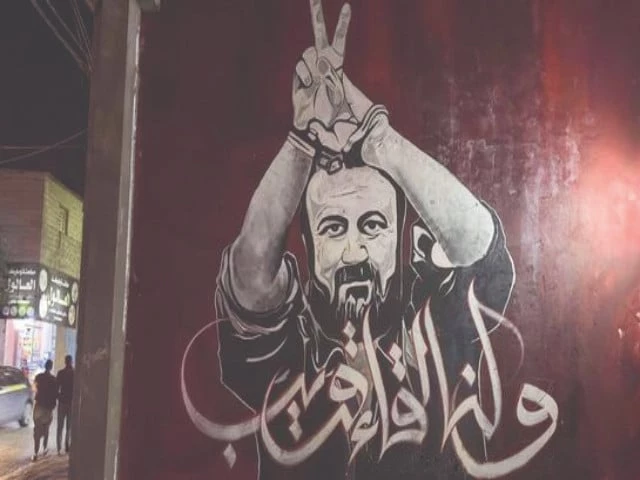
Celebrities from across the cultural spectrum intensified international pressure on Israel this week by rallying behind a growing campaign for the release of jailed Palestinian leader Marwan Barghouti, whose supporters regard him as a pivotal unifying force in any future Palestinian state.
The renewed call came through two open letters signed by more than 200 prominent figures in film, literature, music, art and activism, underscoring a widening global consensus demanding an end to what signatories describe as his prolonged and unjust imprisonment.
Barghouti, now 66, has been behind bars since 2002 after being seized by Israeli forces in the West Bank and later handed five life sentences over attacks carried out during the second Palestinian intifada, a trial that human rights groups and legal specialists have long condemned as fundamentally flawed.
The Inter-Parliamentary Union, which represents global legislatures, previously criticised the proceedings, while Barghouti himself refused to recognise the court, insisting it lacked legitimacy under international law.
The letters have attracted a striking coalition of cultural heavyweights, including actors Benedict Cumberbatch, Ian McKellen, Tilda Swinton, Javier Bardem, Mark Ruffalo and Josh O'Connor, alongside musicians Sting, Paul Simon, Annie Lennox and Brian Eno.
Celebrated authors Margaret Atwood, Annie Ernaux, Philip Pullman, Zadie Smith and Fatima Bhutto also joined the appeal, while figures such as Ai Weiwei, Gary Lineker, Stephen Fry, Nan Goldin and Sir Richard Branson added further weight to the campaign.
The statements express deep alarm over Barghouti's treatment in custody, citing violent mistreatment and repeated denial of legal rights. His family said he was severely beaten during a prison transfer in September, leaving him with broken ribs and head injuries.
A video released earlier showed Israel's far-right National Security Minister Itamar Ben Gvir issuing threats as Barghouti appeared visibly weakened. The letters accuse Israeli authorities of holding him under conditions intended to silence a political figure whose popularity has consistently endured despite decades of imprisonment.
A central concern raised by the signatories is Israel's push for legislation enabling the death penalty for Palestinian prisoners, a move they say would place Barghouti at heightened risk and further erode hopes for a viable political settlement.
They have urged the United Nations and governments worldwide to intervene decisively, arguing that his release is essential for rebuilding Palestinian political cohesion and advancing any credible peace process.
Barghouti remains a dominant figure in Palestinian public life, regularly topping opinion polls as the preferred leader despite spending more than two decades behind bars.
Supporters describe him as a rare figure capable of bridging the deep divides between Palestinian political factions, and believe his continued detention reflects political calculations rather than security concerns, particularly as he was excluded from recent prisoner exchanges after last year's Gaza ceasefire.
The cultural mobilisation surrounding Barghouti draws deliberate parallels with the global movement that helped secure Nelson Mandela's release during South Africa's apartheid era. Mandela himself drew the same comparison in 2002, saying Barghouti's treatment mirrored his own experience as a political prisoner.
Eno echoed that message in his statement, arguing that cultural voices had once shifted the course of South African history and could do so again in the Palestinian struggle.
British-Palestinian novelist and lawyer Selma Dabbagh said Barghouti's freedom would be a crucial step toward allowing Palestinians to determine their own leadership and restore a sense of political agency after years of conflict and fragmentation. She stressed that his case had long symbolised broader concerns over fair trial standards and the targeting of elected representatives.
While many of the signatories have been active in campaigns condemning Israel's war in Gaza, the letters mark a concerted effort by Barghouti's family to build a dedicated international movement under the "Free Marwan" banner.
Advocates believe sustained cultural pressure could force governments to treat his case as a diplomatic priority, arguing that his absence from the political landscape has become a major obstacle to any meaningful progress toward a negotiated settlement.
The statements conclude with a direct appeal to world leaders to push for Barghouti's immediate release, insisting that continued inaction deepens a political stalemate that has already cost thousands of lives.
Whether the campaign can achieve the momentum seen during the anti-apartheid era remains uncertain, but its wide and influential support signals a new phase in one of the most enduring cases in the Israeli-Palestinian conflict.
(AFP WITH INPUT FROM NEWS DESK)













This material may not be published, broadcast, rewritten, redistributed or derived from. Unless otherwise stated, all content is copyrighted © 2026 The Express Tribune.




COMMENTS
Comments are moderated and generally will be posted if they are on-topic and not abusive.
For more information, please see our Comments FAQ