Ella Langley's rise meets online scrutiny
Updated 3 hours ago

Israel cleared to compete as Spain, Ireland, the Netherlands and Slovenia withdraw over Gaza crisis
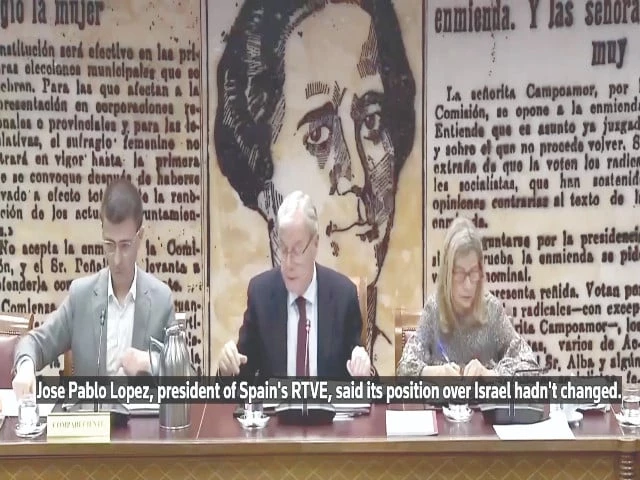
The Eurovision Song Contest, the world's largest live music competition, finds itself embroiled in a political storm after organisers confirmed that Israel would be allowed to compete in the 2026 edition.
The decision prompted Spain, Ireland, the Netherlands, and Slovenia to withdraw, citing both the ongoing humanitarian crisis in Gaza and alleged breaches of the contest's rules intended to safeguard neutrality.
Following a tense meeting in Geneva, the European Broadcasting Union (EBU), which oversees the annual event, opted not to put Israel's participation to a vote. Instead, it passed a set of new rules designed to prevent governments or third parties from influencing public voting or disproportionately promoting entries.
The EBU said these measures would "reinforce trust and protect neutrality," addressing allegations that Israel had unfairly boosted its entry in previous contests. Despite these assurances, broadcasters in several European countries made their positions clear immediately after the announcement.
Ireland's national broadcaster RTE described its participation as "unconscionable given the appalling loss of lives in Gaza and the humanitarian crisis there, which continues to put the lives of so many civilians at risk."
Similarly, Spain's RTVE stressed that Eurovision could no longer remain a neutral cultural event under current circumstances, citing Israel's perceived politicisation of the contest. AVROTROS, the Dutch broadcaster, also confirmed its withdrawal, saying participation "cannot be reconciled with the public values that are fundamental to our organisation."
Slovenia followed suit and other countries are reportedly reconsidering their participation. Iceland had previously threatened to pull out, while Belgium, Finland, and Sweden have said they are closely watching developments before making a decision.
The scale of these withdrawals is unprecedented in Eurovision's history, underscoring the deep divisions the Gaza war has created even within cultural spheres. German support played a key role, with Chancellor Friedrich Merz signalling that Germany would withdraw if Israel were excluded.
The German stance underlines the diplomatic and cultural weight Eurovision now carries, as countries grapple with balancing artistic engagement and political protest. The controversy is not only rooted in the Gaza conflict but also in concerns over voting transparency.
Israel's 2025 entrant, Yuval Raphael surged to second place after the public vote, despite more modest jury scores. Similar disputes arose the previous year when Israel's Eden Golan secured fifth place, raising questions about voter manipulation and the impact of aggressive overseas promotion.
Eurovision's voting system combines professional juries with public voting, allowing each to influence final standings. Countries are barred from voting for their own entries, but broadcasters such as AVROTROS allege that Israel's outreach to international audiences influenced results disproportionately.
The EBU has sought to address these concerns through rule changes aimed at increasing transparency and reducing the risk of politically motivated voting. The EBU had initially planned a vote on Israel's participation in November, but postponed the decision following the October 10 ceasefire agreement between Israel and Hamas.
By December, organisers opted to implement rule changes and proceed without a formal vote, arguing that sufficient consensus existed among members to continue the contest as planned.
Austria, which will host Eurovision 2026, expressed hope that as many countries as possible could participate, reflecting a desire to maintain the competition's inclusive spirit despite the political tensions.
Historically, Eurovision has often intersected with politics. Russia was barred from competing in 2022 following its war with Ukraine, while Belarus was excluded in 2021 after disputed presidential elections under Alexander Lukashenko.
Yet the current wave of voluntary withdrawals highlights a new dimension, where moral and humanitarian concerns are prompting countries to step away rather than being formally excluded.
For Israel, the stakes are particularly high. The 2025 contest saw Raphael performing in the shadow of the Nova music festival attack that killed 1,200 people and left 251 hostages, igniting the Gaza war.
Since then, more than 70,000 people have died in Gaza, according to health authorities in the enclave. Against this backdrop, Eurovision has become a symbolic arena where cultural diplomacy, international scrutiny, and the legacy of conflict converge.
The withdrawals also reflect a broader debate over whether cultural events like Eurovision can remain neutral in an increasingly politicised world. Organisers insist that the contest is meant to celebrate music, diversity, and friendship between nations.
Yet with multiple countries choosing to abstain on ethical grounds, questions persist over whether neutrality is attainable when national actions and human rights crises dominate headlines.
While Israel prepares for its next entry, other broadcasters face internal debates over the intersection of public values, audience expectations, and international responsibilities.
The situation has ignited discussions in parliaments and media across Europe, signalling that Eurovision – often celebrated as a light-hearted celebration of music – has become an unexpected battleground for moral and political convictions. The EBU hopes the new rules will restore confidence and prevent similar disputes in the future.
Meanwhile, the withdrawals of Spain, Ireland, the Netherlands, and Slovenia mark a striking departure from Eurovision's tradition of unity through music. For millions of viewers worldwide, Eurovision 2026 will be watched not just for its performances and spectacle, but also as a litmus test for how culture, politics, and ethics intersect on one of the globe's most prominent entertainment stages.









This material may not be published, broadcast, rewritten, redistributed or derived from. Unless otherwise stated, all content is copyrighted © 2026 The Express Tribune.

COMMENTS
Comments are moderated and generally will be posted if they are on-topic and not abusive.
For more information, please see our Comments FAQ