BOI ramps up investor outreach in UK
Updated 5 hours ago

Standing committee denounces corruption; Aurangzeb promises action plan
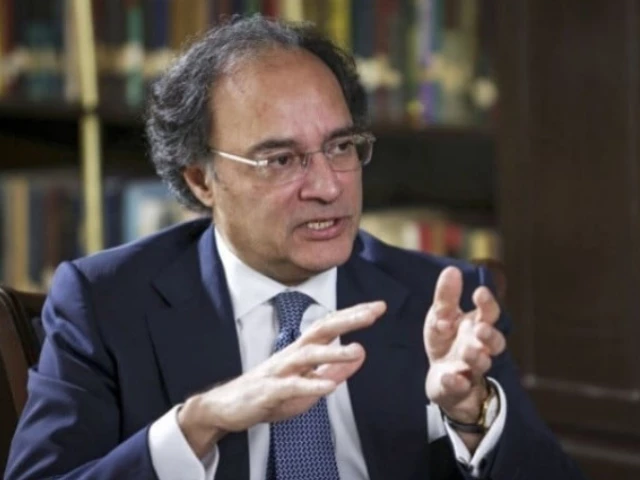
A main arm of parliament on Wednesday declared the International Monetary Fund's (IMF) report an "indictment of the government and parliament", as the finance minister promised to submit an action plan in the current month to address governance and corruption challenges.
"We do not want to use the IMF report to criticise, but it is an indictment of the government and parliament," said Syed Naveed Qamar, Chairman of the National Assembly Standing Committee on Finance. The committee had called the finance minister for a briefing on the IMF report.
However, Finance Minister Muhammad Aurangzeb said that the IMF's report "was not an indictment of the present government".
The National Assembly standing committee meeting took place minutes after a meeting of the Senate Standing Committee on Finance. The Senate committee had also scheduled a briefing on the report, which the finance minister did not attend. Additional Secretary External Finance Saira Najeeb gave an overview of the report to the Senate body.
The senators unanimously condemned corruption and recommended strict measures to eradicate the menace. Senator Farooq H Naek said that the report's findings were related to the government and the bureaucrats.
The Senate committee expressed displeasure over the absence of the finance minister, secretary finance and State Bank of Pakistan governor, and directed them to ensure their presence in the next meeting to formulate a comprehensive strategy to address corruption.
In the NA committee, Aurangzeb assured lawmakers that an action plan would be submitted for implementation of the priority recommendations from the IMF by December 31. It is a condition of the IMF to submit the action plan.
The IMF has diagnosed corruption and governance-related problems in seven different areas, which are critical, and also prescribed 92 recommendations including 15 priority recommendations essential for revitalising these critical sectors. To a question about holding back the release of the report, the finance minister said that the first draft of the report was shared with all the relevant departments and then discussions took place with the IMF in light of their observations.
The finance ministry had earlier said that the IMF too sent the draft report close to the deadline, which did not leave room for discussions with the relevant departments.
Aurangzeb said that the judiciary was on board and has agreed to give an action plan to reduce the backlog of cases and minimise the number of cases related to commercial disputes. He highlighted that the priority recommendations included the publication of declarations of high-level civil servants and the introduction of risk-based verification. The secretary said that asset declarations of officers would be made public from next year.
The minister said that there was also a requirement to avoid budget adjustments during a year without parliamentary approval and to introduce contingency reserves.
Secretary finance claimed that the government was already implementing this measure, but Naveed Qamar disputed the claim and said that the finance ministry should take prior consent of the National Assembly even for technical supplementary grants.
The technical supplementary grants have become a main tool to adjust major expenditures during the course of a fiscal year. Aurangzeb maintained that, as per the IMF's condition, the Special Investment Facilitation Council (SIFC) would submit a report on investment and any concession given.
He said that the IMF has also asked Pakistan to improve FBR's organisational structure, reduce field office autonomy and enhance accountability. It has also proposed to enforce a 10% cap on new projects, rationalise portfolios and protect capital spending.
The IMF's priority recommendations include enhancing investigation, improving money laundering reporting and enhancing asset recovery. It also wants the government to ensure merit-based, transparent selection processes for heads of key oversight bodies, publish an action plan targeting corruption in high-risk agencies and report progress annually. The finance minister said that the government was committed to eliminating preferences for SOEs in state contracts. This is a major objection from the IMF as state-owned entities take expensive major contracts without bidding and then give sub-contracts to private parties. In the briefing to the Senate standing committee, the additional secretary finance said that the corruption report had been finalised after detailed discussions with all stakeholders and it was released after approval from the prime minister.
To a question whether the government accepted the IMF's allegations of corruption, the secretary said that it was not about whether the reports' observations were truthful or not, but it was a holistic diagnosis of the country's governance structure. She said that the government was committed to taking action where needed.
The additional secretary said that the government has taken certain measures and introduced faceless appraisement in Customs to eliminate human interaction and biases in tax assessment.
She said that the government was implementing digital systems for sales tax and monitoring production in tax evasion-prone sectors to plug revenue leaks. It has also rolled out Compliance Risk Management (CRM) and integrated data from 26 agencies to better target audit resources, said the additional secretary
There has been an overhaul of the appellate tribunal to reduce the backlog, including a more transparent appointment process and increasing the number of benches from 20 to 36 to address governance challenges, she said. The finance minister informed the NA committee that Pakistan was not the only country where the IMF held the governance review. He said that such exercises have also been completed in other countries.
The countries where the IMF undertook corruption assessment included Congo, Equatorial Guinea, Peru, Mozambique, Honduras, Guinea-Bissau, Zimbabwe, Central African Republic, Mali, Moldova, Sudan, Paraguay, Zambia, Benin, Mauritania, Cameroon, Sri Lanka, Ukraine and Haiti.
There were 13 countries that undertook the assessment voluntarily. These were Austria, Canada, Germany, France, Italy, Japan, the Czech Republic, Saudi Arabia, Switzerland, the Netherlands, Norway, the United Kingdom and the United States.











This material may not be published, broadcast, rewritten, redistributed or derived from. Unless otherwise stated, all content is copyrighted © 2026 The Express Tribune.






COMMENTS
Comments are moderated and generally will be posted if they are on-topic and not abusive.
For more information, please see our Comments FAQ