Mahira Khan, Hina Rabbani Khar and more to attend Harvard conference
Updated 1 hour ago

Speedy AI tools grow as laws target underage access
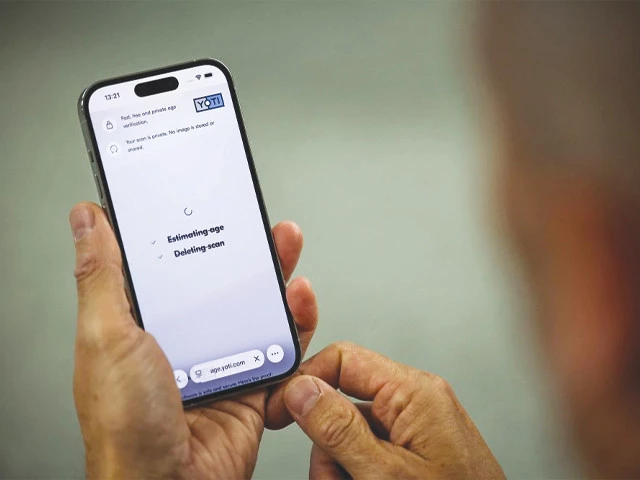
Governments pushing tougher controls on social networks, gaming platforms and adult sites are fuelling a rapid expansion of AI-driven age checks, with selfie-based systems emerging as the preferred enforcement tool for regulators and tech firms seeking quick, low-friction screening.
As online-age gates tighten worldwide, the appeal of these systems lies in their simplicity. A user takes a head-on selfie with a phone or computer camera, and within a minute the automated tool delivers a verdict. On the Roblox gaming site, a recent pop-up bluntly told a tester: "We estimated your age is 18 or older."
At Yoti's London headquarters, mannequin heads lined with wigs and masks are deployed to probe the system's defences. The firm says its AI flags anything that does not resemble a genuine human face, prompting warnings such as: "We can't be sure that the image was of a real face."
Chief executive Robin Tombs said years of training have taught the algorithm to map subtle facial patterns linked with age, allowing it to infer whether a face resembles a teenager or an adult.
The company's growth has accelerated sharply. It now handles about one million checks a day for clients including Meta, TikTok, Sony and Pinterest. Yoti turned profitable this year, reporting $26 million in revenue in the 12 months to March, and expects sales to rise by roughly 50% in its current financial year.
The wider market is also buoyant, with 34 firms in the Age Verification Providers Association, whose earlier forecasts projected potential annual revenue of nearly $10 billion for OECD countries between 2031 and 2036. Yet experts caution that both regulation and technology remain in flux.
AVPA director Iain Corby said it is difficult to predict the sector's trajectory because legal requirements and AI capabilities are evolving at speed. The tools have also drawn scrutiny over possible privacy risks and algorithmic bias.
Olivier Blazy, a cybersecurity professor at Polytechnique, warned that such systems could be intrusive depending on how much user data is shared with verification providers, and suggested a future swing back toward stronger privacy safeguards.
Blazy also highlighted technical vulnerabilities, noting that ordinary make-up can distort estimates by making a person appear older or younger. Independent assessments have found accuracy gaps for some demographics, with one Australian report identifying continued underrepresentation of Indigenous groups in training datasets.
Tombs acknowledged uneven data availability for certain ages and skin tones but maintained that Yoti's tool is trained to detect disguises, make-up tricks or other attempts to subvert the scan.
The company says its system deletes data immediately after analysis, and platforms using selfie-based tools can adjust their thresholds. Sites restricting under-18s often require users to be judged as over 21 to reduce the margin of error.
Anyone landing in the grey zone may still be asked to provide conventional proof, such as uploading a photo or scan of an official ID.









1725429132-0/Untitled-design-(12)1725429132-0-208x130.webp "widespread rain thunderstorms expected across country from april 1 pmd")






This material may not be published, broadcast, rewritten, redistributed or derived from. Unless otherwise stated, all content is copyrighted © 2026 The Express Tribune.






COMMENTS
Comments are moderated and generally will be posted if they are on-topic and not abusive.
For more information, please see our Comments FAQ