<?xml version="1.0" encoding="UTF-8"?>
<rss version="2.0"
	xmlns:content="http://purl.org/rss/1.0/modules/content/"
	xmlns:wfw="http://wellformedweb.org/CommentAPI/"
	xmlns:dc="http://purl.org/dc/elements/1.1/"
	xmlns:atom="http://www.w3.org/2005/Atom"
	xmlns:sy="http://purl.org/rss/1.0/modules/syndication/"
	xmlns:slash="http://purl.org/rss/1.0/modules/slash/"
	xmlns:media="http://search.yahoo.com/mrss/"
	>

<channel>
	<title>The Express Tribune &#187; Sonia Malik</title>
	<atom:link href="http://tribune.com.pk/author/458/sonia-malik/feed/" rel="self" type="application/rss+xml" />
	<link>http://tribune.com.pk</link>
	<description>Latest Breaking Pakistan News, Business, Life, Style, Cricket, Videos, Comments</description>
	<lastBuildDate>Sun, 19 May 2013 21:08:36 +0000</lastBuildDate>
	<language></language>
	<sy:updatePeriod>hourly</sy:updatePeriod>
	<sy:updateFrequency>1</sy:updateFrequency>
	<generator>http://wordpress.org/?v=3.5.1</generator>

		<item>
		<title>Green car: The juice on hybrids in Pakistan </title>
		<link>http://tribune.com.pk/story/549615/green-car-the-juice-on-hybrids-in-pakistan/</link>
		<pubDate>Sun, 19 May 2013 06:57:54 +0000</pubDate>

		<guid isPermaLink="false">http://tribune.com.pk/?p=549615</guid>

		<description>
		<![CDATA[
			<a href="http://tribune.com.pk/story/549615/green-car-the-juice-on-hybrids-in-pakistan/">
				<img src="http://i1.tribune.com.pk/wp-content/uploads/2013/05/549615-car-1368626591-109-160x120.jpg" width="160" height="120" alt="" />
			</a>
			<p><p><strong>If you lived near the Lahore airport and had to drive to Mall road regularly, you’d be open to buying a car whose fuel cost you less. Amir Riaz has that 50km commute, and he’s quite frank about his decision to keep a hybrid car. “I have a [regular car] too,” he told <i>The Express Tribune</i>. “But I prefer taking my [hybrid]. It is just sensible. It consumes one-fourth of the fuel.”</strong></p>
<p>The hybrid guzzles less gas because it uses a combination of petrol and electric power (in the form of a battery). Pakwheels CEO Raza Saeed says over 90% of the hybrids sold on their website are the Toyota Prius manufactured in Japan. Other choices include the Insight and Reborn by Honda or the Civic hybrid. Some high-end names recently introduced to Pakistan are the Porsche hybrid and the BMW 7-series.</p>
<p><img alt="" src="http://pullquotesandexcerpts.files.wordpress.com/2013/05/car-01.jpg" /></p>
<blockquote><p>Porsche Panamera S-E Hybrid</p></blockquote>
<p>While prices may vary depending on the model of the used car, something like the Toyota Prius will set you back 1.4m rupees. If you’ve got the cash to spare you could consider what Porsche, Mercedes and BMW have to offer at a hefty price tag of Rs13.5m. Porsche Pakistan CEO Abuzar Bukhari brought in the first luxury hybrid, the Cayenne, which gives 13.75 kilometres a litre. Interestingly enough, this is an SUV giving you better road mileage than a much smaller non-hybrid 1300cc or 1000cc car. “Pakistanis should not be limited to […] for hybrids,” he argues while naming two companies. “We Pakistanis deserve better, why buy used cars from other countries?”</p>
<p>Imports are the most obvious option, though, especially since no one is making them locally. These hybrids, many from Japan and the UK, are being brought over the Afghan border in Khyber Pakhtunkhwa and Balochistan. However, the majority of them are arriving at Port Qasim in Karachi. About two out of 10,000 used cars reaching Karachi shores each month are hybrids.</p>
<p><img alt="" src="http://pullquotesandexcerpts.files.wordpress.com/2013/05/car-02.jpg" /></p>
<p>The hybrid is considered more environmentally friendly and economical when it comes to fuel consumption. And as petrol prices rise in Pakistan, some people are thinking this type of car is a better option. But despite these positives, this technology is struggling to become a viable player in Pakistan’s controlled market.</p>
<p><strong>No bang for your buck</strong></p>
<p>The government has put the squeeze on importing used cars. It now says that you can’t get them if they are more than three years old. It used to allow used cars that were up to five years old until the end of 2012.</p>
<p>According to official car import numbers, over 1,140 Toyota Prius were imported from July to October 2012 compared to less than a thousand units before the end of the previous financial year. But then the official policy changed.</p>
<p><img alt="" src="http://pullquotesandexcerpts.files.wordpress.com/2013/05/car-03.jpg" /></p>
<blockquote><p>Honda Insight Hybrid</p></blockquote>
<p>“[Newer] used cars mean a higher price,” explains Salman Hameed, a hybrid dealer in Lahore. He was getting up to 70 cars until the government changed the rules. Now it’s just 20 and he thinks demand could sink further. This means that dealers like Hameed who used to be getting the 2007 models are now forced to get the 2010 ones. This means an average price difference of Rs400,000. “But it is also a newer car,” he says.</p>
<p>All of this would change if the government gave local manufacturers incentives. If not, people like Pakwheels CEO Raza Saeed feel that the market for hybrids will remain small because the choices are so limited. If local companies made the car, it would be cheaper and hybrids could possibly become the norm.</p>
<p>Take the example of India where there has been a concerted push by the government. Today, one of India’s leading local manufacturers, Tata, produces the Nano hybrid which is known as the world’s cheapest hybrid at a mere 100,000 Indian rupees.</p>
<p>On the other hand, in Pakistan, the government has deliberately kept a tight fist to protect the existing local car industry. The Federal Board of Revenue, which is the brains behind the import policy on hybrids, openly says it will not be opening the doors on this new technology because local manufacturers will be affected. FBR spokesman Israr Rauf admitted the previous government hadn’t done much to encourage it either. “We have to wait for the next budget first,” he says. “Even then, it is unlikely of the government to take any drastic steps to push local manufacturers to incorporate greener cars.” There is no roadmap on how to factor it into the budget either.</p>
<p><img alt="" src="http://pullquotesandexcerpts.files.wordpress.com/2013/05/car-041.jpg" /></p>
<blockquote><p>Honda Civic Hybrid</p></blockquote>
<p>“The real issue today is that mainstream parties we have spoken to have little clarity on the long-term role of hybrid automobiles,” says Syed Umair, the head of the Lahore Chamber of Commerce’s environmental committee. It is certain though, that globally petrol-only cars will go, he adds.</p>
<p><img alt="" src="http://pullquotesandexcerpts.files.wordpress.com/2013/05/2991.jpg?w=625" /></p>
<p><strong>Features and what to look out for</strong></p>
<p>Hybrids are popular because people think they offer better mileage. Honda’s hybrid switches between the battery and fuel at a speed of up to 40km. The Prius operates dually at a speed of up to 120km, says dealer Hameed.</p>
<p><img alt="" src="http://pullquotesandexcerpts.files.wordpress.com/2013/05/the-deal.jpg?w=625" /></p>
<p>The ordinary hybrid car will likely have automatic windows, steering, a push start button, a remote key and a CD player. Others feature bluetooth, a GPS system, a back-view camera, an auto parking system, a hard-disk drive and a mini-disc player. Some more modified versions have two additional features of cruise control, a keyless entry by touching the car door and a keyless start option.</p>
<p>The deal-breaker is that these used cars don’t come with insurance. For some models the battery needs be changed after 200,000km which is about five years. When you buy one, advises Hameed, make sure you check that the battery is original and the synergy driver has not been tampered with.</p>
<p><img alt="" src="http://pullquotesandexcerpts.files.wordpress.com/2013/05/the-cay.jpg?w=625" /></p>
<p>Another concern is whether we have enough mechanics versed in this technology to repair them. But as has been proven in the past, when the market grows, eventually the manpower catches up. For now, it seems though that unless the government moves, hybrids will be stuck in the back seat.</p>
<p><strong>Hybrids available in Pakistan</strong></p>
<p><b>Cars                         Price                     Models </b></p>
<p>Toyota Prius            Rs1.4m-Rs3.2m          2003-2011</p>
<p>Honda Civic             Rs1.6m-Rs1.8m          2006-2010</p>
<p>Honda Insight         Rs1.7m                         2008-2010</p>
<p>Porsche Cayenne     Rs17m                          2013</p>
<p><b>All the cars mentioned above are imported</b></p>
<p><i>Published in The Express Tribune, Sunday Magazine, May 19<sup>th</sup>, 2013.</i></p>
<p><i>Like </i><a href="https://www.facebook.com/ETribuneMag"><i>Express Tribune Magazine on Facebook</i></a><i> to stay informed and join the conversation. </i></p>
</p>
			<br clear="all"/>
		]]>
		</description>

		<media:content width="424" height="318"
							isDefault="true" medium="image" url="http://i1.tribune.com.pk/wp-content/uploads/2013/05/549615-car-1368626591-109-640x480.jpg">
			<media:title>car 03</media:title>
			<media:description>The Porsche Panamera S E-Hybrid can accelerate from a standstill to 100 km/h in 5.5 seconds. Its special feature is its unique efficiency and the ability to drive considerable distances in all-electric mode. </media:description>
			<media:thumbnail url="http://i1.tribune.com.pk/wp-content/uploads/2013/05/549615-car-1368626591-109-160x120.jpg" width="160" height="120" />
      </media:content>

		<wfw:commentRss></wfw:commentRss>
		<slash:comments>3</slash:comments>
	</item>
		<item>
		<title>Multan Road villages ravaged by hepatitis</title>
		<link>http://tribune.com.pk/story/544135/multan-road-villages-ravaged-by-hepatitis/</link>
		<pubDate>Fri, 03 May 2013 21:04:15 +0000</pubDate>

		<guid isPermaLink="false">http://tribune.com.pk/?p=544135</guid>

		<description>
		<![CDATA[
			<a href="http://tribune.com.pk/story/544135/multan-road-villages-ravaged-by-hepatitis/">
				<img src="http://i1.tribune.com.pk/wp-content/uploads/2013/05/544135-Watersupply-1367605435-621-160x120.JPG" width="160" height="120" alt="" />
			</a>
			<p><div><strong class='location'>LAHORE:&nbsp;</strong>
<p><strong>In the past five years, Aslam, a resident of Baath village, has lost seven friends to hepatitis. Close to half of the village’s residents, he says, have been infected with the disease in the last three years.</strong></p>
</div>
<p>Syed Ahmad, a resident of Naye Abadi village, also off Multan Road, says he knows of up to 20 village residents who have died of Hepatitis A in the last year. Gastroenteritis and typhoid are also common, particularly in children aged under 10. “The water we drink is not even suitable for animals,” he says.</p>
<p>Baath and Naye Abadi are among 12 villages along a 35-kilometre stretch of Multan Road where water-borne diseases are common and much of the population is sickly. The water supply is contaminated not just by waste produced domestically, but also by that produced by some 500 factories located nearby. Though the problem arose years ago, civic agencies have done nothing to tackle it.</p>
<p>Three years ago, Aslam, a lawyer, and over a thousand other residents staged a sit-in to protest against the factories’ dumping practices. About 200 FIRs were registered against the demonstrators by the police for disrupting public order. “Everyone backed off and I could not fight alone,” says Aslam.</p>
<p><strong>Water testing </strong></p>
<p>Two months ago, the Environmental Protection Agency tested water samples from the area in the laboratory, EPA officials told <em>The Express Tribune</em>. The water samples contained TDS (total dissolved solids) levels of 4,400mg/l, more than five times the maximum safe limit of 800mg/l set in the Punjab Environment Protection Act of 2012. Microbial tests revealed that the water had a high bacteria and virus content. The arsenic levels were over 100 parts per billion, above the limit of 50ppb set in PEPA 2012.</p>
<p>TDS levels indicate the amount of dissolve substances in water, says Tauqueer Qureshi, an EPA director and specialist in industrial waste. “It could contain faeces or metals that can cause chronic diseases such as arsenic, lead and chromium,” he says.</p>
<p>The only mechanism for treating waste water adulterated with organic waste is reverse osmosis. “It is extremely expensive. The water must first be filtered, then cleansed through the process of reverse osmosis and then disinfected and re-mineralised,” he says.</p>
<p><strong>Sources of waste</strong><b> </b></p>
<p>The groundwater is heavily contaminated with organic waste because of a lack of sewerage. Not only do the villages lack sewage systems to usher away waste produced domestically, but they are located near some 500 factories which, with the exception of 10 or so, dump chemical and organic waste in socket pits 80 to 150 feet deep.</p>
<p>“The factories are dumping the sanitary waste from toilets used by factory employees, which is seeping into the ground water used for drinking,” an EPA official said.</p>
<p>Dr Afshan Siddiqi says water laced with human excreta can cause typhoid, gastroenteritis, and hepatitis A and E. Jaundice (hepatitis A) is underreported because people prefer being treated at home and usually do not seek a doctor’s help, she said.</p>
<p>Boiling drinking water is usually recommended in areas with high rates of hepatitis, she adds. The villagers do this, but the results are unappetising. “As the water simmers, a green mush forms at the top,” says Aslam of Baath village. “The water remains brackish and yellow even after boiling.”</p>
<p><strong>Who’s responsible? </strong></p>
<p>Deputy District Officer (Environment) Younas Zahid says the rise in the number of Hepatitis A cases is mainly due to poor sanitation in the villages.</p>
<p>They do not have proper sewerage, with various departments and agencies disputing whose responsibility it is to provide such systems. For several years, they have debated whether it falls in Lahore’s city limits – in which case it would be the Water and Sanitation Agency’s responsibility – or is a rural area – in which it case it would be the Public Health Engineering Department’s job to build sewerage.</p>
<p>Zahid said that about three years ago, Wasa had agreed to establish a sewerage system at Shaam Ki Bhatian, another village off Multan Road, provided the National Highway Authority (NHA) provide land along the road and the locals agree to raise funds. But NHA officials said that there was not enough land along the road and the plan did not materialise, he said.</p>
<p>Former district officer (spatial planning) Tamana Mehmood told <em>The Express Tribune</em> that according to the Lahore Master Plan for 2021, the area beyond Thokar Niaz Beg off Multan Road is an agricultural area within the city limits, in Allama Iqbal Town. However, he indicated that some of the region where the factories are located may be rezoned as an industrial area in the Master Plan for 2035.</p>
<p>Wasa spokesman Irfan Ghauri said that the city government had recently suggested that the area beyond Thokar Niaz Beg be included in Wasa jurisdiction. “However it has not been officially taken over yet,” he said. “Once that happens, Wasa will be informed of the details of the area and given budget additions. This is only likely to happen after the elections.”</p>
<p>Mirza Suhail Aamir, the secretary of the Housing, Urban Development and Public Health Engineering Department, was unavailable for comment.</p>
<p><em>Published in The Express Tribune, May 4<sup>th</sup>, 2013.</em></p>
</p>
			<br clear="all"/>
		]]>
		</description>

		<media:content width="424" height="318"
							isDefault="true" medium="image" url="http://i1.tribune.com.pk/wp-content/uploads/2013/05/544135-Watersupply-1367605435-621-640x480.JPG">
			<media:title>Water supply</media:title>
			<media:description>Though the problem arose years ago, civic agencies have done nothing to tackle it. PHOTO: FILE</media:description>
			<media:thumbnail url="http://i1.tribune.com.pk/wp-content/uploads/2013/05/544135-Watersupply-1367605435-621-160x120.JPG" width="160" height="120" />
      </media:content>

		<wfw:commentRss></wfw:commentRss>
		<slash:comments>0</slash:comments>
	</item>
		<item>
		<title>Forests workshop: Trees in south Punjab felled at ‘alarming rate’ </title>
		<link>http://tribune.com.pk/story/542183/forests-workshop-trees-in-south-punjab-felled-at-alarming-rate/</link>
		<pubDate>Mon, 29 Apr 2013 23:53:42 +0000</pubDate>

		<guid isPermaLink="false">http://tribune.com.pk/?p=542183</guid>

		<description>
		<![CDATA[
			<a href="http://tribune.com.pk/story/542183/forests-workshop-trees-in-south-punjab-felled-at-alarming-rate/">
				<img src="http://i1.tribune.com.pk/wp-content/uploads/2013/04/542183-WWFlogo-1367279580-288-160x120.jpg" width="160" height="120" alt="" />
			</a>
			<p><div><strong class='location'>LAHORE:&nbsp;</strong>
<p><strong>The riverine forests in southern Punjab are being chopped down at an “alarmingly fast rate”, according to a recent survey by the World Wide Fund for Nature-Pakistan (WWF-P).</strong></p>
</div>
<p>“In Punjab, there are three forest types – the pine forests of Murree, the scrubs of the Salt Range and the riverine forests near Kot Addu, Vehari and Muzaffargarh,” said Ibrahim Khan, the WWF-P senior manager for conservation in Khyber Pakhtunkhwa, at a workshop here on Monday.</p>
<p>The riverine forests, mainly along the River Indus in south Punjab, are being chopped down at an alarmingly fast rate compared to other natural forests in the Punjab, Khan said.</p>
<p>In the recent survey, residents near forests in 10 districts – two each in the Punjab, Sindh, Khyber-Pakhtunkhwa and Balochistan, and one each in Gilgit-Baltistan and Azad Jammu and Kashmir – were interviewed to find out why trees were being chopped down.</p>
<p>“Deforestation is far more complex and pervasive in Gilgit Baltistan, Azad Jammu Kashmir and Khyber Pakhtunkhwa than Balochistan, Sindh and the Punjab,” said Khan. This was because in the former areas, people were more dependent on the forests for their livelihoods and the timber mafias were stronger.</p>
<p>The survey was conducted as part of the REDD+ (Reducing Emissions from Deforestation and Degradation) project, funded by the United Nations. The two-day workshop aims to educate stakeholders on how REDD can bring positive change in forested areas.</p>
<p>The workshop organised by the Ministry of Climate Change, the UN and the International Centre for Integrated Mountain Development (ICIMOD),   was attended by officials from the Forest, Wildlife and Fisheries, the Livestock and Agriculture, and the Environment Protection Departments, as well as students and professors from the University of Agriculture Faisalabad, the Government College University Lahore and the University of the Punjab.</p>
<p>The challenge is to convince stakeholders to agree and cooperate in implementing projects to combat deforestation and degradation, Khan said.</p>
<p>The workshop, inaugurated by Wildlife Secretary Dr Amir Ahmad, began with an overview of forests in the Punjab and was followed by an introduction to REDD and its roadmap development process for Pakistan.</p>
<p>The REDD project aims to create financial value for the carbon stored in forests by offering incentives for developing countries to reduce emissions from forested lands and by investing in low-carbon paths to sustainable development. So far the WWF-P has received $200,000 (Rs20 million) in funding from the UN and will receive another $100,000 (Rs10 million) in June.</p>
<p>Faiza Lodhi, the REDD+ coordinator for WWF-P, said a roadmap for Pakistan will be finalised by December 2013, after which implementation will begin. The project is more advanced in Nepal than in the rest of South Asia. A demonstration site has been set up in Godawari, a hilly village in northern Nepal where locals are being taught ways to conserve water for fish farming, to make briquettes for fuel using hay or sand with coal to reduce dependency on forest wood, and to plant kiwi trees to earn extra money. All these activities help reduce the need for chopping down trees, Lodhi said.</p>
<p>Nepal has increased its forest cover in the last three years, going up to 25.36 per cent, according to a 2012 World Bank report. India, Bangladesh and Pakistan are still in the preparation phases for REDD initiatives, Lodhi said.</p>
<p>The WWF-Pakistan has already hosted workshops in AJK and KPK and plans to hold them in in Gilgit Baltistan, Sindh and Balochistan next.</p>
<p><em>Published in The Express Tribune, April 30<sup>th</sup>, 2013.</em></p>
</p>
			<br clear="all"/>
		]]>
		</description>

		<media:content width="424" height="318"
							isDefault="true" medium="image" url="http://i1.tribune.com.pk/wp-content/uploads/2013/04/542183-WWFlogo-1367279580-288-640x480.jpg">
			<media:title>WWF-logo</media:title>
			<media:description>The WWF-Pakistan has already hosted workshops in AJK and KPK and plans to hold them in in Gilgit Baltistan, Sindh and Balochistan next. PHOTO: WWF</media:description>
			<media:thumbnail url="http://i1.tribune.com.pk/wp-content/uploads/2013/04/542183-WWFlogo-1367279580-288-160x120.jpg" width="160" height="120" />
      </media:content>

		<wfw:commentRss></wfw:commentRss>
		<slash:comments>0</slash:comments>
	</item>
		<item>
		<title>Au naturale: Foodies flock to City’s first farmers’ market </title>
		<link>http://tribune.com.pk/story/541836/au-naturale-foodies-flock-to-citys-first-farmers-market/</link>
		<pubDate>Sun, 28 Apr 2013 21:04:19 +0000</pubDate>

		<guid isPermaLink="false">http://tribune.com.pk/?p=541836</guid>

		<description>
		<![CDATA[
			<a href="http://tribune.com.pk/story/541836/au-naturale-foodies-flock-to-citys-first-farmers-market/">
				<img src="http://i1.tribune.com.pk/wp-content/uploads/2013/04/541836-food-1367174452-950-160x120.jpg" width="160" height="120" alt="" />
			</a>
			<p><div><strong class='location'>LAHORE:&nbsp;</strong>
<p><strong>Nine months ago, Qasim Khawaja, a resident of the Cantonment, started experimenting with cheese recipes at his home. He began selling cream cheese and ricotta in January this year.  Encouraged by early success, he added gouda, mascarpone, cottage, cheddar and mozzarella to his products. His Grade A Farms supplies cheese on order.</strong></p>
</div>
<p>“Most of the cheese available in supermarkets here is imported from the US or Europe. It is priced really high,” he says, “I started small because I did not know how the market would respond to European cheese produced in Pakistan.”</p>
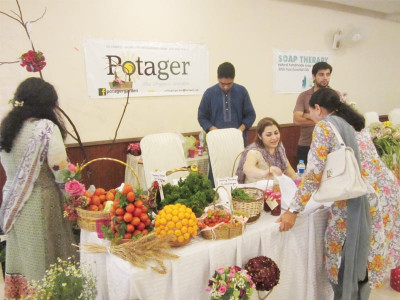
<p>Khawaja had set up one of the 30 stalls at the Khaalis Food Market, Lahore’s first farmers’ market, at MM Alam Road on Sunday. Within 20 minutes of opening at 3pm, the cream cheese was sold out. Mozarella and mascarpone, priced between Rs200 to Rs250 for 200 grams, were sold out next.</p>
<p>The market featured home-based entrepreneurs, mostly residents of Model Town, Defence and Cantt, who grow vegetables at their homes. There were vendors selling jams, chutneys and spreads, gluten-free breads, muffins and organic teas. A few restaurants had also set up stalls.</p>
<p><img alt="" src="http://pullquotesandexcerpts.files.wordpress.com/2013/04/asma-shah.jpg?w=625" /></p>
<p>The event was organised by Asma Shah and Rizwan, editor of the Flavour magazine.</p>
<p>“Most of the vegetables sold in Lahore’s markets are grown in water contaminated by industrial waste. Many people have begun growing their own produce in their gardens, with little sewage intrusion,” Shah says. There is a gulf between those growing organic food to sell and consumers interested in purchasing safe and healthy fresh produce, she said. “We set up this market to bring them together,” she said.</p>
<p>Sonia Saleem, a nutritionist, had a series of diet plans lined up for sale at her stall. “This is a 10-day junk-cleanse plan. It is a combination of meditation, diet and exercise which help detoxify the body,” said Saleem. The plans sold for Rs1,000 each. “My clients can call me to ask questions at each step,” she said.</p>
<p>Samrah Jabeen has been managing an agri-business project, an initiative funded by the USAID to encourage small farmers to grow organic food. She said she had been training farmers to grow organic food since May 2012. The project’s stall had 16 varieties of vegetable, nuts and honey.  Jabeen said farmers across Lahore were being trained in vegetable growing techniques. People had been trained to grow nuts and farm honey in and on the outskirts of Peshawar. Five farmers, including Naseem Akhtar, the trainer in Peshawar, were present at the stall. Akhtar had brought two types of honey and nuts from Swat. Jabeen said it was a non-profit project with the proceeds going to the farmers.</p>
<p>Tanya Elahi, the owner of Simply Bread, was selling a variety of breads, health bars, desserts, drinks, dips and condiments.  Elahi said she began cooking gluten-free food, dairy products and sugar on account of her daughter’s food allergies. “I started baking for my family then decided to expand so others too could benefit,” she said. Elahi is based in Defence and has been baking on order.</p>
<p>Aysha Raja, proprietor of The Last Word bookshop, had set up a stall of baked items and recipe books. “I baked the food here using recipes from these books. I tell people to buy the books if they enjoyed the food,” she said.</p>
<p>The iced teas- mint, chamomile, and lavender- made using home-grown produce, sold out quickly.</p>
<p>Farhana, a resident of Model Town, was selling cherry tomatoes. “We did not use pesticides. The tomatoes are pure and nutritious.”</p>
<p>Shah said they would try to arrange the farmers’ market on a weekly or fortnightly basis after Ramazan.</p>
<p>“We will organise a market in Islamabad next month. Many people from Islamabad and Karachi had contacted us but only Necos set up a stall here,” said Shah.</p>
<p><i>Published in The Express Tribune, April </i><i>29<sup>th</sup>, 2013.</i></p>
</p>
			<br clear="all"/>
		]]>
		</description>

		<media:content width="424" height="318"
							isDefault="true" medium="image" url="http://i1.tribune.com.pk/wp-content/uploads/2013/04/541836-food-1367174452-950-640x480.jpg">
			<media:title>food 01</media:title>
			<media:description>The market featured home-based entrepreneurs, mostly residents of Model Town, Defence and Cantt, who grow vegetables at their homes. </media:description>
			<media:thumbnail url="http://i1.tribune.com.pk/wp-content/uploads/2013/04/541836-food-1367174452-950-160x120.jpg" width="160" height="120" />
      </media:content>

		<wfw:commentRss></wfw:commentRss>
		<slash:comments>3</slash:comments>
	</item>
		<item>
		<title>Innovative media: Exploring haunted terrain</title>
		<link>http://tribune.com.pk/story/541430/innovative-media-exploring-haunted-terrain/</link>
		<pubDate>Sat, 27 Apr 2013 21:21:22 +0000</pubDate>

		<guid isPermaLink="false">http://tribune.com.pk/?p=541430</guid>

		<description>
		<![CDATA[
			<a href="http://tribune.com.pk/story/541430/innovative-media-exploring-haunted-terrain/">
				<img src="http://i1.tribune.com.pk/wp-content/uploads/2013/04/541430-art-1367088612-803-160x120.jpg" width="160" height="120" alt="" />
			</a>
			<p><div><strong class='location'>LAHORE:&nbsp;</strong>
<p><strong>For artist Aleem Dad Khan, inspiration for his work comes from his expeditions in Pakistan.</strong></p>
</div>
<p><i>Gorge Slide</i>, one of eight paintings by the artist to go on display at 39K Gallery on Friday evening, offers a scenic view of Darail in Kohistan, an area said to be haunted.</p>
<p>“Travellers are advised to avoid it during the day and to pass through at night and quickly,” says the Hunza native. He stopped at the spot a few months ago in daylight to capture its vivid mountainous terrain, ignoring the locals’ advice. “It was creepy,” he adds.</p>
<p>In <i>Hot Engagement</i>, Khan combines a symbol of a horseman with a female idol, images coming from different regions of the country. “Many rocks are inscribed with an ancient sign language as one travels north beyond Hunza. I have painted one of those symbols next to a painting of a goddess from the Indus Valley civilisation in the south,” he says.</p>
<p><i>Opening Slide </i>gives a view of a hillside through a car window, while <i>Slab Slide</i> looks at the Margala Hills from a desk. “Khan has cleverly combined human impressions of nature and vice versa through his work in tarpaulin, an unexplored art medium,” said curator Rakshanda Atawar.</p>
<p>Atawar said she became a fan of the artist after seeing a painting by Khan at the Pakistan National Council of Arts in Islamabad a few months ago.</p>
<p>“I prefer exploring different mediums myself as an artist and this was the first time I saw someone use tarpaulin,” she said.</p>
<p>Khan’s works involve the use of charcoal, gouache (vegetable paints) and gesso, a material used for preparing the surface of a canvas. “Interestingly, he has used gesso as a painting medium and not to even out the surface,” she said.</p>
<p>The works, priced at around Rs100,000 each, will remain on display until May 7.</p>
<p>Khan attended the National College of Arts from 1999 to 2002, training as a print artist.</p>
<p>He teaches at the Fatima Jinnah College for Women and the National College of Arts, both in Rawalpindi. He often travels between Hunza and Islamabad, where he currently resides.</p>
<p><em>Published in The Express Tribune, April 28<sup>th</sup>, 2013.<b></b></em></p>
</p>
			<br clear="all"/>
		]]>
		</description>

		<media:content width="424" height="318"
							isDefault="true" medium="image" url="http://i1.tribune.com.pk/wp-content/uploads/2013/04/541430-art-1367088612-803-640x480.jpg">
			<media:title>art</media:title>
			<media:description>Works by Aleem Dad Khan on display till May 7.</media:description>
			<media:thumbnail url="http://i1.tribune.com.pk/wp-content/uploads/2013/04/541430-art-1367088612-803-160x120.jpg" width="160" height="120" />
      </media:content>

		<wfw:commentRss></wfw:commentRss>
		<slash:comments>0</slash:comments>
	</item>
		<item>
		<title>Toxic emissions: Alternative factory fuels causing respiratory disease</title>
		<link>http://tribune.com.pk/story/540172/toxic-emissions-alternative-factory-fuels-causing-respiratory-disease/</link>
		<pubDate>Wed, 24 Apr 2013 21:36:19 +0000</pubDate>

		<guid isPermaLink="false">http://tribune.com.pk/?p=540172</guid>

		<description>
		<![CDATA[
			<a href="http://tribune.com.pk/story/540172/toxic-emissions-alternative-factory-fuels-causing-respiratory-disease/">
				<img src="http://i1.tribune.com.pk/wp-content/uploads/2013/04/540172-image-1366827291-333-160x120.JPG" width="160" height="120" alt="" />
			</a>
			<p><div><strong class='location'>LAHORE:&nbsp;</strong>
<p><strong>Around 30 complaints were received from workers and people living near factories in the city over the last two months, an Environment Protection Agency (EPA) official requesting anonymity told <em>The Express Tribune.</em></strong></p>
</div>
<p>Ever since gas supply to industries has become irregular, an increasing number of factories have begun using rice husk, corn cobs and mustard husk as cheap alternatives to run the furnaces.</p>
<p>Rizwan, a worker living close to the factory he works at on Defence Road, says he has filed several complaints about the high carbon soot emitted by the factory chimneys to the Environment Protection Agency (EPA).</p>
<p>Nearly 1,000 workers at the factory have contracted eye infection and respiratory disease, he said. Several workers have reported the problem to the EPA.</p>
<p>When Descon Engineering Metalics Manufacturing Manager Captain Ghulam Mustafa was contacted about the matter, he refused to comment.</p>
<p>The first such complaint was filed in 2007. Rizwan says the EPA has been checking smoke emissions from these factories. However, he says, the factory he works at has not stopped using rice husk as a replacement for furnace oil.</p>
<p>“Inspectors from the EPA carry out inspections, issue warnings and sometimes an environment protection order. The factory’s administration stops using rice husk and corn cobs for a few days, but after a while they switch back to these,” Rizwan said.</p>
<p>As many as 200 factories in the city, particularly textile and paper factories have been using rice husk, corn cobs and mustard husk in the place of gas and furnace oil. These fuels emit high levels of ash particles and dust that cause respiratory disease in workers and people living near the factories.</p>
<p>The EPA official said most of the factories using the alternative fuels were situated along the Defence Road, Hadiara Drain, and Sunder and Quaid-i-Azam Industrial Estates.</p>
<p>The people working in these factories and those living near them often complained about their clothes and houses being covered in soot, he said. If scrubbers were installed, he said they would wash down the ash (thus reducing air pollution) but the factories would likely dump their waste water exceeding safe bio-chemical oxygen demand (BOD) and chemical oxygen demand (COD) standards untreated into the River Ravi.</p>
<p>The Ringelmann scale, used to measure the apparent density of smoke on a scale of zero (white) to five (black), gives a reading of five factories burning rice husk. This is even higher than rubber tyres and furnace oil that give readings between two and four, the official said. “This is a big problem and will only get bigger unless concerted efforts are taken to solve it.”</p>
<p>Availability of the bio-fuels varies seasonally. Rice husk is not available nowadays so mustard husk and wheat husk are being used instead. Shah Kaan Textiles General Administrator Muhammad Ajaz says the factory has been using alternative fuel for two years “because of the gas shortage”. The EPA inspected the factory following complaints of high smoke emissions and told the owners to install electrostatic precipitators (ECPs) and cyclones that wash down the ash.</p>
<p>Ajaz says the factory has upgraded its boiler and installed one with a higher capacity. Around 2,400 maunds of husk are now used daily. In 2013, the price for a maund of rice husk went up from Rs300 to Rs550, the price for mustard husk from Rs150 to Rs310 and corn cobs up to Rs450. A tonne of these bio-fuels, he said, could cost between Rs2,200 and Rs2,500. Furnace oil, a cleaner alternative fuel, costs Rs5,000 per tonne and gas costs up to Rs1,450 per tonne, said Ajaz.</p>
<p>Most of these bio-fuels are brought by farmers from Dipalpur and Mian Channu in southern Punjab to the industrial zones in Lahore, Sialkot and Sheikhupura, he said.</p>
<p>A factory worker says rice husk is considered the most efficient bio-fuel followed by corn cobs and mustard husk.</p>
<p>Deputy Environment District Officer Younas Zahid says there is no harm in using rice or mustard husk or corn cobs as long as the factories use scrubbers to prevent ash particles from escaping into the air.</p>
<p>However, he says, these scrubbers use electricity, the cost of which factory owners are reluctant to bear. He says Shah Kaan Textiles were issued warnings and have since installed electrostatic precipitators.</p>
<p>“We realise there is a shortage of clean fuels. We advise factories, that use husk, to install and operate scrubbers,” Zahid says.</p>
<p><em>Published in The Express Tribune, April 25<sup>th</sup>, 2013.</em></p>
</p>
			<br clear="all"/>
		]]>
		</description>

		<media:content width="424" height="318"
							isDefault="true" medium="image" url="http://i1.tribune.com.pk/wp-content/uploads/2013/04/540172-image-1366827291-333-640x480.JPG">
			<media:title>001</media:title>
			<media:description>Ever since gas supply to industries has become irregular, an increasing number of factories have begun using rice husk, corn cobs and mustard husk as cheap alternatives to run the furnaces.</media:description>
			<media:thumbnail url="http://i1.tribune.com.pk/wp-content/uploads/2013/04/540172-image-1366827291-333-160x120.JPG" width="160" height="120" />
      </media:content>

		<wfw:commentRss></wfw:commentRss>
		<slash:comments>0</slash:comments>
	</item>
		<item>
		<title>Strategic changes: ‘Pakistan has complex issues due to climate change’ </title>
		<link>http://tribune.com.pk/story/539460/strategic-changes-pakistan-has-complex-issues-due-to-climate-change/</link>
		<pubDate>Tue, 23 Apr 2013 20:34:23 +0000</pubDate>

		<guid isPermaLink="false">http://tribune.com.pk/?p=539460</guid>

		<description>
		<![CDATA[
			<a href="http://tribune.com.pk/story/539460/strategic-changes-pakistan-has-complex-issues-due-to-climate-change/">
				<img src="http://i1.tribune.com.pk/wp-content/uploads/2013/04/539460-Climatechange-1366749185-695-160x120.jpg" width="160" height="120" alt="" />
			</a>
			<p><div><strong class='location'>LAHORE:&nbsp;</strong>
<p><strong>“We have suggested building several upstream water reservoirs in Pakistan to prevent floods. We are also examining reforestation as it slows down the process of floods and subsequent droughts,” Marius Keller, an adaptation consultant with the International Institute of Sustainable Development, said speaking to Lahore University of Management Sciences students on Monday.</strong></p>
</div>
<p>Keller presented an overview of climate change, examining its impact on economy, poverty and development in several countries. He stressed the need for an enabling environment where government and research institutes could work together towards adapting climate resilient measures.</p>
<p>Keller said that in the last 20 years 140 climate-change triggered events in Pakistan had lead to an average of 500 deaths every year and a loss of $200 million to the country’s economy. He added that in the last 120 years, the average temperature had risen by 2 degrees Celsius globally. He said the temperature in Pakistan had risen by 0.57 degrees Celsius. He added that the sea level had risen by 1.2mm annually and would likely be up by 40mm in 2100.</p>
<p>Keller has been invited by Lead Pakistan to aid the Ministry of Climate Change in devising a national level implementation plan. He said his main objective was to integrate climate change development in a peaceful manner to help people adapt well. He said his team would also assess the climate vulnerability of semi-arid areas.</p>
<p>“Since Pakistan has a very complex geographical terrain, it also has complex issues arising due to climate change.” He added that the ministry had asked for assistance in the areas of food and water security. “But they place even higher importance on attaining sustainable energy.”</p>
<p>He said they had proposed more diversified and durable climate resilient crops which are less dependent on water. “Design systems have been suggested that are robust in more ways than one.” He explained this idea further saying that dams could be built not to certain capacity but to adjust to extreme weather conditions.</p>
<p>Keller said that the national climate change policy was a good stepping stone but no good would come of it until the provinces were engaged. “The policy needs to be decentralised &#8230; as people at the grassroots level are the most affected by climate change.”</p>
<p>He said Pakistan needed to figure out key projects and prioritise those. He said it was of utmost importance to bring all stakeholders on board for a project. He said the IISD involved stakeholders from day one. He added that recently they had had a scoping session with the key ministries in Islamabad.</p>
<p>Event moderator Rafay Alam announced a LUMS climate change project in collaboration with the Worldwide Fund for Nature-Pakistan. He said students and researchers were observing meteorological data of eight districts in the Punjab and Sindh to note changes in weather patterns and the ways in which local farmers adapted to those changes.</p>
<p>“It will be a good baseline study for future reference.”<em></em></p>
<p><em>Published in The Express Tribune, April 24<sup>th</sup>, 2013. </em></p>
</p>
			<br clear="all"/>
		]]>
		</description>

		<media:content width="424" height="318"
							isDefault="true" medium="image" url="http://i1.tribune.com.pk/wp-content/uploads/2013/04/539460-Climatechange-1366749185-695-640x480.jpg">
			<media:title>Climate change</media:title>
			<media:description>&quot;The policy needs to be decentralized as people at the grassroots level are the most affected by climate change,&quot; says Marius Keller. PHOTO: FILE</media:description>
			<media:thumbnail url="http://i1.tribune.com.pk/wp-content/uploads/2013/04/539460-Climatechange-1366749185-695-160x120.jpg" width="160" height="120" />
      </media:content>

		<wfw:commentRss></wfw:commentRss>
		<slash:comments>1</slash:comments>
	</item>
		<item>
		<title>Architectural nostalgia: Ajaz Anwar recreates Old Lahore in water colour</title>
		<link>http://tribune.com.pk/story/538378/architectural-nostalgia-ajaz-anwar-recreates-old-lahore-in-water-colour/</link>
		<pubDate>Sat, 20 Apr 2013 20:31:41 +0000</pubDate>

		<guid isPermaLink="false">http://tribune.com.pk/?p=538378</guid>

		<description>
		<![CDATA[
			<a href="http://tribune.com.pk/story/538378/architectural-nostalgia-ajaz-anwar-recreates-old-lahore-in-water-colour/">
				<img src="http://i1.tribune.com.pk/wp-content/uploads/2013/04/538378-Architecturalnostalgia-1366487759-997-160x120.JPG" width="160" height="120" alt="" />
			</a>
			<p><div><strong class='location'>LAHORE:&nbsp;</strong>
<p><strong>Lahore Reincarnated, an art exhibition, by Dr Ajaz Anwar opened at the Colour Art Gallery in Gulberg on Saturday.</strong></p>
</div>
<p>The exhibit is at once a tribute to his teacher Ana Molka Ahmed, the founder of what is now the Punjab University College of Art and Design and “a call to preserve the essence of historic architecture of the city,” Dr Anwar says.</p>
<p>“Lahore is dying. The entire city is on the death bed. This is an appeal to save the city,” says Dr Anwar, who is also a conservationist, an environmentalist and a member of the Dilkash Lahore steering committee. Dr Anwar began painting in the late 1950’s. He received the president’s Pride of Performance award in 1997. He has also been the curator of the Zahoorul Akhlaq Gallery at the NCA till six years ago.</p>
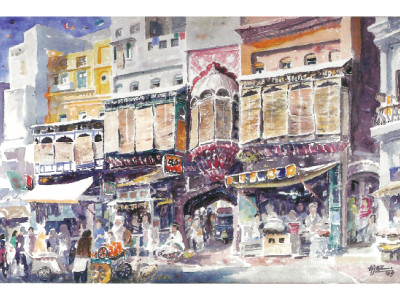
<p>The exhibit showcases 10 large water colour paintings that Dr Anwar completed over the last two years.</p>
<p>“These paintings have a similar theme: the historical buildings in the Walled City. I have experimented with the composition and the angles,” says the artist.</p>
<p>The painting, <i>Gathering of the Storm</i>, shows Bradlaugh Hall behind the University of Veterinary and Animal Sciences. The hall had housed the arts council. It was built with large windows and doors for ventilation. It was constructed in 1900, just before the arrival of electricity in Lahore, explains Dr Anwar. “The now dilapidated hall could collapse any moment,” he says, adding, “The painting is an appeal to the authorities to save it.”</p>
<p><i>Kucha Pir Shirazi II</i>, another painting, is reminiscent of the ancient structures inside Shah Almi Gate. <i>Muran Han II </i>shows an English haveli, opposite Monnoo House on Montgomery Road that was demolished 15 years ago.</p>
<p>“The building exists only in my paintings and in my mind. I have painted it from three different angles previously,” says Dr Anwar, who repainted it in 2012.</p>
<p>The painting, <i>Railway Road III</i>, commemorates the demolished architectural facets of the road connecting the Walled City to the City Railway Station.</p>
<p>A 28 by 42 inch painting titled <i>The 40 Thieves </i>shows several historic buildings being torn down at the Urdu Bazaar. The ‘thieves’ in the painting are the donkeys transporting the rubble from the buildings, says Dr Anwar.</p>
<p>“Lahore and brightness of colours and light complement one another,” he said.</p>
<p>“I am displaying these paintings for my friends and fans and anyone interested in having a look at them,” Dr Anwar says. Most of the visitors at the opening were students and faculty of the National College of Arts where Dr Anwar taught till 2000, and some senior artists.</p>
<p>“The paintings are not for sale. It’s more like a travelling exhibition,” says Dr Anwar. Some pieces have been displayed at the House of Nanna- a trust established by Dr Anwar in 2010.</p>
<p>“Looking at Dr Anwar’s work is always an experience to relish. His facility with working large scale water colours is evident. It seems as if the city is waiting to be picked up for his subject matter,” said Asad Hayee, a former student of Dr Anwar at the NCA.</p>
<p>The paintings will remain on display until April 30.<em></em></p>
<p><em>Published in The Express Tribune, April 21<sup>st</sup>, 2013.</em></p>
</p>
			<br clear="all"/>
		]]>
		</description>

		<media:content width="424" height="318"
							isDefault="true" medium="image" url="http://i1.tribune.com.pk/wp-content/uploads/2013/04/538378-Architecturalnostalgia-1366487759-997-640x480.JPG">
			<media:title>Architectural nostalgia02</media:title>
			<media:description>The exhibit showcases 10 large water colour paintings completed over two years.</media:description>
			<media:thumbnail url="http://i1.tribune.com.pk/wp-content/uploads/2013/04/538378-Architecturalnostalgia-1366487759-997-160x120.JPG" width="160" height="120" />
      </media:content>

		<wfw:commentRss></wfw:commentRss>
		<slash:comments>1</slash:comments>
	</item>
		<item>
		<title>Baisakhi 2013: Number of Indian yatris falls by 60%  </title>
		<link>http://tribune.com.pk/story/537358/baisakhi-2013-number-of-indian-yatris-falls-by-60/</link>
		<pubDate>Thu, 18 Apr 2013 21:34:21 +0000</pubDate>

		<guid isPermaLink="false">http://tribune.com.pk/?p=537358</guid>

		<description>
		<![CDATA[
			<a href="http://tribune.com.pk/story/537358/baisakhi-2013-number-of-indian-yatris-falls-by-60/">
				<img src="http://i1.tribune.com.pk/wp-content/uploads/2013/04/537358-Visa-1366320748-758-160x120.jpg" width="160" height="120" alt="" />
			</a>
			<p><div><strong class='location'>LAHORE:&nbsp;</strong>
<p><strong>This year’s Baisakhi festivities had fewer participants than the last few years. The reason: a significantly lower turnout of Sikh pilgrims from India.</strong></p>
</div>
<p>Compared to about 3,000 pilgrims who visited in 2011 and 2012, only 1,137 Indian yatris were able to get visas this year in addition to about 150 pilgrims from other countries including Canada, USA and Dubai.</p>
<p>According to Evacuee Trust Property Board (ETPB) Deputy Secretary Azhar Nazir Sulehri said the reason for the plunge in numbers was that many in India had applied for a visa “at the last minute”, which meant that the visas could not be processed. A visa requires 45 working days to be processed. Those who had applied on time were issued visas, he said.</p>
<p>Sulehri said that the board had made arrangements to accommodate 3,000 Sikh pilgrims this year too. The ETPB, he said, had arranged for 150 extra rooms at the gurdwaras at Hasanabdal and Nankana Sahib, where the pilgrims spent the first six days of their visit.</p>
<p>Khushwant Singh, who has been coming to Pakistan for Baisakhi for the last three years, felt that the arrangements this year were “an improvement on the years before”. “Maybe there were fewer pilgrims [this year] and the festival was not as crowded,” he said. He, however, said he could not speculate as to why so few yatris had been able to attend the annual festival this year.</p>
<p>The Sikh pilgrims had arrived in Lahore on April 10. Some have already left for their home countries. The Indian pilgrims will go back today (April 19).</p>
<p><em>Published in The Express Tribune, April 19<sup>th</sup>, 2013. </em></p>
</p>
			<br clear="all"/>
		]]>
		</description>

		<media:content width="424" height="318"
							isDefault="true" medium="image" url="http://i1.tribune.com.pk/wp-content/uploads/2013/04/537358-Visa-1366320748-758-640x480.jpg">
			<media:title>Visa</media:title>
			<media:description>Sulehri said that the board had made arrangements to accommodate 3,000 Sikh pilgrims this year. PHOTO: FILE</media:description>
			<media:thumbnail url="http://i1.tribune.com.pk/wp-content/uploads/2013/04/537358-Visa-1366320748-758-160x120.jpg" width="160" height="120" />
      </media:content>

		<wfw:commentRss></wfw:commentRss>
		<slash:comments>0</slash:comments>
	</item>
		<item>
		<title> Sikh heritage: Rare items go on display at Sheesh Mahal  </title>
		<link>http://tribune.com.pk/story/537058/sikh-heritage-rare-items-go-on-display-at-sheesh-mahal/</link>
		<pubDate>Wed, 17 Apr 2013 20:13:29 +0000</pubDate>

		<guid isPermaLink="false">http://tribune.com.pk/?p=537058</guid>

		<description>
		<![CDATA[
			<a href="http://tribune.com.pk/story/537058/sikh-heritage-rare-items-go-on-display-at-sheesh-mahal/">
				<img src="http://i1.tribune.com.pk/wp-content/uploads/2013/04/537058-SikhsPHOTOFILE-1366229374-673-160x120.jpg" width="160" height="120" alt="" />
			</a>
			<p><div><strong class='location'>LAHORE:&nbsp;</strong>
<p><strong>When the exhibition Sikh Heritage opens at the Lahore Fort today (Thursday), it will be a first on many counts.</strong></p>
</div>
<p>For one, none of the items on display have been exhibited before.</p>
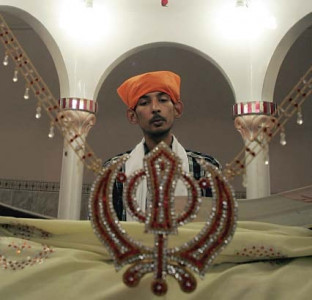
<p>The event will also mark the first time that the government has organised an exhibition of objects, relevant to the Sikh history in the Punjab, to coincide with the annual Baisakhi festival. Thousands of Sikh yatris (pilgrims) are in the country to celebrate the festival, which marks the day when their 10th guru organised the order of the Khalsa. This year about 1,100 Sikh yatris from India and about 1,000 from other countries arrived in Pakistan for the Baisakhi festival on April 10. About 300 yatris were issued special invitations for the event.</p>
<p>Lastly, with the exhibition, the Sheesh Mahal will be reopened – if only for a limited time – to the public after almost seven years. The Punjab Archaeology Department had closed it to the public after the structure was restored in 2004. In 2006, the public was allowed access to the Sheesh Mahal for a few days when the work of artisans from across Pakistan was displayed in the basement.</p>
<p>The exhibition, for which the Archaeology Department and the Archives Department have contributed a number of documents and artefacts belonging to the period of Sikh rule in the Punjab, is being organised with the help of the Evacuee Trust Property Board and the Dayal Singh Society.</p>
<p>Officials of the Archaeology Department told <em>The Express Tribune</em> that among the items being displayed at the Lahore Fort exhibition were clothes, swords and pottery belonging to Ranjit Singh and his son Sher Singh as well as the personal belongings of Ranjit Singh’s wife, Maharani Mahtab Devi Sahiba.</p>
<p>For its part, the Archives Department has transported its entire Princess Bamba Sophia Jindan collection from the Civil Secretariat to the Fort, Archives and Libraries Secretary Orya Maqbool Jan told <em>The Express Tribune</em>. The collection, which has been named after the daughter of Duleep Singh (one of Ranjit Singh’s sons), consists of miniature paintings of Sikh royals, the official record of Ranjit Singh’s government and documents belonging to Ranjit Singh’s sons Duleep and Kharak Singh.</p>
<p>Also on display will be the official Sale of Kashmir papers.</p>
<p>An Archaeology Department official said the event had been arranged as a “goodwill gesture to promote religious tourism”.</p>
<p>The exhibition will be inaugurated by Governor Makhdum Syed Ahmed Mahmood at 10 am. The relics will remain on display till April 20 between 9 am and 5 pm.</p>
<p><em>Published in The Express Tribune, April 18<sup>th</sup>, 2013. </em></p>
</p>
			<br clear="all"/>
		]]>
		</description>

		<media:content width="424" height="318"
							isDefault="true" medium="image" url="http://i1.tribune.com.pk/wp-content/uploads/2013/04/537058-SikhsPHOTOFILE-1366229374-673-640x480.jpg">
			<media:title>Sikhs-PHOTO-FILE</media:title>
			<media:description>Thousands of Sikh yatris (pilgrims) are in the country to celebrate the festival, which marks the day when their 10th guru organised the order of the Khalsa. PHOTO: FILE
</media:description>
			<media:thumbnail url="http://i1.tribune.com.pk/wp-content/uploads/2013/04/537058-SikhsPHOTOFILE-1366229374-673-160x120.jpg" width="160" height="120" />
      </media:content>

		<wfw:commentRss></wfw:commentRss>
		<slash:comments>3</slash:comments>
	</item>
	
</channel>
</rss>
<!-- Performance optimized by W3 Total Cache. Learn more: http://www.w3-edge.com/wordpress-plugins/

Page Caching using apc
Database Caching 15/42 queries in 1.465 seconds using memcached
Object Caching 1430/1584 objects using apc

 Served from: tribune.com.pk @ 2013-05-20 03:08:32 by W3 Total Cache -->