<?xml version="1.0" encoding="UTF-8"?>
<rss version="2.0"
	xmlns:content="http://purl.org/rss/1.0/modules/content/"
	xmlns:wfw="http://wellformedweb.org/CommentAPI/"
	xmlns:dc="http://purl.org/dc/elements/1.1/"
	xmlns:atom="http://www.w3.org/2005/Atom"
	xmlns:sy="http://purl.org/rss/1.0/modules/syndication/"
	xmlns:slash="http://purl.org/rss/1.0/modules/slash/"
	xmlns:media="http://search.yahoo.com/mrss/"
	>

<channel>
	<title>The Express Tribune &#187; Prakash Belawadi</title>
	<atom:link href="http://tribune.com.pk/author/2970/prakash-belawadi/feed/" rel="self" type="application/rss+xml" />
	<link>http://tribune.com.pk</link>
	<description>Latest Breaking Pakistan News, Business, Life, Style, Cricket, Videos, Comments</description>
	<lastBuildDate>Thu, 20 Jun 2013 06:36:41 +0000</lastBuildDate>
	<language></language>
	<sy:updatePeriod>hourly</sy:updatePeriod>
	<sy:updateFrequency>1</sy:updateFrequency>
	<generator>http://wordpress.org/?v=3.5.1</generator>

		<item>
		<title>Ends and means</title>
		<link>http://tribune.com.pk/story/479357/ends-and-means/</link>
		<pubDate>Thu, 13 Dec 2012 18:20:17 +0000</pubDate>

		<guid isPermaLink="false">http://tribune.com.pk/?p=479357</guid>

		<description>
		<![CDATA[
			<a href="http://tribune.com.pk/story/479357/ends-and-means/">
				<img src="http://i1.tribune.com.pk/wp-content/uploads/2012/12/479357-PrakashBelawadiNew-1355415080-339-160x120.JPG" width="160" height="120" alt="" />
			</a>
			<p><p>Now that the Vatican has confirmed that the world will not end on December 21, as predicted in some old Mayan calendar, science has met religion in harmony. NASA has been publishing articles on its website, for many months now, to show that the doomsday story is a hoax. Scientist David Morrison created a special <a href="http://lunarscience.nasa.gov/articles/doomsday-2012-fact-sheet/">Doomsday 2012 Fact Sheet</a> in September on the NASA website because “opinion polls suggest that one in 10 Americans worry about whether they will survive past December 21 of this year.”</p>
<p>So the US government, too, has put out a reassuring notice to calm its citizens. In the blog titled “<a href="http://www.google.com.pk/url?sa=t&amp;rct=j&amp;q=&amp;esrc=s&amp;source=web&amp;cd=1&amp;cad=rja&amp;ved=0CCwQFjAA&amp;url=http%3A%2F%2Fblog.usa.gov%2Fpost%2F37121041300%2Fscary-rumors-about-the-world-ending-in-2012-are-just&amp;ei=KhfKUJ3tEu7s0gWX_ICICg&amp;usg=AFQjCNHdquWvb-q97DDAn_ZCMp9CbvkA0Q&amp;sig2=gUINVLXZARXkD7uGxoiaAA&amp;bvm=bv.1355272958,d.d2k">Scary Rumours about the World Ending in 2012 Are Just Rumours</a>”, it says, “The world will not end on December 21, 2012, or any day in 2012. Unfortunately, these rumours have many people frightened, especially children. NASA has received thousands of letters concerned about the end of the world.”NASA veteran David Morrison put out the fact sheet because he was getting messages from children, who said they were sick or thinking of suicide because of the feared end of the world. The space agency has published a video, <em><a href="http://www.nasa.gov/multimedia/podcasting/jpl-asteroid20120307.html">Just Another Day</a></em>, on its website.</p>
<p>The trusting faithful are in a frenzy around the world. In my home state of Karnataka, lawmakers in the upper house brought up the issue on December 21 because the local television channels have the worst of the assorted numerologists, astrologers, <em>vaastu</em> (architecture) frauds and such, setting ridiculous tasks of <em>poojas</em> and appeasements to the deities to survive The Flood. The Internet has fed the panic, sending people around the world out to camp on hilltops, safe resorts and in ready-to-escape arks.</p>
<p>So, what is interesting is that the Vatican’s opinion is based on a scientific premise, not faith. The director of the Vatican Observatory, Reverend Jose Funes, has said that because the universe is expanding, it will break at some point but “<a href="http://global.christianpost.com/news/vatican-us-government-weighs-in-on-mayan-dec-21-2012-doomsday-86535/#SrBVMf4HCA7qpVxD.99">not for billions of years</a>”. Apart from the disaster movie 2012, which created a popular imagination of the catastrophic end, the world has been visited in recent years with frightening earthquakes, tsunami and natural tragedies to move many of us to faith, but the idea of the end-of-the-world is also attractive to the faithful because it confirms the immanence of the ultimate one.</p>
<p>In an uncertain world, the need to believe in an almighty force is so strong that even evidence in destruction is, perhaps, welcome. The give-me-a-sign desperation will make the doomsday predictions engaging for even the marginal believers. Magazines and TV shows in India have found that the end-of-the-world features and shows sell big and continue to publish them at regular intervals. No matter the world has survived all the ‘end-ist’ predictions, there is always renewed fear or belief and there will be new converts. The intense competition faced by Indian TV channels, which depend more on advertising than subscription, has created a space for semi-literate spooks, who buy TV time to invite call-in consultations for the distressed clients. The solutions offered range from the usual “change the spelling of your name”, “break down the north wall of your bathroom”, to urging them to walk down Chowpatty beach and eat <em>bhel puri</em>.</p>
<p>The tendency of <a href="https://www.google.com/url?q=http://blogs.tribune.com.pk/story/14660/can-masjids-and-laboratories-co-exist/&amp;sa=U&amp;ei=7BrKULrLAo65hAe5joHABw&amp;ved=0CAcQFjAA&amp;client=internal-uds-cse&amp;usg=AFQjCNGx5sPXgMEdBa_sDKrRADQyeoe4Jg">superstition in India is now so strong that it has been made virtually official</a>. In Karnataka, ministers were given official instructions last month to desist from breaking down partition walls in their official rooms in the state legislature building on grounds of bad <em>vaastu</em>. For many years, local councillors in Bangalore refused to work out of a new municipal building because it brought bad luck. Ministers are known to bury animals live, pour down barrels of milk or <em>ghee</em> on made-up gods and participate in other rituals to secure their fortune. The official day and calendar is now marked by dates and times fixed by idiot astrologers and charlatans who have the confidence of these paranoid people in power. What does it matter that the sun rises and sets every single day? There is so little ‘auspicious’ time to work that it hardly ever gets done.</p>
<p><em>Published in The Express Tribune, December </em><em>14<sup>th</sup>, 2012.</em></p>
</p>
			<br clear="all"/>
		]]>
		</description>

		<media:content width="424" height="318"
							isDefault="true" medium="image" url="http://i1.tribune.com.pk/wp-content/uploads/2012/12/479357-PrakashBelawadiNew-1355415080-339-640x480.JPG">
			<media:title>Prakash Belawadi  - New</media:title>
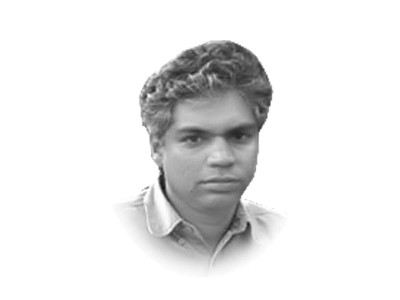
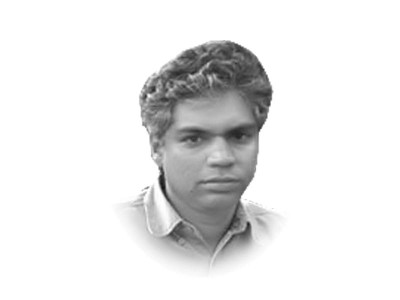
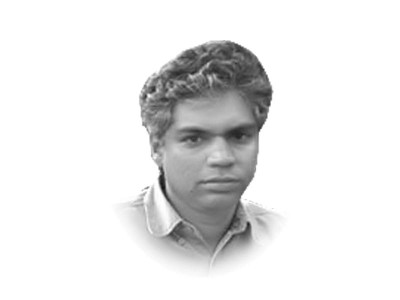
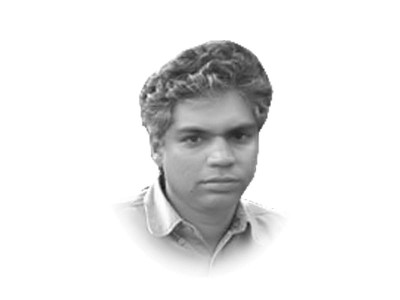
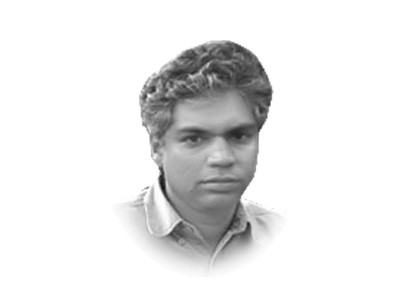
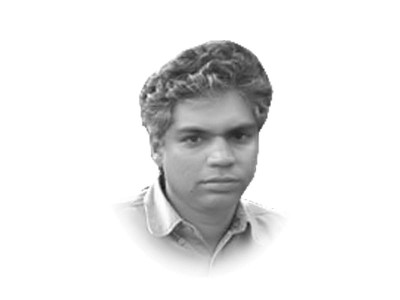
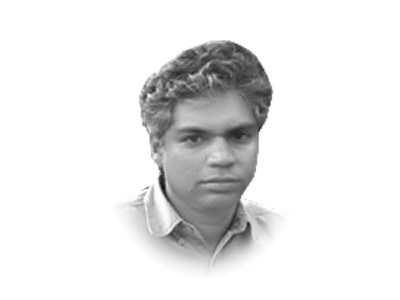
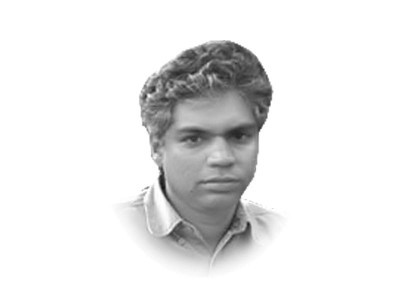
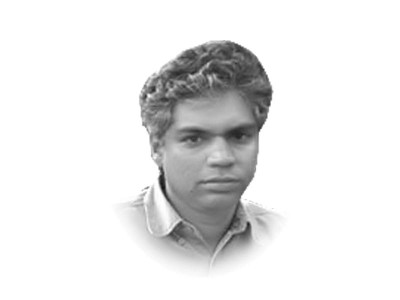
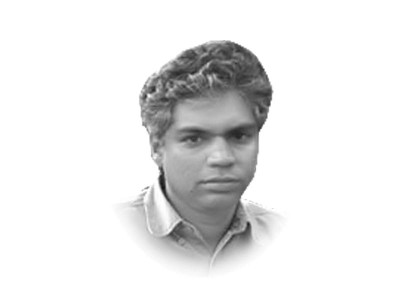
			<media:description>The writer is a stage director, film-maker and journalist in Bangalore. He is a cofounder of the Suchitra Centre for Film and Drama</media:description>
			<media:thumbnail url="http://i1.tribune.com.pk/wp-content/uploads/2012/12/479357-PrakashBelawadiNew-1355415080-339-160x120.JPG" width="160" height="120" />
      </media:content>

		<wfw:commentRss></wfw:commentRss>
		<slash:comments>1</slash:comments>
	</item>
		<item>
		<title>Accounts of peace and terror</title>
		<link>http://tribune.com.pk/story/476100/accounts-of-peace-and-terror/</link>
		<pubDate>Thu, 06 Dec 2012 19:12:15 +0000</pubDate>

		<guid isPermaLink="false">http://tribune.com.pk/?p=476100</guid>

		<description>
		<![CDATA[
			<a href="http://tribune.com.pk/story/476100/accounts-of-peace-and-terror/">
				<img src="http://i1.tribune.com.pk/wp-content/uploads/2012/12/476100-PrakashBelawadiNew-1354809230-819-160x120.JPG" width="160" height="120" alt="" />
			</a>
			<p><p>The <a href="http://www.visionofhumanity.org/globalterrorismindex/#/2011/OVER/" target="_blank">Global Terrorism Index</a> (GTI) of December 4 that brackets Pakistan and India in the top four of 158 countries of the world could be contested on purpose and methodology of the study, but still puts out some startling conclusions from what researchers claim is the most comprehensive analysis ever of data on terrorism incidents in the world over the past 10 years.</p>
<p>Although obvious, it is somewhat an irony that the study finds North America is the region least likely to suffer from a terrorist attack. The US, which could reasonably consider itself to be the global target of hate and jealousy, should be pleased with the report. Assumed, intuitively, to be a major target for terrorist attacks, it has dropped from rank one in 2002 to 41 in 2012. After the US military intervention in Iraq, an escalation of terror attacks have occurred in Iraq itself, of course; but the next big increases have been seen in Pakistan and Afghanistan, in that order.</p>
<p>Besides, the objects of the terrorist attacks are not the other obvious ones even by way of categories. The GTI study has found that private citizens, government facilities and the police are the three most common targets of terrorism. Military targets comprise only four per cent of the attacks and religious persons and institutions together account for less than five per cent. So, like its sibling’s jealousy and hate, terror seems to find its realisation in objects closest to it. The problem, as the study notes, is that religious terrorism simply gets better coverage.</p>
<p>The index has been produced by the global think tank Institute for Economics and Peace (IEP), which has offices in Sydney, New York and Washington, DC, and is based on data sourced from the Maryland-based <a href="http://www.start.umd.edu/start/" target="_blank">National Consortium for the Study of Terrorism and Responses to Terrorism</a> (START); an institution established by the US Department of Homeland Security. The START database has information on more than 100,000 cases of terrorism. The rankings are based on the number of terrorist attacks, fatalities, injuries and the extent of property damage caused through the attacks.</p>
<p>The study’s definition of a terror attack will likely be disputed because it “excludes perceived acts of state terror, such as drone attacks resulting in civilian casualties.” The US, therefore, ranks way down in the list. Apart from Iraq, the stand-out candidate, the study notes that Pakistan, India, and Afghanistan were the countries that most “influenced the steep increase in terrorism from 2002 to 2009.” And terror has a high success rate; in 2011, the attacks scored nine times out of 10.</p>
<p>The study, in an interesting diversion, found that “while corruption did not correlate globally”, the world’s top 10 in the terror index scored way below the average in the World Bank and Transparency International indices of the most-corrupt nations. The other curious discovery of the study is that poorer countries are much less likely to suffer from terrorism than lower middle-income countries.</p>
<p>In June this year, the same think tank put out a <a href="http://tribune.com.pk/story/467672/something-to-celebrate-the-good-and-the-ugly/" target="_blank">Global Peace Index</a> which ranked India at 142 out of 158 and Pakistan at 149, but ahead of Russia at 153. But in that list, it was Somalia, not Iraq, that finished at the bottom. The terror index, according to the think tank, is the first index to systematically analyse and compare the impact of terror attacks on countries.</p>
<p>The production of a terror index quantifies human intent, action and agony but the think tank believes the study of terrorism is a useful way to tackle it. “The aim of the GTI is to systematically analyse and quantify the phenomenon,” according to IEP’s executive chairman, Steve Killelea. Its partner database organisation, START, set up by US homeland security as an institute of excellence, even offers a fully-online, open-enrolment graduate programme at the University of Maryland to analyse terror with the tagline: “Think like a terrorist”.</p>
<p><em>Published in The Express Tribune, December 7<sup>th</sup>, 2012.</em></p>
</p>
			<br clear="all"/>
		]]>
		</description>

		<media:content width="424" height="318"
							isDefault="true" medium="image" url="http://i1.tribune.com.pk/wp-content/uploads/2012/12/476100-PrakashBelawadiNew-1354809230-819-640x480.JPG">
			<media:title>Prakash Belawadi  - New</media:title>
			<media:description>The writer is a stage director, film-maker and journalist in Bangalore. He is a cofounder of the Suchitra Centre for Film and Drama</media:description>
			<media:thumbnail url="http://i1.tribune.com.pk/wp-content/uploads/2012/12/476100-PrakashBelawadiNew-1354809230-819-160x120.JPG" width="160" height="120" />
      </media:content>

		<wfw:commentRss></wfw:commentRss>
		<slash:comments>2</slash:comments>
	</item>
		<item>
		<title>Your mines and ours</title>
		<link>http://tribune.com.pk/story/472802/your-mines-and-ours/</link>
		<pubDate>Thu, 29 Nov 2012 18:11:02 +0000</pubDate>

		<guid isPermaLink="false">http://tribune.com.pk/?p=472802</guid>

		<description>
		<![CDATA[
			<a href="http://tribune.com.pk/story/472802/your-mines-and-ours/">
				<img src="http://i1.tribune.com.pk/wp-content/uploads/2012/11/472802-PrakashBelawadiNew-1354207265-777-160x120.JPG" width="160" height="120" alt="" />
			</a>
			<p><p>The federal government of Pakistan seems to have found consensus earlier this month on its new <a href="https://www.google.com/url?q=http://tribune.com.pk/story/462896/cci-meeting-clear-your-power-bills-pm-tells-provincial-federal-govts/&amp;sa=U&amp;ei=paG3UJSIHtSzhAfV2IDgBQ&amp;ved=0CAoQFjAB&amp;client=internal-uds-cse&amp;usg=AFQjCNHEPa12DwMwvCD1QhB4l7NNZ6909Q">national mineral policy</a>, overcoming misgivings of some provincial government. The approval by Pakistan’s Council of Common Interests will eventually enable allocation of mineral leases to private investors. It could be useful, perhaps, to learn from the Indian experience in this regard.</p>
<p>The story of mining involves a larger part of the population than just miners, exporters and metal manufacturers. An ongoing investigation by the <a href="http://timesofindia.indiatimes.com/city/goa/Prosecute-mining-companies-for-theft-says-Justice-Shah/articleshow/16376776.cms">Justice MB Shah Commission of Inquiry</a>, set up by the Indian government in November 2010 to look into widespread illegal mining, has already confirmed in its <a href="https://docs.google.com/viewer?a=v&amp;q=cache:RuS3i4Uuzu4J:mines.nic.in/writereaddata%255CContentlinks%255C8b8068968b7542b0a1ebf77c9862c654.pdf+&amp;hl=en&amp;gl=pk&amp;pid=bl&amp;srcid=ADGEESiBt2CoKmyGkzfTAVvnbsD9lKkPuT26qb17BPaHPIibLBMqgxeZF0Zlm_bsy3ZxfyVQAckDmnYRvv3eLsO8KvNo4J2SDAXqiMJ9d9XSCJT3t4nqU7kx8za58bKBluOmiprfuSbs&amp;sig=AHIEtbR7fNkadieHZcuVdf603DhPhxndKg">interim reports</a> what had been commonly feared and reported. Its summary interim report begins thus: “There is enormous and large-scale, multi-state illegal mining of iron ore and manganese ore running into billions every year, having several pernicious evil effects on the national economy, good governance, public functionaries, bureaucracy, public order, law and order. It has encouraged huge corruption at all different levels in public life, mafia in society and money power. It is not only national loot but also has deleterious effects on the national economy and society. This has to be stopped immediately and effectively.”</p>
<p>Several state (provincial) governments in India, including Goa, Karnataka and Odisha, have come under pressure to prevent illegal iron ore extraction and exports. An agency report noted that “India’s efforts to clamp down on illegal mining have handed a $15 billion lifeline to global iron ore giants.” The mining and manufacturing industries see this as India’s loss but there is another way of looking at it. The Shah Commission report in September estimated that Goa alone could have lost close to Rs350 billion in official revenues due to illegal practices. The immediate <a href="http://timesofindia.indiatimes.com/city/goa/Stop-all-dump-mining-Centre-tells-Goa/articleshow/16304947.cms">ban on mining in Goa</a> has followed the example of neighbouring Karnataka, also under a similar investigation, and the Shah Commission has now turned its attention on another mineral-rich state, Odisha.</p>
<p>Pakistan’s new mineral policy declares: “Our vision for Pakistan’s mineral sector is of a strong, vibrant, and sustainable private sector-driven mining industry, contributing significantly to our economic development.” This possibly entails foreign investment and the nation’s provinces are naturally wary. Indeed, more than a few conspiracy theories in Pakistan seem to be built around the possible <a href="http://tribune.com.pk/story/471949/reko-diq-case-supreme-court-seeks-lease-documents-from-balochistan-government/">foreign interests in the mineral resources of west Pakistan</a>. As in India, the exploitation of most mineral resources in Pakistan is complicated by ownership and policy issues.</p>
<p>The boom in Indian mining started with a similar national mineral policy that encouraged the participation of private players and was fuelled by the explosive growth in the Chinese demand for ore ahead of the Beijing Olympic Games. The mineral-rich states pushed for export-oriented mining and set aside large areas owned by state entities for exploitation by private players. Iron ore prices had one time jumped more than five-fold, from around Rs1,300 a metric tonne to over Rs6,000 but royalties fixed by the Union government averaged at about Rs20 a tonne. A more reasonable regime of royalties was introduced in August 2009 but by then, private greed had done the damage. The Shah Commission noted that in some instances, ore prices “have gone up by about 20 times without any corresponding benefit and increase to the public exchequer.”</p>
<p>Mineral areas, unfortunately, are naturally laid over by rich forests and biodiversity zones in India. They are also in the poorest regions of India. Private mining companies have transgressed beyond their officially leased areas into the forests, polluted precious water sources and criminalised the local administration with bribes and threats. The populations around the mining areas have been severely impacted. A <a href="http://www.google.com.pk/url?sa=t&amp;rct=j&amp;q=&amp;esrc=s&amp;source=web&amp;cd=1&amp;cad=rja&amp;ved=0CC8QFjAA&amp;url=http%3A%2F%2Fwww.hrw.org%2Fnews%2F2012%2F06%2F14%2Findia-mining-industry-out-control&amp;ei=pqO3UNiVKojChAeruYCYCA&amp;usg=AFQjCNEarDn6GZHbCLrexIPitLRK8CXuow&amp;sig2=tNqB71lO-d2CBzJqEqWEaA">Human Rights Watch report</a> in June this year said official negligence by the governments at the Union and the states had led to rampant mining that could have have damaged “the health, water, environment and livelihoods of these communities.” But the mining tycoons have simply become richer.</p>
<p><em>Published in The Express Tribune, November </em><em>30<sup>th</sup>, 2012.</em></p>
</p>
			<br clear="all"/>
		]]>
		</description>

		<media:content width="424" height="318"
							isDefault="true" medium="image" url="http://i1.tribune.com.pk/wp-content/uploads/2012/11/472802-PrakashBelawadiNew-1354207265-777-640x480.JPG">
			<media:title>Prakash Belawadi  - New</media:title>
			<media:description>The writer is a stage director, film-maker and journalist in Bangalore. He is a cofounder of the Suchitra Centre for Film and Drama</media:description>
			<media:thumbnail url="http://i1.tribune.com.pk/wp-content/uploads/2012/11/472802-PrakashBelawadiNew-1354207265-777-160x120.JPG" width="160" height="120" />
      </media:content>

		<wfw:commentRss></wfw:commentRss>
		<slash:comments>2</slash:comments>
	</item>
		<item>
		<title>Indian political heirs</title>
		<link>http://tribune.com.pk/story/469778/indian-political-heirs/</link>
		<pubDate>Thu, 22 Nov 2012 19:30:32 +0000</pubDate>

		<guid isPermaLink="false">http://tribune.com.pk/?p=469778</guid>

		<description>
		<![CDATA[
			<a href="http://tribune.com.pk/story/469778/indian-political-heirs/">
				<img src="http://i1.tribune.com.pk/wp-content/uploads/2012/11/469778-PrakashBelawadiNew-1353601533-183-160x120.JPG" width="160" height="120" alt="" />
			</a>
			<p><p>In October 2008, the young Rahul Gandhi, then the Congress party general secretary, had frankly admitted to a group of schoolgirls in Uttarakhand that he was a symptom of what was wrong with Indian politics — dynasty, patronage and money. Terming it a “closed system”, he had gone on: “If I had not come from my family, I wouldn’t be here &#8230; Without family, friends or money, you cannot enter the system. My father was in politics. My grandmother and great grandfather were in politics. So, it was easy for me to enter politics. This is a problem. I am a symptom of this problem. I want to change it.” During the same interaction, he had also philosophised: “In politics and in life, answers come only through time. Time will tell what I am like.”</p>
<p>The time has come. As Manmohan Singh’s t<a href="http://tribune.com.pk/story/457679/indian-pm-overhauls-cabinet-ahead-of-2014-polls/">roubled government nears the end of its second term</a>, the 42-year-old son of the Congress’s top leader, Sonia Gandhi, has now been formally declared the face of the party for the 2014 parliamentary elections. He has been appointed the head of the election coordination committee, which means he will eventually pick the candidates for the elections. As head of the Indian Youth Congress, too, Rahul Gandhi has had the opportunity to groom potential leaders of the Congress party’s next generation. So, his claims to inner party democracy are up for scrutiny.</p>
<p>The party itself is ready for change. In July this year, Union minister <a href="http://tribune.com.pk/story/458400/change-but-no-change/">Salman Khurshid</a>, possibly still smarting from the Congress drubbing in the Uttar Pradesh elections, lamented that the party had lost “ideological direction” and looked up to Rahul Gandhi to provide a “new ideology”. “Until now,” Mr Khurshid said, “we have only seen cameos of his thought and ideas like democratising elections to the Youth Congress. But he has not weaved all of this into a grand announcement. This is a period of waiting.”</p>
<p>Now that the waiting time has ended, it is to be seen whether the scion of the Congress party has it in him to articulate such an ideology. The start has not given any cause for comfort. At the mega rally to launch the new political campaign in New Delhi last month, Rahul Gandhi caused <a href="http://blogs.tribune.com.pk/story/14281/kashmir-rahul-gandhis-proposals-are-meaningless/">embarrassment to his own party members</a> by strangely comparing the Opposition’s thwarting of the government’s new economic reforms to the Congress’s role as opposition party during the Kargil war. The Bharatiya Janata Party (BJP) ridiculed him; the Shiv Sena said he was not only a <em>bachcha</em>, but also <em>kachcha</em> (immature) in politics. Not a great ideological start.</p>
<p>But for all the contempt the opposition parties would want to display towards Rahul Gandhi, they have carefully avoided speaking about dynasty and nepotism in politics, the core issue of the crisis of leadership in Indian politics. This is because most of the parties, barring the Left and, to an extent, the BJP, are guilty of it — the Dravida parties in Tamil Nadu, the Janata Dal (Secular) in Karnataka, all the parties in Andhra Pradesh, the Biju Janata Dal in Orissa, the Shiv Sena in Maharashtra, all the way up to parties in Jammu and Kashmir.</p>
<p>The political class has gradually turned into a virtual Indian caste, the most privileged yet, and the only challenges that the inheritors may face are from their own siblings and near kin, as in the days of the mughals. Rahul Gandhi’s own experiment with inner party democracy in the Youth Congress will reveal its outcomes when he declares the candidates for the parliamentary polls. It is hard to believe that the best will be allowed to rise to the top.</p>
<p>Even in terms of ideology, now that every colour and hue of the spectrum has been tried in Indian politics, it has become difficult to find sharp lines of separation between the parties. It is completely possible for Karnataka’s disgruntled BJP leader BS Yeddyurappa to be welcomed into the Congress as it was for the former member of Rashtriya Swayam Sevak Sangh Shankar Singh Vaghela to be adopted by the Congress to fight Narendra Modi in Gujarat. The rhetoric of parties in opposition is abandoned during their stints in power. It seems they are in it together now.<em></em></p>
<p><em>Published in The Express Tribune, November 23<sup>rd</sup>, 2012.</em></p>
</p>
			<br clear="all"/>
		]]>
		</description>

		<media:content width="424" height="318"
							isDefault="true" medium="image" url="http://i1.tribune.com.pk/wp-content/uploads/2012/11/469778-PrakashBelawadiNew-1353601533-183-640x480.JPG">
			<media:title>Prakash Belawadi  - New</media:title>
			<media:description>The writer is a stage director, film-maker and journalist in Bangalore. He is a cofounder of the Suchitra Centre for Film and Drama</media:description>
			<media:thumbnail url="http://i1.tribune.com.pk/wp-content/uploads/2012/11/469778-PrakashBelawadiNew-1353601533-183-160x120.JPG" width="160" height="120" />
      </media:content>

		<wfw:commentRss></wfw:commentRss>
		<slash:comments>7</slash:comments>
	</item>
		<item>
		<title>How to build cities?  </title>
		<link>http://tribune.com.pk/story/466251/how-to-build-cities/</link>
		<pubDate>Thu, 15 Nov 2012 17:56:47 +0000</pubDate>

		<guid isPermaLink="false">http://tribune.com.pk/?p=466251</guid>

		<description>
		<![CDATA[
			<a href="http://tribune.com.pk/story/466251/how-to-build-cities/">
				<img src="http://i1.tribune.com.pk/wp-content/uploads/2012/11/466251-PrakashBelawadiNew-1352996173-519-160x120.JPG" width="160" height="120" alt="" />
			</a>
			<p><p>Former mayor of Bogota <a href="http://www.google.com.pk/url?sa=t&amp;rct=j&amp;q=enrique%20pe%C3%B1alosa%20londo%C3%B1o&amp;source=web&amp;cd=1&amp;cad=rja&amp;ved=0CB8QFjAA&amp;url=http%3A%2F%2Fen.wikipedia.org%2Fwiki%2FEnrique_Pe%25C3%25B1alosa&amp;ei=PCmlUMGYHeWe0QWEmIDIDA&amp;usg=AFQjCNGp2N40wXAwRoqUJ5Wy-cLLlRrNnA">Enrique Peñalosa Londoño</a>, hailed for transforming the Colombian capital into a tolerable urban space, said during his visit to India in 2009: “The single biggest difference between the infrastructure of an advanced nation and a backward nation is its footpaths, not its highways.” He was hinting, probably, at what is wrong with India’s urban planning. Indian cities are often rated by newspapers and magazines on the basis of their standard of living features. But the typical indices are real estate prices, leisure and entertainment, and education and career opportunities. There are also the occasional stories about the crime rate, safety of single women, medical treatment facilities and so on, but the right to walk, efficient waste disposal and affordable public transport almost never figure as priorities.</p>
<p>Celebrated only a decade ago as India’s city of the future, Bangalore, in the state of Karnataka, south India, <a href="http://www.ndtv.com/article/south/bangalore-garbage-crisis-karnataka-high-court-questions-municipal-authority-287731">is now sinking under heaps of garbage piling up on its streets</a>. The crisis hit the city a few months ago, when villagers around landfills starting protesting against illegal dumping of solid wastes and it is not likely to be resolved anytime soon. There are many reasons for it, but the crucial one is that the civic authority is not competent to deal with it, legally or materially. The Bharatiya Janata Party government in the state is choking with internal power struggles and heading into an election year. A majority of the lawmakers will seek re-election from constituencies elsewhere in the state and need not care about Bangalore which, for the record, generates about two-thirds of the state’s revenues.</p>
<p>The civic administration is actually quite helpless because it has no powers or resources to take over private land around the city for new landfills. The plans for the city are actually made by the state government, which is not directly accountable to the citizens. But besides these political issues, India’s ideas of urban planning are themselves open to question. Bangalore is a good example of how not to do it. In 1980, it had a population of about two million; now it is close to 10 million. This was not a surprise, because successive administrations at the Union and state always knew that this was India’s first big city that Indians would build. The other big metros — Delhi, Kolkata, Mumbai and Chennai — were already done by the British. India’s first prime minister Jawarharlal Nehru, during a visit to the city in 1962, was moved to remark: “Bangalore, more than any other great city of India, is a picture of the future.”  Asia’s first light bulb glowed in the city’s market in 1905. When the boom began 20 years ago, Bangalore was already a fine city. A Bangalore Agenda Task Force led by software tycoon <a href="http://en.wikipedia.org/wiki/Nandan_Nilekani">Nandan Nilekani</a> was set-up in 2001 by the state government to work out the city’s future.</p>
<p>Ten years down, the city is an urban nightmare. It has more than four million private vehicles because its public bus service, though efficient, is not sufficient. The metro rail project, started just too late, is still under construction. The pedestrians have been edged out of the roads, always expanded to accommodate more vehicles, new ones registering on the street at the rate of 1,000 every day. The crime rate has grown because the old neighbourhoods are utterly transformed and community networks have broken down. Those that can afford it are moving into gated communities with guards at the portals. Two million construction workers and the poorest live in slums without sanitation. In an incredible decision, the state administration in 1991 found more than 20,000 acres of land to handover to a private corporation for new townships and an expressway that are yet to materialise for  just Rs10 per acre covering a period of 30 years. Now the government says it cannot find 500 acres for a modern landfill to store and treat its solid wastes.</p>
<p>In the case of garbage, it has been out-of-sight is out-of-mind. The comfort for the citizen comes at the cost of dumping daily 4,000 tonnes of unsegregated waste at a couple of landfills in the margins of the city. The civic authorities have ducked questions on the legality of this policy by simply outsourcing the collection and disposal of city wastes to a lobby of private contractors. The villagers around the landfill eventually have rebelled and precipitated the garbage crisis. But the rubbish is now visible and the stink, unbearable. In the case of pedestrian rights, the neglect is simply bewildering. Nearly 1,000 pedestrians were killed in Delhi in 2011.  About 400 will die in Bangalore this year. Nearly 70 per cent of all pedestrian deaths are in urban India. In 2009, the World Health Organization in its global report on road safety said <a href="http://articles.timesofindia.indiatimes.com/2009-08-17/india/28181973_1_road-accidents-road-fatalities-global-road-safety">India had the highest number of road accident deaths in the world</a>, more than the more populous China. Before the planners offer the solutions, it is time to ask the right questions.</p>
<p><em>Published in The Express Tribune, November </em><em>16<sup>th</sup>, 2012.</em></p>
</p>
			<br clear="all"/>
		]]>
		</description>

		<media:content width="424" height="318"
							isDefault="true" medium="image" url="http://i1.tribune.com.pk/wp-content/uploads/2012/11/466251-PrakashBelawadiNew-1352996173-519-640x480.JPG">
			<media:title>Prakash Belawadi  - New</media:title>
			<media:description>The writer is a stage director, film-maker and journalist in Bangalore. He is a cofounder of the Suchitra Centre for Film and Drama</media:description>
			<media:thumbnail url="http://i1.tribune.com.pk/wp-content/uploads/2012/11/466251-PrakashBelawadiNew-1352996173-519-160x120.JPG" width="160" height="120" />
      </media:content>

		<wfw:commentRss></wfw:commentRss>
		<slash:comments>17</slash:comments>
	</item>
		<item>
		<title>Violence as performance</title>
		<link>http://tribune.com.pk/story/462759/violence-as-performance/</link>
		<pubDate>Thu, 08 Nov 2012 17:32:35 +0000</pubDate>

		<guid isPermaLink="false">http://tribune.com.pk/?p=462759</guid>

		<description>
		<![CDATA[
			<a href="http://tribune.com.pk/story/462759/violence-as-performance/">
				<img src="http://i1.tribune.com.pk/wp-content/uploads/2012/11/462759-PrakashBelawadiNew-1352392783-882-160x120.JPG" width="160" height="120" alt="" />
			</a>
			<p><p>The <a href="http://www.thehindu.com/news/cities/Mangalore/tv-journalist-arrested-in-homestay-attack-case/article4077103.ece">arrest on November 7 of a television journalist in Mangalore</a> for not preventing the violent attack by Hindu extremists on a group of boys and girls at a birthday party raises again the question of the role of media as a possible maker of violence. Does the presence of a TV camera or the promise of wide exposure in itself stimulate the performance of violent acts?</p>
<p>In this instance, activists of the <a href="http://articles.timesofindia.indiatimes.com/2012-07-29/bangalore/32922871_1_hindu-jagarana-vedike-homestay-hjv">Hindu Jagarana Vedike</a> barged into a July 28 birthday celebration at a homestay resort in Mangalore, partly stripped and molested five girls and beat up seven boys in vigilante action to protect “Indian culture”. The attack was extensively captured on camera by a reporter, Naveen Soorinje of <em>Kasturi TV</em>, who had been alerted about the planned attack. The footage was repeatedly shown on many news channels. Soorinje has now been remanded in judicial custody till November 20. The police, criticised by fellow journalists for “shooting the messenger”, said they were executing a court warrant.</p>
<p>Journalists and liberal activists in Mangalore have called this an attack on the freedom of the media but the police maintain that since Soorinje had prior information about the attack, he should have made efforts to contact the police before it took place. The implication is that TV news professionals look for sensational footage to get more eyeballs in an increasingly competitive environment of 24/7 news channels, always looking to break news. And the vigilantes themselves look for coverage and even ‘sex up’ the action for the camera.</p>
<p>On July 9, Indian viewers watched horrifying footage of the <a href="http://www.ndtv.com/topic/guwahati-girl-molested">obscene attack on a 17-year-old girl</a> on her way home from another birthday party at a night club in Guwahati, Assam. The footage captured by a reporter of <em>NewsLive TV</em> showed about 30 men molesting the poor girl in a posh area of the city while bystanders watched the action. The Assam police said they have no record of a call for help from any media organisation during the time of the attack. Assam Chief Minister Tarun Gogoi said, “I cannot approve the fact that the TV crew went on rolling their tapes for almost 45 minutes without making efforts to save the girl.” TV reporter Gaurav Jyoti Neog was arrested on charges of instigating obscene acts against a woman. The footage became a national television sensation and went viral on YouTube.</p>
<p>The question of the media’s role as observer or responsive agency was poignantly posed in the case of South African photojournalist <a href="http://en.wikipedia.org/wiki/Kevin_Carter">Kevin Carter</a>. Winner of the Pulitzer Prize for his 1993 photograph of a starving child in Sudan being watched by a vulture nearby, Carter was widely criticised for taking the picture and leaving without helping the girl, who was trying to get to a feeding centre. The accompanying <a href="http://www.nytimes.com/1994/07/29/world/kevin-carter-a-pulitzer-winner-for-sudan-photo-is-dead-at-33.html"><em>New York Times</em> story</a> had said it was not known whether the girl made it to the centre. Carter said he left because he had finished his ‘job’. “The man adjusting his lens to take just the right frame of her suffering might just as well be a predator, another vulture on the scene,” one newspaper said. Carter committed suicide in 1994.</p>
<p>In the Mangalore case, the morality in operation seems to be of a different nature. The chairperson of the State’s Commission for Women, C Manjula, an appointee of the ruling Bharatiya Janata Party (BJP) government, submitted a report finding fault with the young people at the birthday party, hinting that they were consuming drugs and involved in prostitution. But the police investigation clearly said there was no evidence of drug abuse at the birthday party. Liberal activists suggest that the police action against the TV journalist in the Mangalore instance is retaliation against the repeated exposes of Hindu extremist action in the district, which has traditionally been a BJP stronghold. In another much-televised attack on a pub in 2009 by activists of the Sri Rama Sene, Hindu activists were captured on camera molesting girls and beating up boys for drinking alcohol. A case was filed but not much came of it for the accused, Subhash Padil, who led the birthday party attack this July.<em></em></p>
<p><em>Published in The Express Tribune, November 9<sup>th</sup>, 2012.</em><em> </em></p>
</p>
			<br clear="all"/>
		]]>
		</description>

		<media:content width="424" height="318"
							isDefault="true" medium="image" url="http://i1.tribune.com.pk/wp-content/uploads/2012/11/462759-PrakashBelawadiNew-1352392783-882-640x480.JPG">
			<media:title>Prakash Belawadi  - New</media:title>
			<media:description>The writer is a stage director, film-maker and journalist in Bangalore. He is a cofounder of the Suchitra Centre for Film and Drama</media:description>
			<media:thumbnail url="http://i1.tribune.com.pk/wp-content/uploads/2012/11/462759-PrakashBelawadiNew-1352392783-882-160x120.JPG" width="160" height="120" />
      </media:content>

		<wfw:commentRss></wfw:commentRss>
		<slash:comments>8</slash:comments>
	</item>
		<item>
		<title> Lost in renaming</title>
		<link>http://tribune.com.pk/story/459314/lost-in-renaming/</link>
		<pubDate>Thu, 01 Nov 2012 18:32:23 +0000</pubDate>

		<guid isPermaLink="false">http://tribune.com.pk/?p=459314</guid>

		<description>
		<![CDATA[
			<a href="http://tribune.com.pk/story/459314/lost-in-renaming/">
				<img src="http://i1.tribune.com.pk/wp-content/uploads/2012/11/459314-PrakashBelawadiNew-1351785630-521-160x120.JPG" width="160" height="120" alt="" />
			</a>
			<p><p>Brian Friel’s play  “<a href="http://en.wikipedia.org/wiki/Translations" target="_blank">Translations</a>”, set in colonial Ireland in 1824, when Britain ordered the first ordnance survey of Ireland to map the country and change the names of every place and landmark from the Gaelic into similar-sounding English names, is about colonisation by other means — the distortion of identity and the supplanting of mythos by logos. Friel’s principal character, school master Hugh, challenges the idea of interpreting the world by empirical means alone: “It is not the literal past, the ‘facts’ of history, that shape us, but images of the past embodied in language. We must never cease renewing those images; because once we do, we fossilise.” He resists the British appropriation of the Irish universe by continuing to teach his pupils Greek and Latin, dismissing English as a “language of commerce”.</p>
<p><a href="http://tribune.com.pk/story/458642/city-heritage-renaming-of-chowk-after-bhagat-singh-put-on-hold/" target="_blank">The renaming project at Lahore’s Shadman Chowk</a> is under a long historical shadow. It will be difficult to ignore claims to nation, faith and the colonial past. Indeed, for a 4,000-year-old city, it would be interesting to know what the area was called before it was Shadman Colony or a jail was built there, as part of the colonising project. The process of creating landmarks in the subcontinent, or any such colonised time-space is always fraught with conflicting claims of history and experience. The renaming projects of India are witness to this, further complicated by regional and linguistic identities. The idea of history itself is somewhat alien to the Indian consciousness. The idea of empirical history, a narrative of facts and events, is difficult for a mind that refuses to separate myth from memory. We would, therefore, claim the birthplace of Rama with more faith and passion than the birthplace of Pandit Jawaharlal Nehru or Mahatma Gandhi. A tour of the Purana Qila in Delhi will be accompanied by one narrative if the tour guide is Muslim and a wildly differing one if he were Hindu.</p>
<p>James Mill’s <em><a href="http://books.google.com.pk/books/about/The_History_of_British_India.html?id=Orw_AAAAcAAJ&amp;redir_esc=y" target="_blank">History of British India</a></em>, described by Thomas Macaulay (who introduced English education in the subcontinent) as the “greatest thing after Gibbon (<em>The History of the Decline and Fall of the Roman Empire</em>)”, was written without the direct experience of India. Mill wrote: “This writer has never been in India; and, if he has any, has a very slight, and elementary acquaintance, with any of the languages of the East.” This omission, he believed, made his book better. Mill went on: “I have no doubt of being able to make out, to the satisfaction of all reflecting minds, that the man who should bring to the composition of a history of India, the qualifications alone which can be acquired in Europe, would come, in an almost infinite degree, better fitted for the task, than the man who should bring to it the qualifications alone which can be acquired in India; and that the business of acquiring the one set of qualifications is almost wholly incompatible with that of acquiring the other.”</p>
<p>And so it was that his admirer, Macaulay, without any knowledge of Sanskrit or Arabic, asserted in 1839 that a single shelf of a good European library “is worth the whole native literature of India and Arabia”. He demanded that English should be the medium of instruction in Indian schools, to create subjects that would be “Indian in blood and colour, but English in taste, in opinion, in morals, in intellect.”</p>
<p>Macaulay got the East India Company to hire Max Mueller for four shillings a page to translate Sanskrit scriptures. It is doubtful if Mueller, too, ever visited India. There is an account of his meeting Dwarkanath Tagore, Rabindranath’s grandfather in Paris, where he persuaded the Indian to sing. After Tagore finished, Mueller remarked it was devoid of melody, rhythm and harmony. This was the man who knew India, in and out — empirically, not through experience. If Macaulay had his way, he would, perhaps, have replaced Indian music, too, with European music.</p>
<p>The civilising project, which involves rewriting history and renaming landmarks, often erases much more than it builds. But, in the end, we were a colonised people. In the end, Friel’s character Hugh promises to teach his pupil English. “We must learn where we live. We must learn to make them our own. We must make them our new home.”</p>
<p><em>Published in The Express Tribune, November </em><em>2<sup>nd</sup>, 2012.</em></p>
</p>
			<br clear="all"/>
		]]>
		</description>

		<media:content width="424" height="318"
							isDefault="true" medium="image" url="http://i1.tribune.com.pk/wp-content/uploads/2012/11/459314-PrakashBelawadiNew-1351785630-521-640x480.JPG">
			<media:title>Prakash Belawadi  - New</media:title>
			<media:description>The writer is a stage director, film-maker and journalist in Bangalore. He is a cofounder of the Suchitra Centre for Film and Drama</media:description>
			<media:thumbnail url="http://i1.tribune.com.pk/wp-content/uploads/2012/11/459314-PrakashBelawadiNew-1351785630-521-160x120.JPG" width="160" height="120" />
      </media:content>

		<wfw:commentRss></wfw:commentRss>
		<slash:comments>3</slash:comments>
	</item>
		<item>
		<title>A private agenda  </title>
		<link>http://tribune.com.pk/story/456799/a-private-agenda/</link>
		<pubDate>Thu, 25 Oct 2012 16:57:13 +0000</pubDate>

		<guid isPermaLink="false">http://tribune.com.pk/?p=456799</guid>

		<description>
		<![CDATA[
			<a href="http://tribune.com.pk/story/456799/a-private-agenda/">
				<img src="http://i1.tribune.com.pk/wp-content/uploads/2012/10/456799-PrakashBelawadiNew-1351180640-276-160x120.JPG" width="160" height="120" alt="" />
			</a>
			<p><p>On May 11, 2005, intervening in a parliamentary debate on the citizen’s right to information (RTI), Indian Prime Minister Manmohan Singh had made a passionate appeal for the new RTI law: “At the centre of this intricate web (of democratic polity) is the common man, the <em>aam aadmi</em>, whose prosperity and welfare is the core concern of our Constitution. It is this common man or common woman who is the fulcrum of our democratic system, as an observer, as the seeker of information, as the one who asks relevant questions, as the analyst and as the final judge of our performance.”</p>
<p>Earlier this month, a week after leader Arvind Kejriwal, of the movement called India Against Corruption used RTI data to <a href="http://www.google.com.pk/url?sa=t&amp;rct=j&amp;q=robert%20vadra%20tribune&amp;source=web&amp;cd=3&amp;cad=rja&amp;ved=0CCsQFjAC&amp;url=http%3A%2F%2Ftribune.com.pk%2Fstory%2F448692%2Fjoru-ka-bhai-ek-taraf%2F&amp;ei=t22JUOTXH8_EsgarjYH4CQ&amp;usg=AFQjCNHD6LFc2zwZ5FDdKTp9Xhh5Y8KdWQ">implicate Sonia Gandhi’s son-in-law Robert Vadra</a>, in a real estate deal, the prime minister said: “There are some obvious areas of concerns about the way the Right to Information Act is being used presently&#8230; There are concerns about frivolous and vexatious use of the Act in demanding information the disclosure of which cannot possibly serve any public purpose.”</p>
<p>It would indeed be easy to read this as a reaction to the October 5 exposé of the growing pelf of Mr Vadra and his amazing dealings. But it must be conceded that the prime minister had occasion: it was at the seventh annual convention of the RTI law. But what does give cause for concern is his plan to restrict the operation of the law on grounds of protecting “personal privacy” of the citizen. “The citizens’ right to know should definitely be circumscribed if disclosure of information encroaches upon someone’s personal privacy.” However, in 2006, celebrating the first year of the RTI law, Mr Singh had held: “&#8230;the right to know is the most fundamental of all those rights, which are critical for upholding human dignity.” This is a different man speaking, a man tried and tired by governance.</p>
<p>Though he now allows that “where to draw the line is a complicated question”, his government is already moving on a new legislation, The Privacy Bill, to protect privacy. Prime Minister Singh and his Congress colleagues, who were out in full and furious form to protect Robert Vadra on television, have their task cut out. To start with, member countries of the United Nations unanimously resolved 60 years ago, to promote freedom of information as a fundamental human right. On the question of right to privacy, the Supreme Court of India has repeatedly held that while it is a fundamental right, it is subject to conditions and to be decided on a “case by case” basis; especially, in cases involving the public interest. What is Mr Singh’s real case here?</p>
<p>About a million RTI queries were filed before the Union government alone in the last year. This is empowerment and the citizens subscribe to it. Where is the man who had pleaded before parliament in 2005? “I have always believed — all power is a sacred societal trust — that you cannot sit on power, you have to spend it, but you must spend it taking into account the good of the largest number of people&#8230; I would only like to see that everyone, particularly our civil servants, should see the Bill in a positive spirit; not as a draconian law for paralysing the government, but as an instrument for improving government-citizen interface resulting in a friendly, caring and effective government functioning for the good of our people.” This is not even the man who said in 2008, at another RTI convention: “It is (a) revolutionary enactment that has placed huge powers in the hands of the ordinary citizen of the country to demand a transparent and accountable administration. This transition from a tradition of secrecy in official matters has of course not been easy. It has involved not only the setting up of an appropriate institutional mechanism but also a change in the mindset of public servants.” But all that these years of governance have done is to change the mindset of the prime minister.</p>
<p>Perhaps, this has something to do with private citizen Robert Vadra, after all. The <a href="http://en.wikipedia.org/wiki/Robert_Vadra#Biography">Wikipedia entry on Mr Vadra</a> shows a troubled and tragic family history, but he continues to retain his mysterious powers. An <a href="http://htmlimg1.scribdassets.com/2fgc55s1vk1v380b/images/1-025e865b38.jpg">RTI reply from the ministry of home affairs</a> shows he “has been granted exemption from pre-embarkation security checks at all civil airports in the country on the recommendation of this ministry as a special case as he is married to a SPG protectee, i.e. Smt Priyanka Vadra, in consultation with central security agencies (sic).”</p>
<p>The only other special case in that list comprising the President of India and other state dignitaries is the Dalai Lama.</p>
<p>Surely, Mr Vadra is not Mr Singh’s idea of the common man? At the first anniversary of the RTI law in 2006, this very same prime minister had said: “Mahatma Gandhi had once observed, ‘real <em>Swaraj</em> will come not by the acquisition of authority by a few, but by the acquisition of capacity by all to resist authority when abused.’ In many ways, I would like to think that the Right to Information Act&#8230;enable(s) us to fulfil to a considerable degree, Bapu’s dream&#8230; What is of particular satisfaction is that it has become clear that the citizens of our country have owned this Act with their arms wide open. This has become, if anything, a Peoples’ Law.” So what is the problem now?</p>
<p><em>Published in The Express Tribune, October </em><em>26<sup>th</sup>, 2012.</em></p>
</p>
			<br clear="all"/>
		]]>
		</description>

		<media:content width="424" height="318"
							isDefault="true" medium="image" url="http://i1.tribune.com.pk/wp-content/uploads/2012/10/456799-PrakashBelawadiNew-1351180640-276-640x480.JPG">
			<media:title>Prakash Belawadi  - New</media:title>
			<media:description>The writer is a stage director, film-maker and journalist in Bangalore. He is a cofounder of the Suchitra Centre for Film and Drama</media:description>
			<media:thumbnail url="http://i1.tribune.com.pk/wp-content/uploads/2012/10/456799-PrakashBelawadiNew-1351180640-276-160x120.JPG" width="160" height="120" />
      </media:content>

		<wfw:commentRss></wfw:commentRss>
		<slash:comments>6</slash:comments>
	</item>
		<item>
		<title>Caste and capital  </title>
		<link>http://tribune.com.pk/story/453414/caste-and-capital/</link>
		<pubDate>Thu, 18 Oct 2012 17:43:20 +0000</pubDate>

		<guid isPermaLink="false">http://tribune.com.pk/?p=453414</guid>

		<description>
		<![CDATA[
			<a href="http://tribune.com.pk/story/453414/caste-and-capital/">
				<img src="http://i1.tribune.com.pk/wp-content/uploads/2012/10/453414-PrakashBelawadiNew-1350577773-585-160x120.JPG" width="160" height="120" alt="" />
			</a>
			<p><p>It is an easy guess that people in Pakistan will have an unfavourable view of the US and its foreign policies. Several survey reports this year reveal that the negative view of America has hardened post 9/11. The Washington-based Pew Research Center’s survey in June found that <a href="http://www.pewglobal.org/2012/06/27/pakistani-public-opinion-ever-more-critical-of-u-s/">three in four Pakistanis consider the US an enemy</a>. In contrast, while it is equally easy to guess that urban Indians admire the US, it may not be so to learn that the poorest Indians are among its strongest votaries.</p>
<p>The motto of Indian dalit entrepreneurs to “fight caste with capital” is as profound as it is startling. Members of the Dalit Indian Chamber of Commerce and Industry (DICCI) got together at a convention in Lucknow, on October 14, to give effect to the dictum by formally endorsing the Union government’s decision to allow foreign capital in multi-brand retail and welcoming big corporations of the world to do business in India.</p>
<p>Dalits, known formally as the Scheduled Castes and Tribes of India, number about 300 million. They have been treated as the lowest in the caste order and, not surprisingly, are among the poorest in the country. The new DICCI slogan marks a fundamental shift in dalit attitude to caste-based democracy, moving from the traditional demand for reservation in education and government jobs to cooperating with global capital. Political parties may have to rewrite their manifestos, right now so full of the tedious promises to protect dalits with jobs and sops.</p>
<p>Dalit thinker and writer, <a href="http://en.wikipedia.org/wiki/Chandra_Bhan_Prasad">Chandrabhan Prasad</a>, declared at the convention that dalits “don’t need reservation to grow. Instead, they need ample business opportunities to prove their merit.” He called on the industry to support dalits on a “partnership model instead of a patronage model” to help them break free from the conventional commercial culture of India, which runs on caste lines. Prasad is one among leading dalit thinkers who believes in the West and in its ideas of city, democracy, capital and primacy of the English language.</p>
<p>Prasad has even designed a brand new deity, ‘<a href="http://www.bbc.co.uk/news/world-south-asia-12355740">Goddess of English</a>’ (<em>Angrezi Devi Maiyaa</em>), for whom he is building a temple in Uttar Pradesh, in the face of furious opposition from conventional quarters. His two-foot bronze goddess, modelled on the Statue of Liberty, stands on a pedestal representing a computer, sports a hat, holds a pen in her right hand and the Constitution of India in her left. Prasad holds that in the next two decades, there will be no jobs in India for anyone who cannot speak English. “If we don’t do something now, the dalits will not be job worthy,” he says. The deity is a powerful defiance of the Indian scriptures in Sanskrit, a language traditionally prohibited for the dalits and a knowledge system denied to them for thousands of years. The dalits are determined that English will not be similarly denied to them.</p>
<p>But it is the dalit endorsement of capitalism itself that is startling. In an interview last year, DICCI Chairman Milind Kamble said: “Capitalism dismantles rural societies and feudalism. Capitalism dismantles traditions and traditional cultures. Capitalism produces urban societies, democracy and modernity. India’s caste system thrived and survived on agrarianism and traditional culture. Caste is losing its grip over dalits because India is industrialising, urbanising and modernising. Dalit capitalism will accelerate that process and will accord a human face to Indian capitalism. Caste and capital can’t coexist. One has to give way to the other.” The dalit thinkers are now letting go of the demand for reservation as a priority because “government jobs will always be limited, but enterprise is limitless”.</p>
<p>The city offers freedom because a dalit or any low-caste Indian has the best opportunity to lose the oppressive caste identity in it, where he or she can walk in the street without the rural 24-by-7 tags of a ‘barber’s son’ or a ‘butcher’s daughter’, in blessed anonymity, in jeans and T-shirts. Global capitalism offers dignity because the multinational employer imagines all Indians in one colour, even if it is of various tones. The language of global capitalism in India is English. And freedom is money. Like Kamble said, “Without economic independence, dalits can never gain social independence. Without economic equality, there can never be social equality. Without a strong capitalist class within dalits, dalit politicians can never become strong.” The dalits, like Indian Muslims, could then have the strongest case to shed regional identities and set the national agenda.</p>
<p><em>Published in The Express Tribune, October 19<sup>th</sup>, 2012.</em><em></em></p>
</p>
			<br clear="all"/>
		]]>
		</description>

		<media:content width="424" height="318"
							isDefault="true" medium="image" url="http://i1.tribune.com.pk/wp-content/uploads/2012/10/453414-PrakashBelawadiNew-1350577773-585-640x480.JPG">
			<media:title>Prakash Belawadi  - New</media:title>
			<media:description>The writer is a stage director, film-maker and journalist in Bangalore. He is a cofounder of the Suchitra Centre for Film and Drama</media:description>
			<media:thumbnail url="http://i1.tribune.com.pk/wp-content/uploads/2012/10/453414-PrakashBelawadiNew-1350577773-585-160x120.JPG" width="160" height="120" />
      </media:content>

		<wfw:commentRss></wfw:commentRss>
		<slash:comments>29</slash:comments>
	</item>
		<item>
		<title>India’s dirty ways   </title>
		<link>http://tribune.com.pk/story/450191/indias-dirty-ways/</link>
		<pubDate>Thu, 11 Oct 2012 20:53:42 +0000</pubDate>

		<guid isPermaLink="false">http://tribune.com.pk/?p=450191</guid>

		<description>
		<![CDATA[
			<a href="http://tribune.com.pk/story/450191/indias-dirty-ways/">
				<img src="http://i1.tribune.com.pk/wp-content/uploads/2012/10/450191-PrakashBelawadiNew-1349973933-245-160x120.JPG" width="160" height="120" alt="" />
			</a>
			<p><p>India’s Rural Development Minister, <a href="http://timesofindia.indiatimes.com/home/opinion/edit-page/Lets-talk-about-it-Ramesh-has-brought-toilets-into-public-discourse-now-devise-solutions/articleshow/16772821.cms">Jairam Ramesh, speaks for a nation of Gandhian imagination</a> when he says that India needs more toilets than temples — even if he offends the Vishwa Hindu Parishad, the Bajrang Dal, the Bharatiya Janata Party (BJP) and the Shiv Sena with the remark. Distressed by the filth that surrounded even the ministerial buildings in New Delhi, the Mahatma once wrote: “If we keep our backyards unclean, our <em>swaraj</em> (independence) will have a foul stench.”</p>
<p>The <a href="http://www.indianexpress.com/news/census-2011-half-of-india-have-mobile-phones-but-no-toilet-at-home/923274">census of 2011 now reports that nearly half of the Indian population defecates in the open</a> because more than half of Indian households do not have toilets. What is even more humiliating is that about 800,000 households get India’s poorest to remove their  ‘night soil’, as human shit is quaintly termed in government vocabulary. The BJP and its religiously affiliated organisations should have seen this as the greater offence to both man and their deities.</p>
<p>Under the title, “<a href="http://www.gandhi-manibhavan.org/gandhiphilosophy/philosophy_environment_sanitation.htm">Our Dirty Ways</a>”, Gandhi wrote in <em>Navajivan</em> in September 1925: “Both excretory functions should be performed only at fixed places &#8230; To pass urine anywhere in a street, at any place not meant for the purpose should be regarded an offence &#8230; Our lavatories bring our civilisation into discredit; they violate the rules of hygiene”. Jairam Ramesh echoes this line when he says, “nearly 60 per cent of the people in the world who defecate in the open, belong to India. We should be ashamed of this.”</p>
<p>Ramesh, 58, a graduate from the Indian Institute of Technology, Bombay, with a master’s of science in public policy and public management from Carnegie Mellon, is a known admirer of Gandhi. His Nirmal Bharat Yatra aims to make India free of open defecation in the next five years. The two-month campaign began at Sewagram Ashram, Wardha, where Gandhi lived for a while, and will end in Champaran, where he had launched his struggle for independence.</p>
<p>What makes so many people of the subcontinent immune to shame when they defecate in the open? Science fiction writer Brian Aldiss, who served in India and Burma during the Second World War, gets his character to say in <em><a href="http://www.google.com.pk/url?sa=t&amp;rct=j&amp;q=the%20dark%20light%20years&amp;source=web&amp;cd=2&amp;cad=rja&amp;ved=0CCYQFjAB&amp;url=http%3A%2F%2Fwww.amazon.com%2FLight-Years-Brian-Wilson-Aldiss%2Fdp%2F075510062X&amp;ei=LDF3UL2yN6GB4ASOnoDYCA&amp;usg=AFQjCNE3bb25rIy5oEtwgTuDnqK7tR18PA">The Dark Light Years</a></em>: “To our way of thought &#8230; civilisation is reckoned as the distance man has placed between himself and his excreta.” That could be a telling comment on a nation with more mobile phones than toilets. But Gandhi believed that it was rooted in the concept of  ‘untouchability’, in which some humans see others as less clean than their own wastes, where they are willing to wallow in their own shit than share space, food and water with their fellowmen. He wrote: “Corporate (civic) cleanliness can only be ensured if there is a corporate conscience and a corporate insistence on cleanliness in public places. Untouchability has a great deal to answer for the insanitation of our streets and our latrines, whether private or public.”</p>
<p>It is tempting to believe that part of the answer is in education and the empowerment of women. In the southern state of Kerala, which is the most literate in India, its educated women can, perhaps, stake a greater claim to their dignity. Less than four per cent of the population in the state lacks access to toilets. In contrast, more than 70 per cent of households in the low-literacy states of Jharkhand, Odisha, Bihar, Chhattisgarh and Madhya Pradesh defecate in the open.</p>
<p>And, for those who wish to take offence with the minister on religious grounds, here’s one more from the Mahatma: “Anyone who fouls the air by spitting about carelessly, throwing refuse and rubbish, or otherwise dirtying the ground, sins against man and nature. Man’s body is the temple of God. Anyone who fouls the air that is to enter that temple desecrates it.” Ramesh — who very recently ruffled some with the crack that “the Indian Railway is really the world’s biggest open toilet” — is a man with a mission. He has talked passionately about the appalling practice of manual scavenging and followed it up with a plan to end it, not only by drafting a new law to be placed in parliament, but also with a budget to build toilets. The BJP and its cohorts are on the wrong side of history and decency.</p>
<p><em>Published in The Express Tribune, October </em><em>12<sup>th</sup>, 2012.</em></p>
</p>
			<br clear="all"/>
		]]>
		</description>

		<media:content width="424" height="318"
							isDefault="true" medium="image" url="http://i1.tribune.com.pk/wp-content/uploads/2012/10/450191-PrakashBelawadiNew-1349973933-245-640x480.JPG">
			<media:title>Prakash Belawadi  - New</media:title>
			<media:description>The writer is a stage director, film-maker and journalist in Bangalore. He is a cofounder of the Suchitra Centre for Film and Drama</media:description>
			<media:thumbnail url="http://i1.tribune.com.pk/wp-content/uploads/2012/10/450191-PrakashBelawadiNew-1349973933-245-160x120.JPG" width="160" height="120" />
      </media:content>

		<wfw:commentRss></wfw:commentRss>
		<slash:comments>46</slash:comments>
	</item>
	
</channel>
</rss>
<!-- Performance optimized by W3 Total Cache. Learn more: http://www.w3-edge.com/wordpress-plugins/

Page Caching using apc
Database Caching 17/44 queries in 0.035 seconds using memcached
Object Caching 1416/1587 objects using apc

 Served from: tribune.com.pk @ 2013-06-20 11:43:34 by W3 Total Cache -->